
A market cap crypto list is only useful when its purpose is clear. As of 2026-08-20, the global cryptocurrency market was worth about $2.52 trillion, while Bitcoin represented roughly 57% of a $2.46 trillion market in one 2026 summary, so the best list depends on whether the reader needs a broad ranking, cap-tier research, venue-specific monitoring, or a TradingView-ready symbol universe.
Which market-cap list answers the actual question? A generic ticker such as BTC identifies an asset, but a TradingView symbol identifies a venue-specific pair, such as BINANCE:BTCUSDT. That distinction matters because rankings come from market-data providers, while charts and watchlists resolve symbols through exchanges and quote currencies.
The seven approaches below cover ranked market-cap tables, large-, mid-, and small-cap segmentation, calculation rules, refresh discipline, venue mapping, TradingView import, and practical research workflows. The comparison also separates tools for discovery and analysis from tools that turn a selected universe into usable TradingView symbols.
Table of Contents
- 1. TradingList
- 2. CoinMarketCap
- 3. CoinGecko
- 4. Messari Asset Screener
- 5. TradingView Crypto Screener
- 6. CoinPaprika
- 7. CoinCodex
- Top 7 Crypto Market-Cap Platforms Comparison
- Turn Rankings Into a Repeatable TradingView Workflow
1. TradingList
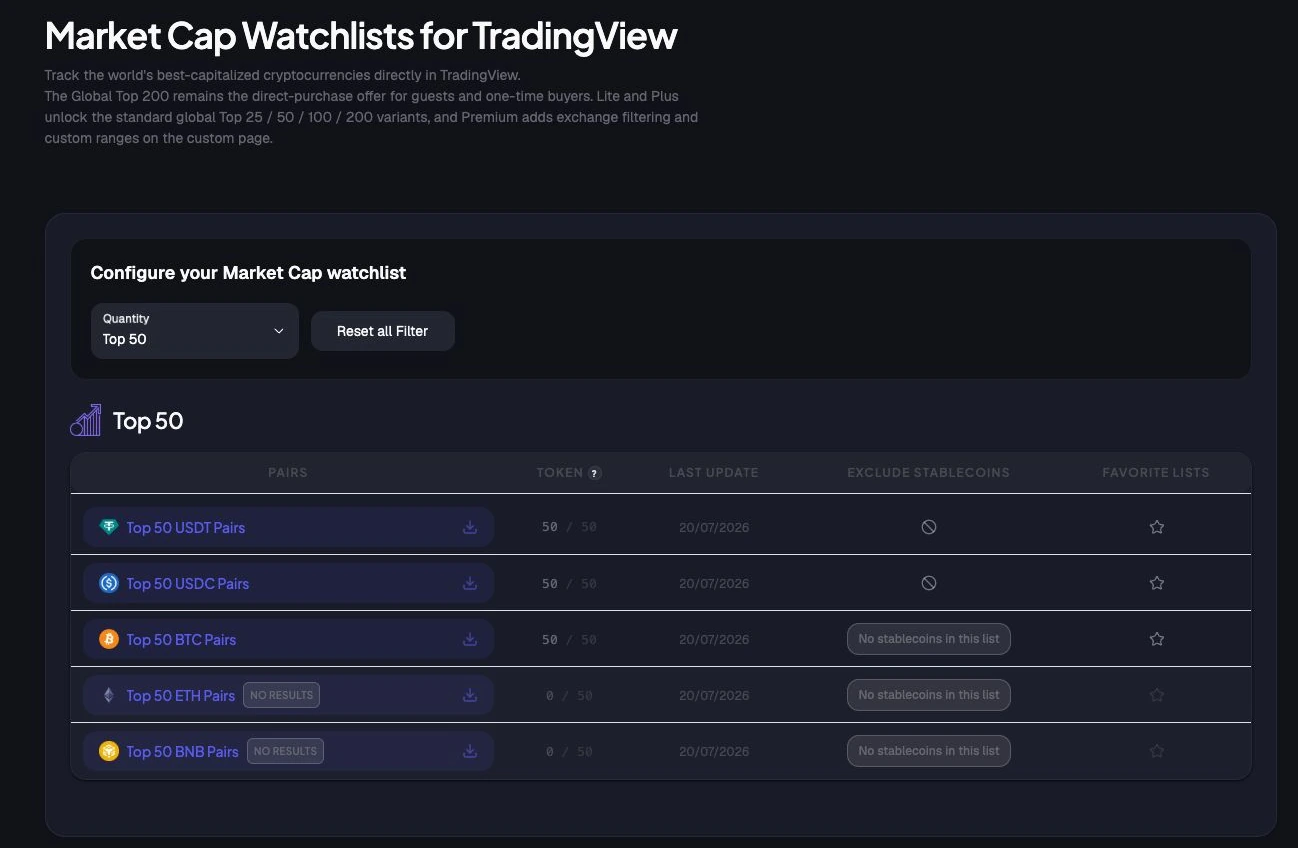
TradingList fits the reader who already knows the market-cap universe needed and wants a TradingView-compatible watchlist without manually cleaning every exchange prefix and pair format. Its standard watchlists organize supported symbols by centralized exchange, market capitalization, supported category, and ecosystem, while custom crypto watchlists narrow a universe through supported market-cap, category, or ecosystem filters.
The important distinction is workflow, not market forecasting. TradingList is a symbol-organization and export product, not an exchange, broker, trading platform, signal provider, portfolio adviser, or financial adviser. Its market-cap lists are designed to help traders, researchers, educators, and advanced TradingView users create a consistent symbol universe for charting, scanning, alerts, and market review.
Where it helps most
A reader comparing broad rankings can select a market-cap list, then use ScreenerList to build a symbol list from market filters. DeltaList compares a reference exchange watchlist with up to five other exchanges for the same quote pair, highlighting assets that appear in a compared exchange but not in the reference list. FusionList combines several watchlists into one exportable configuration, while custom lists support narrower research groups.
The practical advantage is symbol normalization. TradingView's import process requires comma-separated, venue-specific symbols with exchange prefixes, and TradingList is built around that format rather than a generic asset ticker. Its watchlists use a daily refresh cycle when source data is available, but users still need to verify listings and symbols after import.
Practical rule: A market-cap rank identifies the asset universe. The exchange prefix identifies the chart that TradingView can actually open.
TradingList offers standard and custom workflows for centralized exchanges, market-cap tiers, supported categories, and ecosystems. It doesn't provide DeFi watchlists according to its stated product scope, so readers seeking DeFi-specific coverage should verify current availability in the product before relying on that category.
2. CoinMarketCap
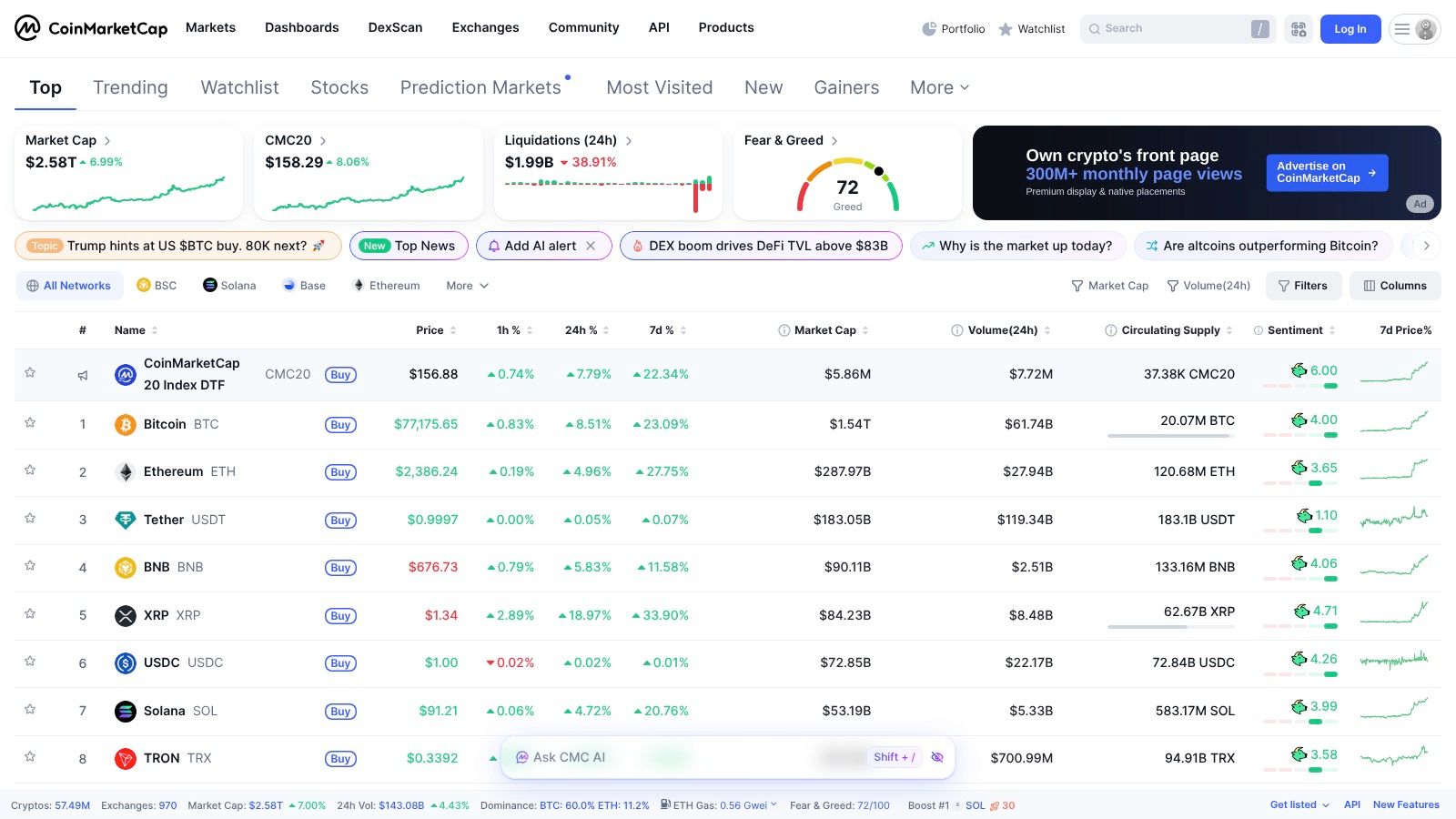
CoinMarketCap is a strong starting point when the task is to inspect a broad ranked table rather than immediately construct a TradingView watchlist. Its all-assets view exposes fields such as rank, name, symbol, market cap, price, circulating supply, and volume, which gives researchers a standardized place to compare assets before selecting a cutoff.
The methodology matters. CoinMarketCap states that cryptoassets are ranked by circulating market cap, calculated by multiplying the reference price by the current circulating supply. That means a market cap crypto list based on this method uses circulating supply, not total supply or maximum supply, and the result can differ from a fully diluted valuation view. CoinMarketCap's ranking explanation documents that distinction directly.
Best use case
CoinMarketCap works well for broad discovery, standardized metadata, exchange cross-checking, and historical research. Its listings endpoint can return the top 100 cryptocurrencies when requested with start=1 and limit=100, making the source relevant for programmatic list construction as well as manual review CoinMarketCap's pagination guide. Researchers building an automated pipeline should document the provider, endpoint, timestamp, supply definition, and eligibility rules rather than treating rank as an objective constant.
Its limitation is that a ranked asset table still needs a second symbol-mapping step before it becomes a TradingView watchlist. A symbol such as ETH is not enough if the intended chart is COINBASE:ETHUSD or BINANCE:ETHUSDT. Readers comparing venue-specific availability can use Coinbase-listed coins as a separate workflow reference, then validate the exact TradingView symbol.
CoinMarketCap is therefore best for ranking and data inspection, while a dedicated symbol workflow is better for formatting, filtering, combining, and exporting the final TradingView universe.
3. CoinGecko
CoinGecko is useful when market-cap ranking needs broader context around categories, supply, exchanges, and methodology. Its global chart showed a total crypto market value of about $2.52 trillion on 2026-08-20, down 40.31% year over year CoinGecko global market chart. Its 2026 Q2 report also described a decline to $2.1 trillion, the lowest point since September 2024 and roughly 52% below the October 2025 peak.
Those figures explain why static top-asset lists age badly. The absolute value of the entire market can contract sharply, yet the upper ranks can still contain very large assets. A researcher comparing lists across cycles should preserve the observation date and the source methodology, because a rank is a snapshot of a moving market rather than a permanent classification.
Strengths for researchers
CoinGecko provides an all-cryptocurrencies view with market cap, supply, price, and performance fields. Its documentation and methodology material are helpful when a team needs to understand how coverage and definitions affect a list. The API also supports programmatic use, with documented plans and rate limits, while WebSocket support is available for real-time streaming workflows.
The data is best used as a research input, not as a substitute for venue validation. CoinGecko can identify the assets that belong in a cap tier, but it doesn't automatically prove that each asset has the required spot pair on a particular centralized exchange. The researcher still has to map the asset to a valid base and quote pair, then confirm that TradingView resolves it.
A market-cap list can tell a researcher what deserves investigation. It can't, by itself, establish that a symbol is liquid, available on the required venue, or suitable for a specific trading workflow.
CoinGecko is a good fit for analysts who need ranked discovery plus category and supply context. A TradingView user who wants a maintained, formatted export will need an additional normalization and import layer.
4. Messari Asset Screener
Messari's Asset Screener is designed for analysts who need more than a simple descending market-cap column. Its value lies in combining market-cap filters with richer asset metadata, ecosystem or network views, exchange context, and research material. That makes it suitable for building a research-driven market-cap universe before mapping selected assets to venue-specific TradingView symbols.
A basic ranking asks which assets are largest now. A research screener can ask a more precise question, such as which assets belonged to a chosen market-cap range at a historical date, or which assets meet several network and exchange conditions at once. Those questions are materially different, and a screener is better suited to them than a consumer-facing top-coins page.
Why advanced filters change the output
Messari's Asset Screener documentation describes more than 50 metrics, including market capitalization. Its customizable views can organize assets by ecosystems, networks, or exchanges, and date-based filters can support historical market-cap research. That extra context helps analysts document why an asset entered a list instead of relying only on its current rank.
The tradeoff is access. Some advanced historical context and screener features are gated behind Pro or Enterprise access, and public coverage may be narrower than the broadest consumer aggregators. Teams should also separate an analytical inclusion rule from a trading eligibility rule. An asset can qualify for a historical cap cohort while lacking a suitable pair on the venue being monitored.
Messari is therefore most useful for curation and thesis-oriented research, not for one-click TradingView import. After the analytical universe is defined, the symbols still need exchange prefixes, quote currencies, and pair validation. That makes it complementary to a watchlist-export workflow rather than a replacement for one.
5. TradingView Crypto Screener
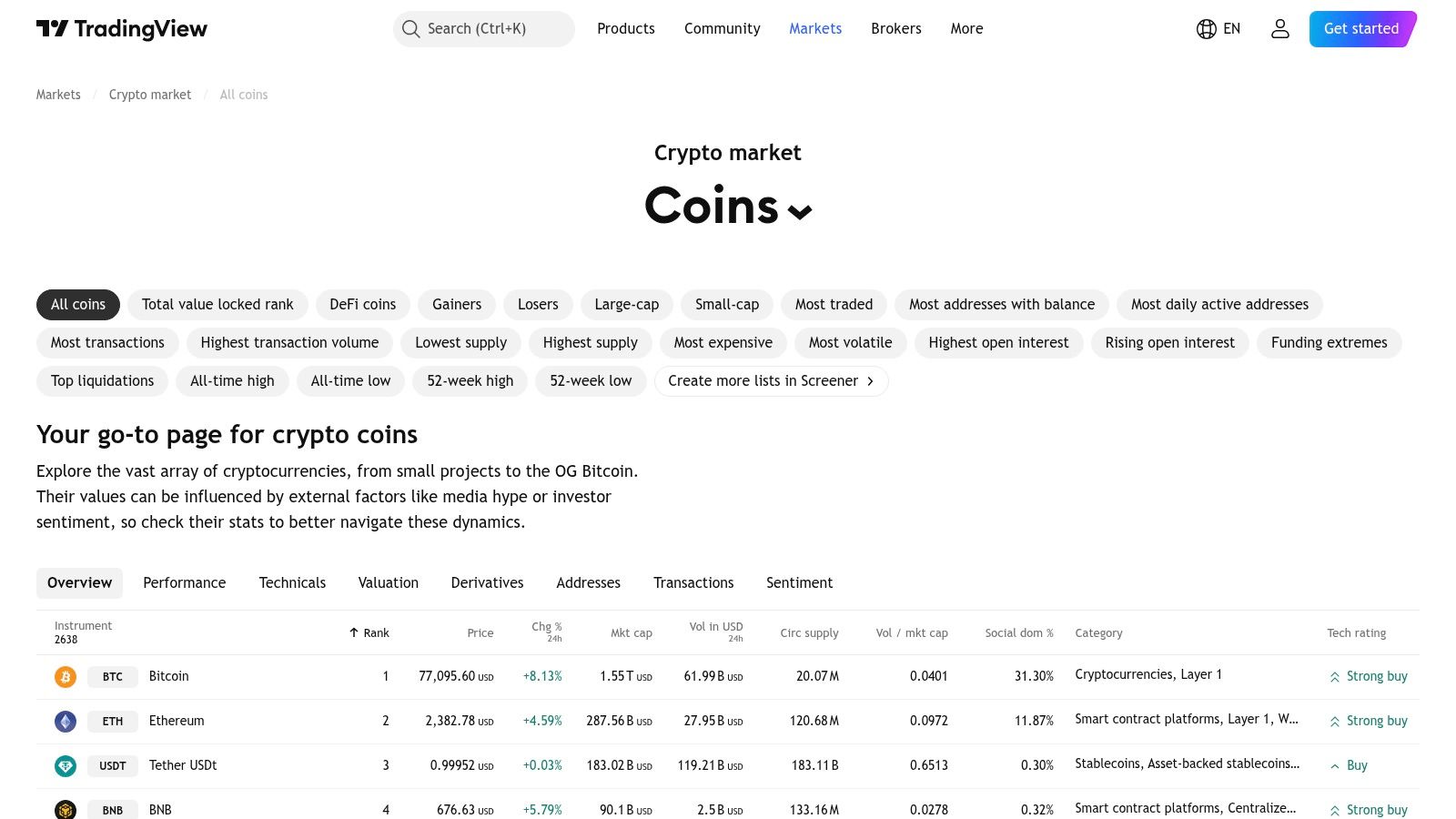
TradingView's Crypto Screener is the most direct option for users who want to remain inside the charting environment. It offers sortable crypto markets with market-cap fields and shortcuts for groups such as large-cap and small-cap assets, allowing users to filter a universe and move straight into charts, alerts, and related TradingView tools.
That native placement removes the import step. A user can screen assets, inspect a chart, and add a venue-specific pair without first converting a provider's generic ticker list into an exchange-prefixed file. TradingView also exposes crypto index symbols such as CRYPTOCAP: for market-level views, which can help researchers compare broad capitalization measures with individual assets.
When native screening is preferable
The screener is a strong fit for discretionary review, chart-based education, and users who want filters next to their technical workspace. It includes fields related to rank, price, market cap, supply, and other market data, although users should inspect the available columns and population for the assets under review.
The main limitation is portability. A filtered screen inside TradingView isn't the same as a documented, reusable symbol universe. New or obscure tokens may have incomplete or delayed market-cap fields, and dedicated aggregators can provide more historical or export-oriented context. A reader who needs a repeatable process can review crypto screener watchlist workflows, then decide whether native screening or a prepared file better matches the task.
Native-workspace advantage: TradingView is strongest when the next action is chart review. A data aggregator is stronger when the next action is ranking, comparison, or historical reconstruction.
TradingView's screener is the best first choice for immediate charting. It isn't automatically the best source for a versioned market-cap list that must be shared, imported, or refreshed on a defined schedule.
6. CoinPaprika
CoinPaprika offers a straightforward alternative for developers who need ranked asset data, supply fields, and a simple API structure. Its all-coin view can be sorted by market cap, while its REST endpoints support assets and ticker data. The platform's coin ID structure can also make provider-to-provider mapping easier than relying on ticker symbols alone.
That distinction is important because tickers are not guaranteed to be unique across the crypto market. A developer building a market-cap crypto list should retain the provider's asset ID, project name, ticker, and intended venue pair as separate fields. Conflating those values can lead to incorrect symbol mapping when multiple assets share similar names or tickers.
A practical developer fit
CoinPaprika is well suited to prototypes, lightweight scripts, and cross-checking a ranked universe against another provider. Its API plans and FAQ document usage limits, coverage, and commercial-use considerations, while the developer examples cover basic asset and ticker requests. Teams considering commercial redistribution should verify the applicable plan and data rights before publishing derived lists.
Plan limits, update intervals, asset coverage, and redistribution rights can affect the intended refresh workflow. Those constraints should be checked against CoinPaprika's current documentation; they do not make one provider's ranking inherently better or worse.
CoinPaprika works best as a secondary data source or development feed. It can produce a ranked asset universe, but it doesn't remove the need to confirm centralized-exchange availability and convert each selected asset into a valid TradingView symbol. For educators and researchers, that extra mapping layer is also useful because it demonstrates the difference between market data and chartable market pairs.
7. CoinCodex
CoinCodex is useful for readers who want a public ranked asset universe and an API-oriented route to category and market-cap filtering. Its public site surfaces total-market statistics and a ranked asset universe. Its API documentation describes paginated lists, category filters, and queries ordered by reported market capitalization.
The platform's practical role is list generation. A script can request a ranked page, apply a cutoff, and pass the resulting asset IDs into a separate symbol-mapping process. That makes CoinCodex a reasonable complementary feed when a team wants another view of rank ordering or needs category-based list construction.
Keep data access separate from symbol access
CoinCodex can expose global metadata and exchange information, but an API response still isn't a ready-to-import TradingView file. The final output needs venue-specific formatting, such as KRAKEN:ETHUSD for a spot pair, or the appropriate perpetual format when supported by the venue. TradingView's symbol documentation explains that spot symbols use a base and quote currency, while perpetual swaps append the .P suffix TradingView symbol information.
Teams planning commercial redistribution should verify the current licensing and usage terms linked from the CoinCodex API documentation. In this workflow, CoinCodex serves as a market-data feed rather than the research layer used to define the final inclusion rules.
CoinCodex is best for automated ranking, category filtering, and cross-provider comparison. It becomes useful in a TradingView workflow only after the data pipeline preserves asset identity, validates the target venue, and formats the final symbols correctly.

Top 7 Crypto Market-Cap Platforms Comparison
| Product | Implementation complexity | Resource requirements | Expected outcomes | Ideal use cases | Key advantages |
|---|---|---|---|---|---|
| TradingList | Low, plug-and-play imports | Minimal: download .txt or subscription for extras | Clean, TradingView-ready watchlists kept current | Traders using TradingView who need ready-made symbol universes | Fast import, daily refreshes, workflow tools (Delta/Fusion/Screener) |
| CoinMarketCap | Medium, API integration for automation | API key; commercial tiers for higher limits | Broad ranked market-cap lists and historical data | Building ranked lists, cross-referencing coverage, automated backfills | Published rank methodology, API documentation and historical data |
| CoinGecko | Medium, REST/WebSocket integration | API key; paid tiers for higher usage | Real-time ranked lists, metadata and streaming feeds | Researchers/developers needing transparent data and live updates | Published methodology, REST API and WebSocket support |
| Messari (Asset Screener) | High, advanced filtering and data mapping | Subscription/Pro for full feature set | Research-grade screener outputs with 50+ metrics | Analysts curating nuanced, historical market-cap or ecosystem lists | Deep filters, research context and date-based market-cap views |
| TradingView Crypto Screener | Low, native within TradingView | TradingView account; no external integration needed | Immediate, sortable cap-tier lists integrated with charts | Traders who want screening, charts and alerts in one workflow | Direct chart/alert integration; no import/export step |
| CoinPaprika | Medium, API integration, developer-friendly | API key; freemium/commercial tiers | Ranked coin lists with simple ID mapping for developers | Prototyping and cross-checking ranks during list aggregation | Clear coin ID structure, documented API examples and published plan limits |
| CoinCodex | Low–Medium, API calls for exports | API key; check licensing for redistribution | Paginated ranked lists and category-filtered exports | Automated cap-tier list generation and complementary feeds | Documented API parameters for ranked lists and category filters |
Turn Rankings Into a Repeatable TradingView Workflow
A market-cap crypto list should be treated as a documented research universe, not as a signal. The ranking source determines the asset order, the circulating-supply methodology determines the calculation, and the exchange mapping determines whether the resulting symbols can be watched in TradingView.
The market itself makes that discipline necessary. CoinGecko's 2026 Q2 report placed total capitalization at $2.1 trillion after a third consecutive quarterly decline, while another 2026 market summary recorded 17,413 tracked cryptocurrencies and Bitcoin dominance of 56.217% on 2026-06-21 the Bitcoin dominance market summary. A list can therefore change because the total market contracts, because assets move across ranks, or because a provider changes eligibility and supply data.
A repeatable process should include these steps:
- Define the ranking source: Choose CoinMarketCap, CoinGecko, Messari, TradingView, CoinPaprika, or CoinCodex based on the research question, then record the source and observation time.
- Set the cutoff: Decide whether the universe covers a broad ranked group, a market-cap tier, a supported category, or a selected ecosystem. Don't assume a provider's default inclusion rules match the project's needs.
- Document the calculation: Record that the ranking uses reference price multiplied by circulating supply when following CoinMarketCap's stated method, rather than substituting total or maximum supply.
- Separate research groups: Keep large-cap, mid-cap, and small-cap groups distinct so a broad ranking doesn't obscure the very different composition of each segment.
- Normalize symbols: Convert each generic ticker into a venue-specific TradingView symbol such as
EXCHANGE:PAIR. Spot pairs use base and quote currencies, while perpetual swaps use the.Psuffix under TradingView's symbol rules TradingView symbol documentation. - Import and verify: TradingView accepts a
.txtwatchlist through the Upload list option. The file must contain comma-separated symbols with the exchange prefix included TradingView's watchlist import instructions. - Review every refresh: Check additions, removals, renamed assets, unavailable pairs, and changed venue mappings whenever the list enters a new daily refresh cycle or the chosen provider updates its data.
TradingList is an optional fit when the requirement is a maintained, TradingView-compatible market-cap universe rather than a raw ranking table. Its standard watchlists, custom crypto watchlists, ScreenerList, DeltaList, and FusionList support selection, filtering, comparison, combination, and export. Those functions organize symbols for charting and research. They don't provide predictions, signals, execution, portfolio advice, or financial advice.
The best tool depends on the handoff point. CoinMarketCap and CoinGecko suit broad market discovery, Messari suits research-heavy filtering, TradingView suits immediate chart workflows, and CoinPaprika or CoinCodex suit API-driven list generation. TradingList fits after the universe has been defined, when the remaining problem is maintaining supported, venue-specific symbols in a format that TradingView can import and use.
TradingList provides maintained market-cap watchlists and custom symbol workflows organized for TradingView-compatible use, including filtering, comparison, combination, and export across supported exchanges and ecosystems. Readers who want to replace manual ticker cleanup with a prepared workflow can visit TradingList and review the available market-cap list options.