
A lot of traders are in the same loop right now. They open TradingView, pull up the crypto screener, sort by change, add a few symbols, remove a few, then realize the list itself is the problem. The screener isn't broken. The starting universe is messy.
That matters more than most guides admit. A crypto screener can only filter what it's given, and if the input list is full of duplicate venues, thinly traded pairs, stale tickers, or symbols from the wrong exchange, the output gets noisy fast. Technical filters don't fix bad list construction. They just apply precision to a flawed starting set.
The practical workflow starts earlier than RSI, MACD, or breakout scans. It starts with symbol selection, ticker formatting, and list hygiene. That's the part many advanced TradingView users still handle manually, even though it's the step that shapes every watchlist, alert stack, and review session that follows.
Table of Contents
- Beyond the Hype Finding Opportunities with a Crypto Screener
- What Makes a Crypto Screener Powerful
- From Thousands of Coins to a Handful of Candidates
- Screening and Watchlist Management in TradingView
- The Smarter First Step Starting with a Curated Universe
- Advanced Workflows with Structured Symbol Sets
- Putting It All Together A Disciplined Screening Process
Beyond the Hype Finding Opportunities with a Crypto Screener
The modern crypto market gives traders too many places to look. That problem has intensified as adoption has expanded. Retail transactions rose by more than 125% between January-September 2024 and the same period in 2025, which is one reason traders increasingly need platforms that organize assets by market cap, category, and ecosystem rather than dumping everything into one endless feed, according to the TRM Labs crypto adoption and stablecoin usage report.
A crypto screener helps because it narrows attention. It doesn't predict anything. It doesn't replace chart reading, liquidity checks, or thesis work. What it does well is reduce the field so that time goes into analysis instead of random browsing.
That sounds basic, but it changes the workday. A trader with a clean universe can screen for momentum, range expansion, or trend continuation in minutes. A trader with a bad universe spends that same time fixing symbols, removing unusable pairs, and wondering why one exchange shows a move that another doesn't.
The difference between noise and a process
Most traders treat the screener as the first step. In practice, it's usually the second. The first step is deciding what deserves to be screened in the first place.
That means answering questions like these:
- Which exchange universe matters: Binance pairs, Coinbase pairs, or a cross-exchange set?
- Which segment matters: large caps, mid-caps, ecosystem tokens, or category lists?
- Which symbols are usable: clean TradingView formatting, current listings, and relevant quote pairs?
- Which names should be ignored: stale, fragmented, or structurally low-quality tickers?
A crypto screener works best when it functions like a narrowing tool, not a discovery toy.
Serious screening is less about finding a magical indicator combination and more about protecting attention. The more symbols the market adds, the more valuable that discipline becomes. Good traders don't try to inspect everything. They build a workable universe, then screen inside it.
What Makes a Crypto Screener Powerful
A strong crypto screener has three moving parts. Most discussions focus almost entirely on one of them.

The three parts that actually matter
The first part is the selection universe. This is the raw pool of symbols being screened. If that pool mixes unrelated exchanges, inconsistent quote pairs, and low-quality listings, every later filter inherits those problems.
The second part is the filtering criteria. These criteria include RSI, moving averages, volume conditions, trend structure, or thematic tags. Filters are useful, but they're only as good as the list beneath them.
The third part is the output list. That final list should be small enough to review manually and clean enough to chart without more housekeeping. If the output still needs heavy cleanup, the process upstream wasn't tight enough.
A useful way to think about it is simple:
| Component | Practical question | Common mistake |
|---|---|---|
| Selection universe | What symbols are even allowed in the screen? | Starting with everything |
| Filtering criteria | What rules reduce the field? | Using indicators too early |
| Output list | What deserves closer review? | Treating output as trade-ready |
Why exchange context changes the result
Price and volume aren't always interchangeable across venues. An effective screener needs to account for that. An effective screener must aggregate price data across venues to show the volume-weighted average, not just a single exchange quote, and 60% of retail traders using generic screeners miss delisting risks or liquidity traps on specific exchanges, according to the TradeAlgo crypto screener guide.
That point gets ignored in a lot of content aimed at retail traders. A symbol can look active on one venue and be thin somewhere else. An altcoin can chart cleanly on one exchange while carrying obvious execution risk on another. If the screener doesn't respect exchange-specific liquidity, it can promote false confidence.
Practical rule: treat exchange selection as part of the screen, not as a separate charting detail.
Many traders often overestimate indicator quality and underestimate dataset quality. RSI isn't the issue. MACD isn't the issue. The issue is asking decent filters to operate on a loose, inconsistent symbol universe.
For traders refining their workflow, it helps to compare list-building approaches before touching the charting layer. The TradingList blog archive is useful for that kind of workflow thinking because the bottleneck often sits in list preparation, not indicator choice.
From Thousands of Coins to a Handful of Candidates
A usable screening process behaves like a funnel. It doesn't begin with pattern hunting. It begins with removal.

Start with exclusion not selection
The first pass should eliminate symbols that don't belong in the working universe. That usually means cutting thin liquidity, weak market structure, and irrelevant venues before any technical setup is considered.
Professional tools are built for this kind of narrowing. Professional screeners allow users to apply multi-layered filters combining technical, fundamental, and on-chain data to narrow a universe of 2,000+ altcoins down to a highly selective set of 87 actionable trade ideas, which improves signal-to-noise ratio according to the altFINS explanation of its coin screener.
That number matters because it reflects process design. Going from a broad universe to a focused candidate set isn't about seeing more. It's about removing most of the market on purpose.
Build a layered funnel
A disciplined crypto screener workflow usually moves through layers like these:
Venue layer
Start by defining where the symbols come from. A Binance-focused workflow and a Coinbase-focused workflow are not the same because the tradable universe, liquidity profile, and available pairs differ.Structural quality layer
Remove symbols that don't meet baseline standards for market relevance. Traders often use market-cap tiers, exchange listing quality, and quote-pair consistency at this stage.Theme layer
Narrow to a category or ecosystem if the goal is contextual research rather than broad scanning. DeFi, gaming, infrastructure, AI-related tokens, or ecosystem baskets can each behave differently during rotation phases.Technical layer Only after the universe is cleaner should trend, momentum, or volatility filters be applied. At this stage, moving-average alignment, RSI range, trend continuation, or breakout structure starts to matter.
Manual review layer
The final list still needs chart inspection. A screener produces candidates, not decisions.
A simple comparison helps:
| Stage | Goal | Example output |
|---|---|---|
| Broad universe | Include all relevant symbols | Large exchange list or category basket |
| Quality filter | Remove structurally weak names | Cleaner subset with better tradability |
| Theme filter | Focus on one market segment | DeFi or ecosystem-specific list |
| Technical filter | Isolate current setups | Short candidate list |
| Manual chart review | Validate context | Watchlist-worthy names |
The best screening funnels don't feel clever. They feel repeatable.
Many traders reverse this order. They scan for bullish patterns across a bloated universe, then try to clean up the results later. That creates extra work and lowers confidence in the output. A better workflow pushes broad cleanup to the front and reserves chart interpretation for the end.
Screening and Watchlist Management in TradingView
TradingView remains the default workspace for a large share of crypto traders because the charting is flexible and the built-in screener is good enough for daily use. The friction appears when the workflow shifts from scanning to list management.

Where the native workflow works well
TradingView's native tools handle live workspace review well. A trader can filter, sort, inspect charts, and move symbols into watchlists without leaving the platform. For active review sessions, that's convenient.
The platform also supports importing symbol lists, which matters for anyone managing larger universes. But the import logic is strict. TradingView expects a text file with symbols formatted clearly and prefixed by exchange, such as BINANCE:BTCUSDT, as explained in the TradingView watchlist import guide.
That sounds minor until a list fails. Then every formatting mistake turns into manual correction.
Where the friction shows up
The practical pain points usually look like this:
- Ticker formatting breaks imports: Missing exchange prefixes or inconsistent symbol naming can make a clean-looking list unusable.
- Manual population takes time: Traders still end up adding symbols one by one when a file isn't import-ready.
- List maintenance keeps returning: Listings change, naming conventions shift, and old sets drift out of sync.
- Theme-based tracking is awkward: Building ecosystem or category watchlists inside the platform takes repeated filtering and manual assembly.
There's also a plan limitation. Traders managing imported watchlists need to know whether their account supports the feature at all. The platform's workflow details and plan-related limitations come up often enough that the TradingList FAQ addresses many of the recurring operational questions advanced users run into.
A screener can be efficient while the watchlist workflow around it is still inefficient.
That's the mismatch many users feel. The analysis tools are strong. The organizational layer often remains manual. The result is a lot of hidden labor around creating, validating, and maintaining symbol universes that should already be clean before they ever reach TradingView.
The Smarter First Step Starting with a Curated Universe
Most traders try to solve screening problems with better filters. Often the better fix is a better starting list.
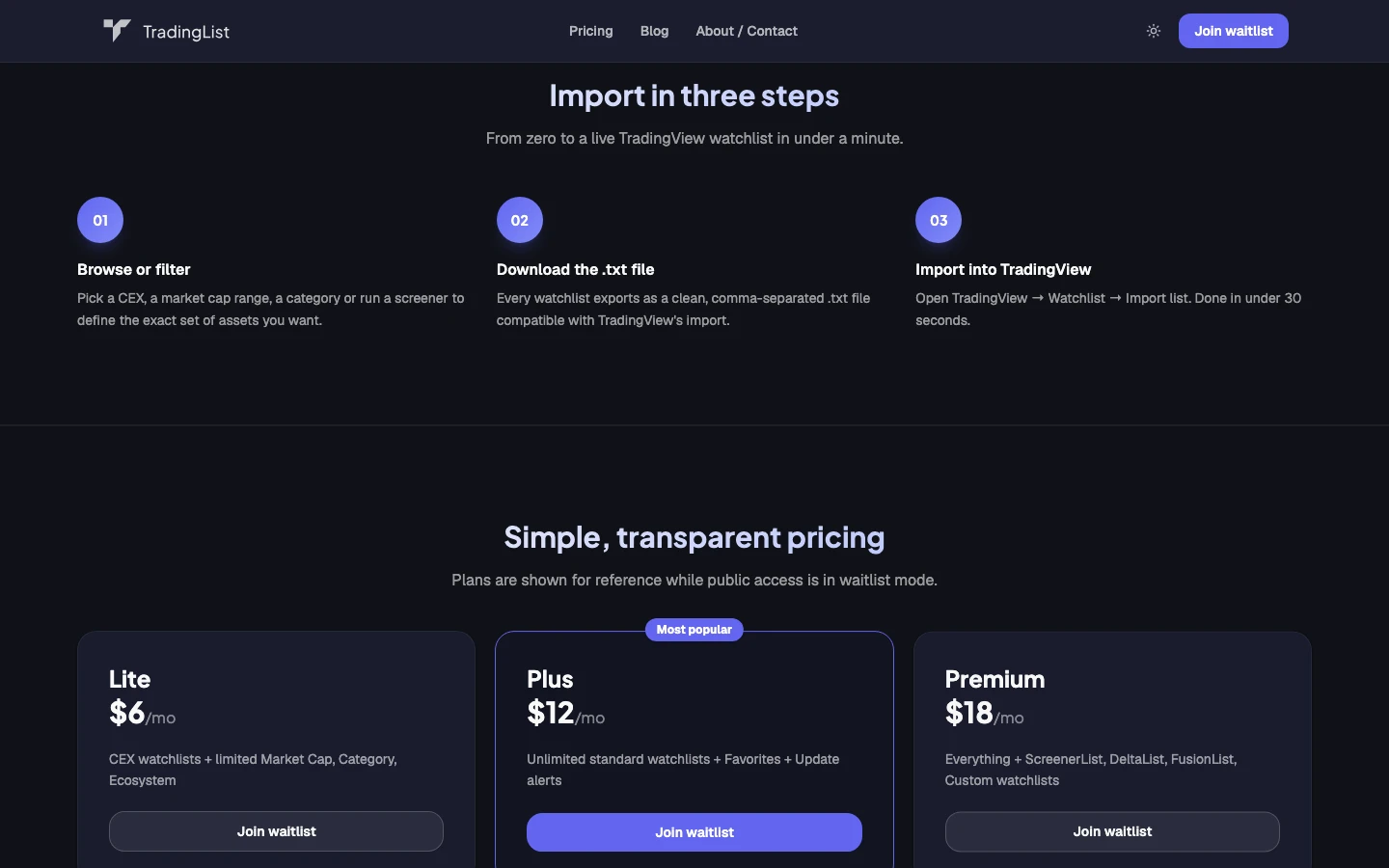
This is where TradingList fits naturally: it does not decide what to trade, but helps prepare the symbol universe that can later be reviewed inside TradingView.
Why a prepared universe changes the workflow
A curated symbol universe removes a class of work that doesn't create insight. It doesn't replace analysis. It removes setup friction.
That distinction matters because TradingView watchlist import is restricted to paid plans starting at Essential Plus, excluding free users, according to the TradingView plan and import guide. Paid users therefore benefit most when imports are clean and ready on the first pass. Free users still face the same organizational challenge, just through more manual steps.
A properly prepared universe helps in a few concrete ways:
- Exchange watchlists keep venue-specific analysis separate.
- Market-cap watchlists let traders screen large-cap and emerging names without mixing them.
- Category watchlists support thematic review, such as AI, gaming, Layer 1, oracle, or RWA.
- Ecosystem watchlists group tokens by chain or network context.
- TradingView-compatible formatting reduces avoidable import failures.
Clean symbol universes don't create signals. They create working conditions where analysis is easier to trust.
What structured symbol sets should include
For serious research, a curated list should do more than collect names. It should classify them in ways that match actual TradingView workflows.
That means organized sets such as:
| List type | Why it matters in practice |
|---|---|
| Exchange-organized | Useful for venue-specific liquidity and listing review |
| Market-cap tiered | Helps separate majors from smaller speculative names |
| Category-based | Makes thematic rotations easier to monitor |
| Ecosystem-focused | Helps compare assets tied to the same chain environment |
Workflow tools offer greater utility than generic datasets. Instead of exporting a raw symbol dump and cleaning it by hand, traders can work with pre-formatted universes built for charting and watchlist management. Standard watchlists handle common coverage needs. Custom crypto watchlists help when a desk or educator needs a specific symbol universe. Structured products such as ScreenerList, DeltaList, and FusionList fit traders who want to build, compare, combine, and export cleaner symbol sets for TradingView without treating the tool itself as a signal engine.
The benefit is operational. Less symbol cleanup. Less duplication. Less time spent rebuilding lists that should already exist in usable form.
Advanced Workflows with Structured Symbol Sets
Once the universe-first approach is in place, more advanced workflows become practical. The biggest gain isn't speed alone. It's consistency.
Three practical use cases
A broad market researcher might start with ScreenerList as the base universe for daily scanning. Instead of rebuilding a list from exchange pages, social posts, and old exports, the trader begins with a structured set that is already intended for TradingView use. That makes recurring scans easier to reproduce across sessions.
A listings-focused analyst might use DeltaList differently. The goal there isn't prediction. It's change tracking. If a symbol set has added or removed names between refreshes, that change can affect watchlist maintenance, chart folders, and screen coverage. Having a clean way to inspect additions and removals is more useful than discovering them halfway through a research session.
A multi-venue trader may get the most value from FusionList. Combining two or more exchange-oriented watchlists into one de-duplicated universe is tedious by hand. It becomes even more tedious when symbols overlap unevenly or use slightly different naming conventions. A clean merged list gives the trader one broader universe for comparison without forcing repeated manual cleanup.
The same logic applies to custom crypto watchlists. Educators can maintain class-specific lists. Script builders can keep stable test universes. Researchers can compare ecosystems without mixing unrelated symbols into one watchlist.
Good workflow tools remove repetitive decisions so that analytical decisions get more attention.
That's the core reason structured symbol sets matter. They don't tell traders what to buy or sell. They make it easier to define the exact market slice being studied, preserve that structure, and reuse it cleanly inside TradingView.
Putting It All Together A Disciplined Screening Process
A disciplined crypto screener workflow starts before the screener itself. The strongest filters in the world won't rescue a weak symbol universe. Clean input produces cleaner output, and cleaner output leads to faster, more confident review.
That's why the overlooked first step matters so much. Exchange choice, market-cap segmentation, category grouping, ecosystem organization, and proper ticker formatting shape the entire downstream process. The screener should narrow a market. It shouldn't clean a market.
For traders who want a more organized setup, ready-to-import symbol universes and workflow tools can remove a lot of recurring watchlist maintenance. Pricing and workflow options are available on the TradingList pricing page.
TradingList helps crypto traders and advanced TradingView users build cleaner workflows with ready-to-import crypto watchlists organized by exchange, market cap, category, and ecosystem. Standard watchlists, custom crypto watchlists, ScreenerList, DeltaList, and FusionList are designed for building, filtering, comparing, combining, and exporting structured symbol universes through a daily refresh cycle.