How should traders evaluate ai crypto coins when the label covers decentralized machine learning, GPU markets, decentralized cloud infrastructure, on-chain intelligence, model competitions, and AI-agent economies? Treating the category as one uniform asset class can hide the most important distinction: a token may support useful network activity without representing ownership of an AI company or guaranteeing token value accrual.
This roundup organizes seven projects by the infrastructure or application problem they address. It separates stated utility from token exposure, then adds practical market-context fields, including category, ecosystem, current ticker status, and venue-specific symbol handling.
The workflow is simple. Research the project, verify the current venue and quote pair, distinguish an asset ticker such as TAO from a TradingView symbol such as EXCHANGE:PAIR, and import only supported symbols into a TradingView-compatible watchlist. Market fields and ticker conventions should be checked at publication because listings, naming, and pair availability can change.
Table of Contents
- TradingList
- 1. Artificial Superintelligence Alliance (FET)
- 2. Bittensor (TAO)
- 3. Render Network (RENDER)
- 4. Akash Network (AKT)
- 5. Arkham (ARKM)
- 6. Numerai (NMR)
- 7. Virtuals Protocol (VIRTUAL)
- Top 7 AI Crypto Coins Comparison
- Turn the Shortlist Into a Clean TradingView Workflow
TradingList
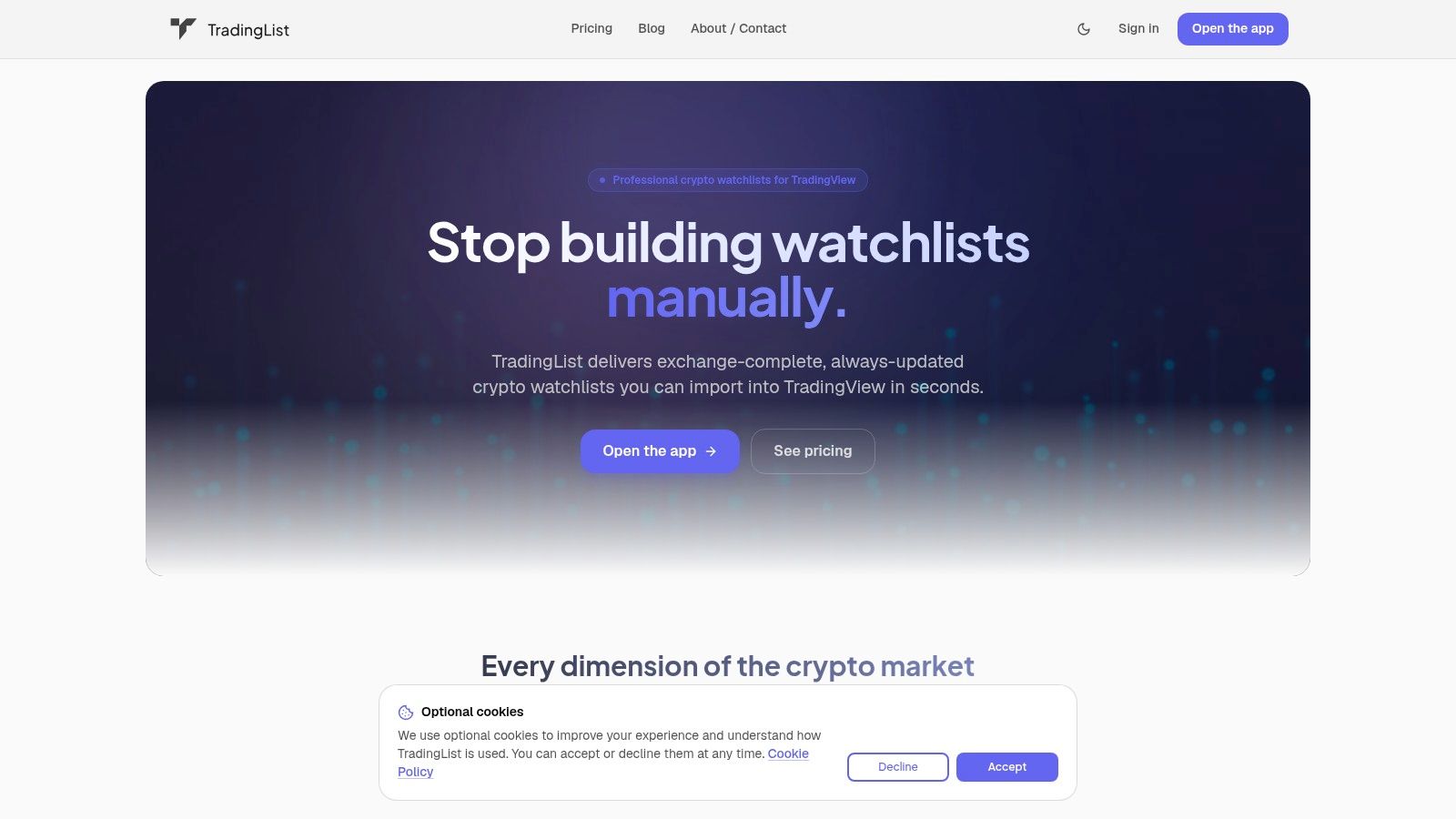
How should TradingList fit into research on AI crypto coins? It is better treated as a market-data and watchlist utility than as an AI project or investment thesis. Its role is to organize a defined asset universe, then reduce the manual work required to check whether those assets can be followed on TradingView.
The distinction between a generic ticker and a venue-specific chart symbol determines whether that workflow is reliable. TAO can identify an asset in a market discussion, while a TradingView import generally requires a formatted symbol tied to an exchange and quote pair, such as EXCHANGE:PAIR. TradingList's exchange-specific files apply that convention and can be exported as .txt files for import into compatible watchlists.
Practical rule: Verify the exchange prefix, quote currency, and exact pair before importing. A token ticker is not a universal chart symbol.
Role in an AI-coin research workflow
TradingList's Standard watchlists organize supported assets by exchange, market-cap tier, category, or blockchain ecosystem. Custom crypto watchlists apply those market-cap, category, and ecosystem filters to narrower research questions. ScreenerList creates symbol lists from market filters. Together, these functions can separate a broad AI category from a specific ecosystem or a larger market-cap group, without turning the output into a trading signal.
DeltaList compares a reference watchlist with exchange or market variants. That comparison is useful when the same AI-focused universe has different symbols or available pairs across venues. FusionList combines compatible watchlists into one exportable configuration, allowing a researcher to examine AI infrastructure alongside a selected ecosystem or market-cap universe.
The analytical value lies in repeatability. A researcher can define the project group, verify the venue and quote pair, record the resulting TradingView symbol, and add only supported entries to a focused watchlist. The tool does not resolve whether a token's utility will create value for holders, so project analysis and market-symbol preparation remain separate tasks.
TradingList uses CoinGecko-powered source data and a daily refresh cycle when source updates are available. Files are exchange-specific, and lists are automatically split to respect TradingView's 1,000-symbol limit, according to the supplied product information. Those constraints make a publication-date check necessary when names, listings, or pairs change.
Analytical limitations
TradingList organizes symbols rather than evaluating model quality, network demand, token economics, or governance. It does not provide signals, predictions, portfolio advice, or brokerage services. Its output therefore belongs at the data-preparation stage of the research process.
The main practical benefit is reduced symbol cleanup across exchange, category, market-cap, and ecosystem views. The main limitation is refresh dependency. Upstream changes may not appear until the available refresh cycle, so every imported list still requires venue and pair verification.
TradingList is most relevant when the research question is which supported symbols belong in a clearly defined AI, market-cap, exchange, or ecosystem universe.
1. Artificial Superintelligence Alliance (FET)
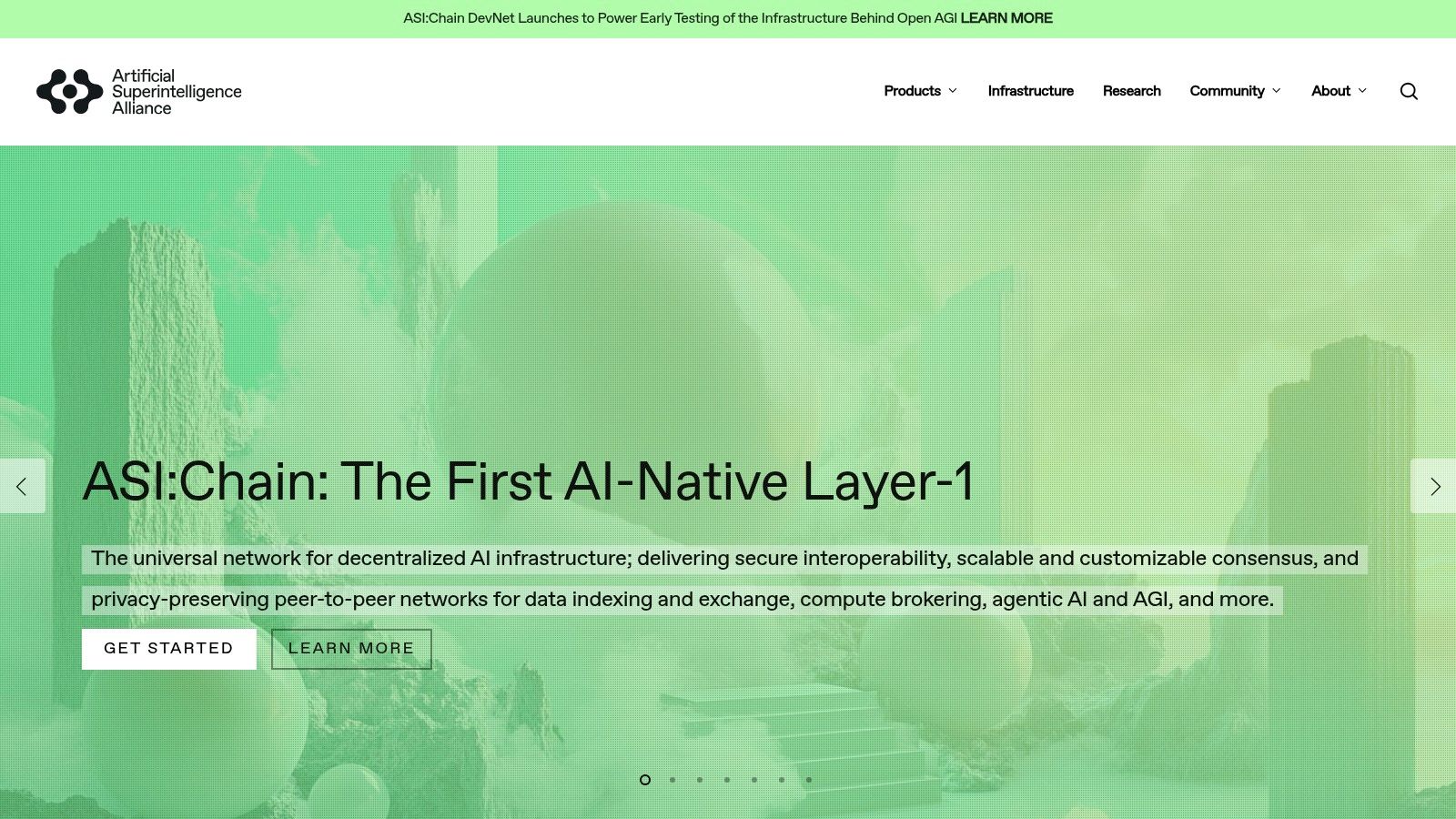
The Artificial Superintelligence Alliance combines Fetch.ai, SingularityNET, and CUDOS within a decentralized AI ecosystem. Its stated scope covers AI agents, marketplaces, compute, and AI services. This positions the Alliance as an ecosystem-coordination project addressing fragmented access to AI services, rather than as a pure compute token or single-model network.
The token record needs particular care. FET remains the primary token while the formal ASI ticker transition is still pending on some venues, per the Artificial Superintelligence Alliance's published migration guidance. A chart search for “ASI” may miss a venue still displaying FET. A FET-only search may create the opposite problem after a venue adopts the new label.
Utility and operational trade-offs
The token's role includes staking and governance through the ASI Wallet, formerly the Fetch Wallet, plus cross-chain support and a documented merger process. Project materials also reference ASI ecosystem tooling and chain-related initiatives. These functions describe coordination across an AI ecosystem. They do not represent equity ownership in the participating organizations.
Consolidation is the main ecosystem benefit. Several previously independent AI teams and services can be examined through a connected token framework instead of as unrelated assets. The cost is operational complexity. Different communities, codebases, migration instructions, and venue conventions can cause project records, custody records, and chart symbols to diverge.
A merger can simplify the narrative while making ticker verification more important, not less.
For a TradingView workflow, record the asset label, current venue display name, quote pair, exchange prefix, and verification date. Review migration guidance on the project website, then use the venue and TradingView search to confirm the chart symbol. A category or market-cap watchlist can locate the asset, but it cannot substitute for venue-level verification. The repeatable process is simple: verify the venue-specific symbol, record its quote pair, and add only the confirmed listing to a focused watchlist.
Artificial Superintelligence Alliance is best classified as a broad decentralized AI ecosystem undergoing ticker transition. Market-context records should retain both FET and ASI references when historical continuity matters, without assuming either label works universally across venues.
2. Bittensor (TAO)
Bittensor addresses a different problem from a GPU marketplace. It is a decentralized machine-intelligence network built from permissionless subnets, where participants contribute AI models or other digital commodities and receive rewards in TAO. The protocol's design attempts to direct incentives toward useful machine-learning outputs by rewarding higher-performing participants.
Its ecosystem role is therefore an intelligence and model-coordination network, rather than just a source of raw hardware. Subnets can specialize in different AI tasks, while clients and validators perform different operational roles. The network's openness creates room for experimentation, but it also means that researchers need to understand subnet mechanics before treating TAO as a straightforward sector proxy.
What to record before charting
The token role is closely connected to network incentives, subnet participation, and the distribution of rewards. That creates a stronger utility narrative than a token whose only connection to AI is branding, but it doesn't eliminate execution, governance, security, or economic-model uncertainty.
A focused TradingView workflow can classify TAO under decentralized machine learning, then verify whether the selected venue displays the intended TAO pair. The asset ticker alone isn't enough. A screener can help define a universe around supported market fields, and TradingList's crypto screener workflow can help organize the resulting symbol set for later review.
Operational fields worth retaining
Network role: Permissionless subnet and machine-intelligence infrastructure.
Token role: Rewards and participation within the Bittensor economy.
Ecosystem field: Bittensor, with subnet-level distinctions where relevant.
Charting field: Exact venue prefix, quote pair, and date verified.
Bittensor belongs in a watchlist when the research question concerns decentralized model production or machine-intelligence incentives. It shouldn't automatically stand in for every AI crypto coin because its infrastructure problem differs from decentralized cloud, GPU rendering, and on-chain analytics.
3. Render Network (RENDER)
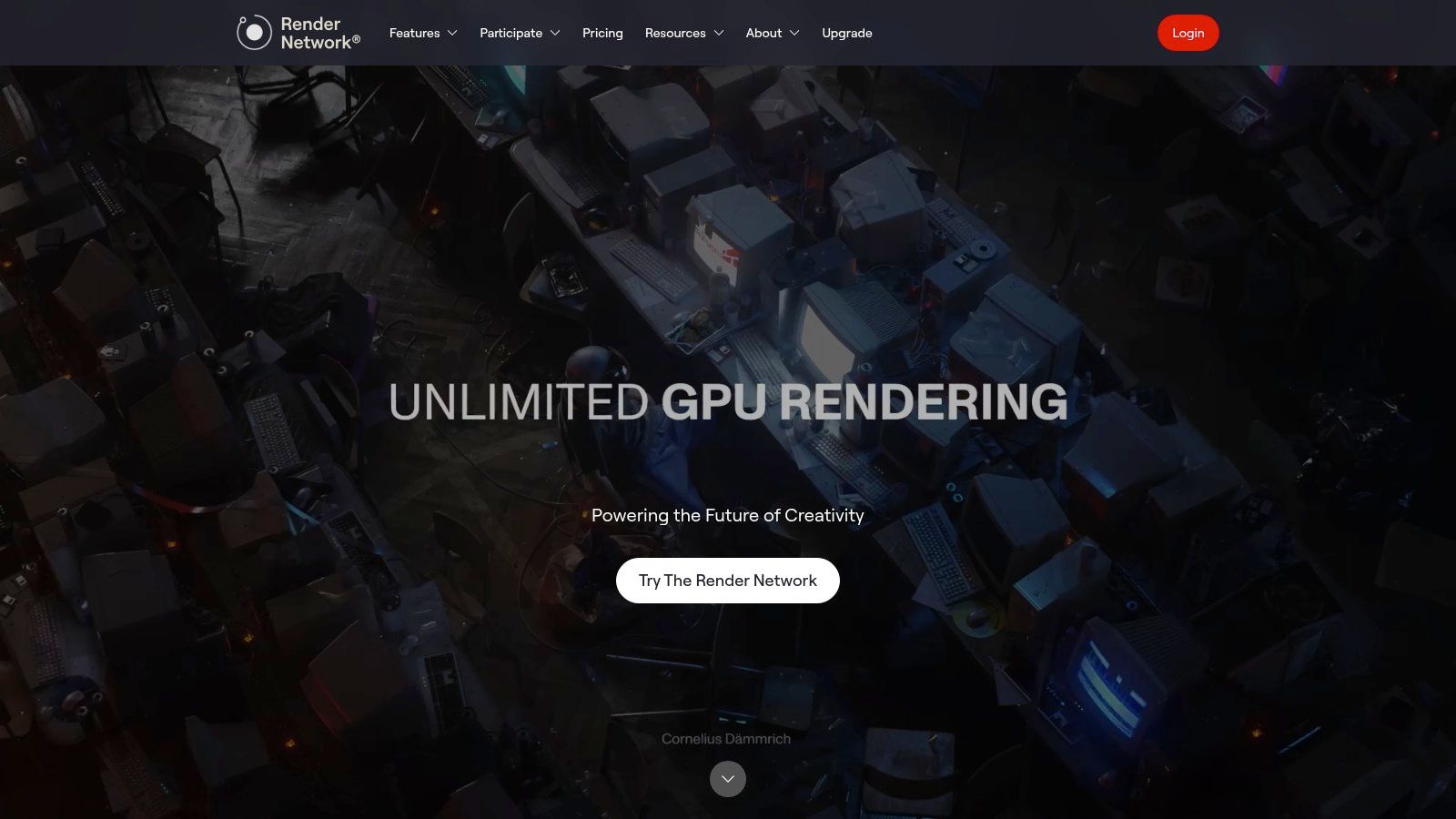
Render Network focuses on the supply and allocation of GPU resources. Its marketplace connects creators submitting rendering jobs with node operators providing GPU capacity, while the project is expanding toward generalized compute services for workloads that include AI. RENDER, previously associated with the RNDR ticker in the supplied project description, is the token used in the network's economic workflow.
That distinction matters because Render's AI connection is infrastructure-based. It isn't primarily a model competition, agent marketplace, or analytics application. The project's core role is closer to decentralized GPU rendering and compute coordination, with a history rooted in digital-content workflows.
Utility before token exposure
Creators submit jobs through the Render portal, and node operators use project tooling and documentation to provide hardware. Governance proposals and the project roadmap address GPU-fleet expansion and token mechanics, while the whitepaper describes the network's architecture and economics. These materials help separate stated service utility from the market behavior of RENDER or RNDR on any particular venue.
The main strength is a concrete resource marketplace for rendering and related workloads. The main limitation is scope. Generalized AI compute is still evolving, and workflows may remain oriented toward particular content-creation and rendering stacks rather than serving every machine-learning requirement.
Render Network should be classified under GPU compute or decentralized infrastructure. Before importing it, the researcher should verify whether the selected venue uses RENDER, RNDR, or another current display convention, then confirm the exact TradingView prefix and quote pair.
A market-cap watchlist can place Render beside other large AI-related assets, while a category watchlist can compare it with compute and infrastructure projects. A venue-focused review should still inspect pair availability directly. TradingList's market heat-map workflow can support broader list organization, but it doesn't determine whether a particular exchange lists the desired pair.
4. Akash Network (AKT)
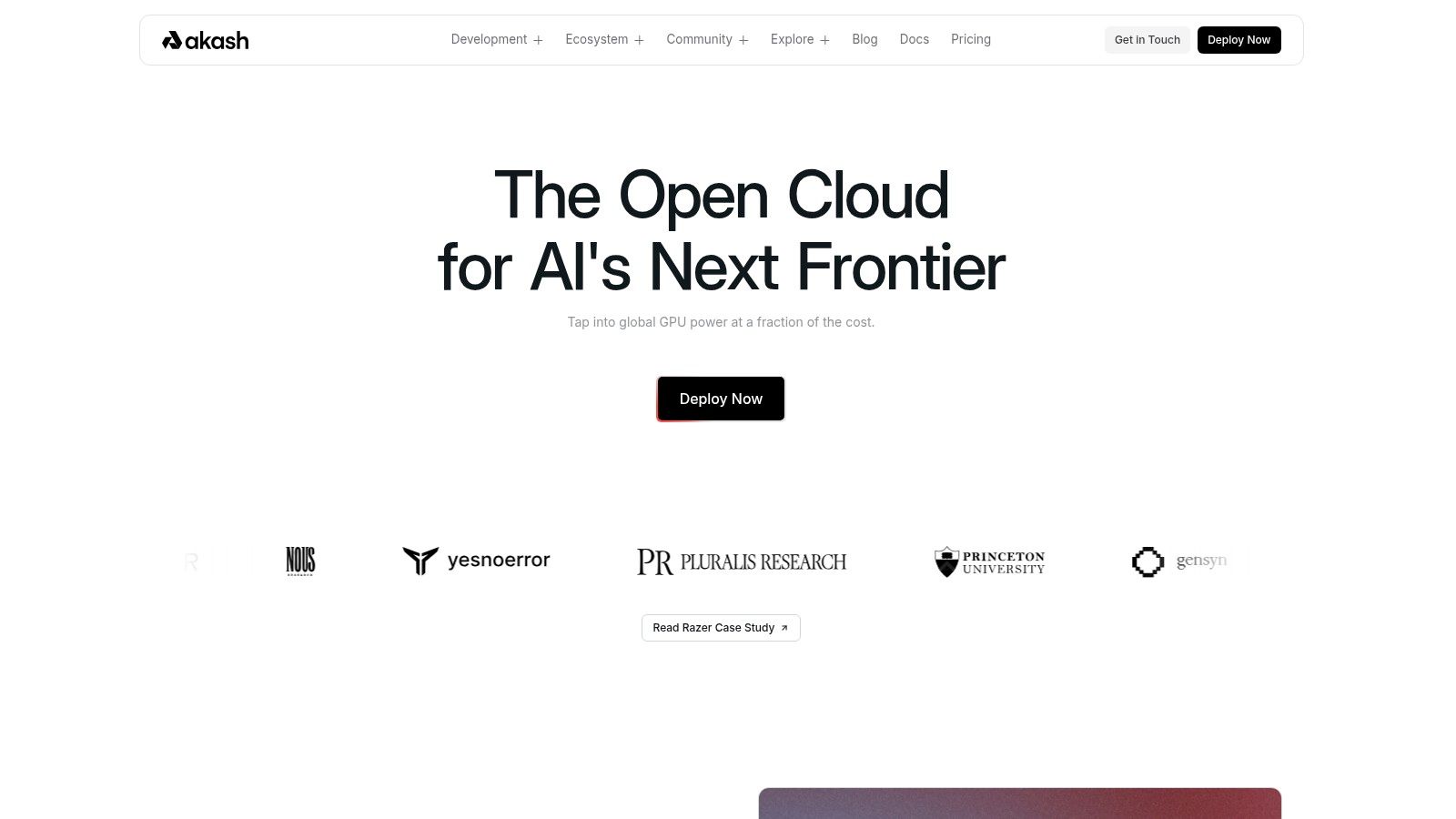
Akash Network approaches AI infrastructure through decentralized cloud deployment. Providers list compute capacity, tenants bid for deployments, and the marketplace increasingly emphasizes GPU instances for AI and machine-learning workloads. AKT supports staking, governance, and network fees, so its token role is tied to network operation rather than merely naming an AI theme.
The ecosystem sits within a broader programmable-cloud model. A roadmap emphasizing CosmWasm and smart-contract expansion points toward more automated resource management and settlement, while AEP proposals provide a public record of ongoing protocol iteration.
Supply, availability, and chart records
Akash's practical appeal is flexibility. A marketplace can give AI teams another route to compute access, particularly when they want alternatives to centralized cloud procurement. However, provider supply determines availability and pricing, and performance can vary between providers. Those constraints make operational validation more important than a headline category label.
A researcher comparing AKT with RENDER should avoid collapsing both into “GPU coins.” Render's stated center of gravity is a GPU rendering marketplace expanding toward broader compute. Akash is a decentralized cloud marketplace where tenants deploy workloads through provider bids. Their infrastructure roles overlap, but the deployment model and operational questions differ.
For charting, the asset record should identify AKT, the venue, the quote currency, and the precise TradingView symbol. A generic AKT ticker could refer to several market contexts, while EXCHANGE:PAIR identifies the charting venue and pair. The project's Akash Network documentation can support protocol research, but the exchange and TradingView search should confirm the current symbol format.
Research fields for an AKT entry
Use case: Decentralized cloud and GPU deployment.
Token function: Staking, governance, and network fees.
Ecosystem: Akash and its provider marketplace.
Risk field: Provider availability and performance consistency.
Import field: Venue prefix, pair, and verification date.
AKT belongs in an AI infrastructure universe when the list is organized by decentralized cloud rather than model quality or on-chain intelligence.
5. Arkham (ARKM)
Arkham connects AI with blockchain data interpretation rather than compute supply. Its platform uses proprietary AI and machine-learning systems to entity-tag blockchain addresses and surface context for traders, researchers, and investigators. ARKM is the native token, while the product surface includes an Intel Marketplace, a real-time API, and a natural-language Oracle for querying transactions and entities.
The project's ecosystem role is on-chain intelligence and attribution. That makes it a useful contrast with Bittensor, Render, and Akash. Arkham consumes and organizes blockchain information for analysis, while those other projects coordinate models, GPU resources, or cloud deployments.
Product utility and disclosure limits
The AI-powered tagging system can help users connect addresses with entities and interpret on-chain activity. The Intel Marketplace allows research contributions through bounties, and the API supports programmatic workflows. Those capabilities may be relevant to risk review or market research, but the platform isn't the same thing as an investment recommendation, and the token shouldn't be treated as a guaranteed claim on platform outcomes.
Privacy and methodology are central trade-offs. Entity attribution can raise ethical and privacy concerns, while proprietary methods limit external auditability. A careful researcher should record what the platform claims to identify, how the information is sourced, and whether the result is sufficiently documented for the intended use.
Arkham should be classified under on-chain intelligence rather than AI infrastructure. For a TradingView workflow, the symbol record needs the current ARKM venue listing and exact pair format. TradingList's crypto-symbol guide can help frame the difference between an asset ticker and a venue-specific symbol, but the live venue and TradingView search remain the final checks.
A category watchlist can place ARKM beside other supported AI assets, while an exchange watchlist can restrict the universe to symbols available on a selected centralized venue. Those are different research questions, so combining them without recording the filter logic can make later comparisons difficult.
6. Numerai (NMR)
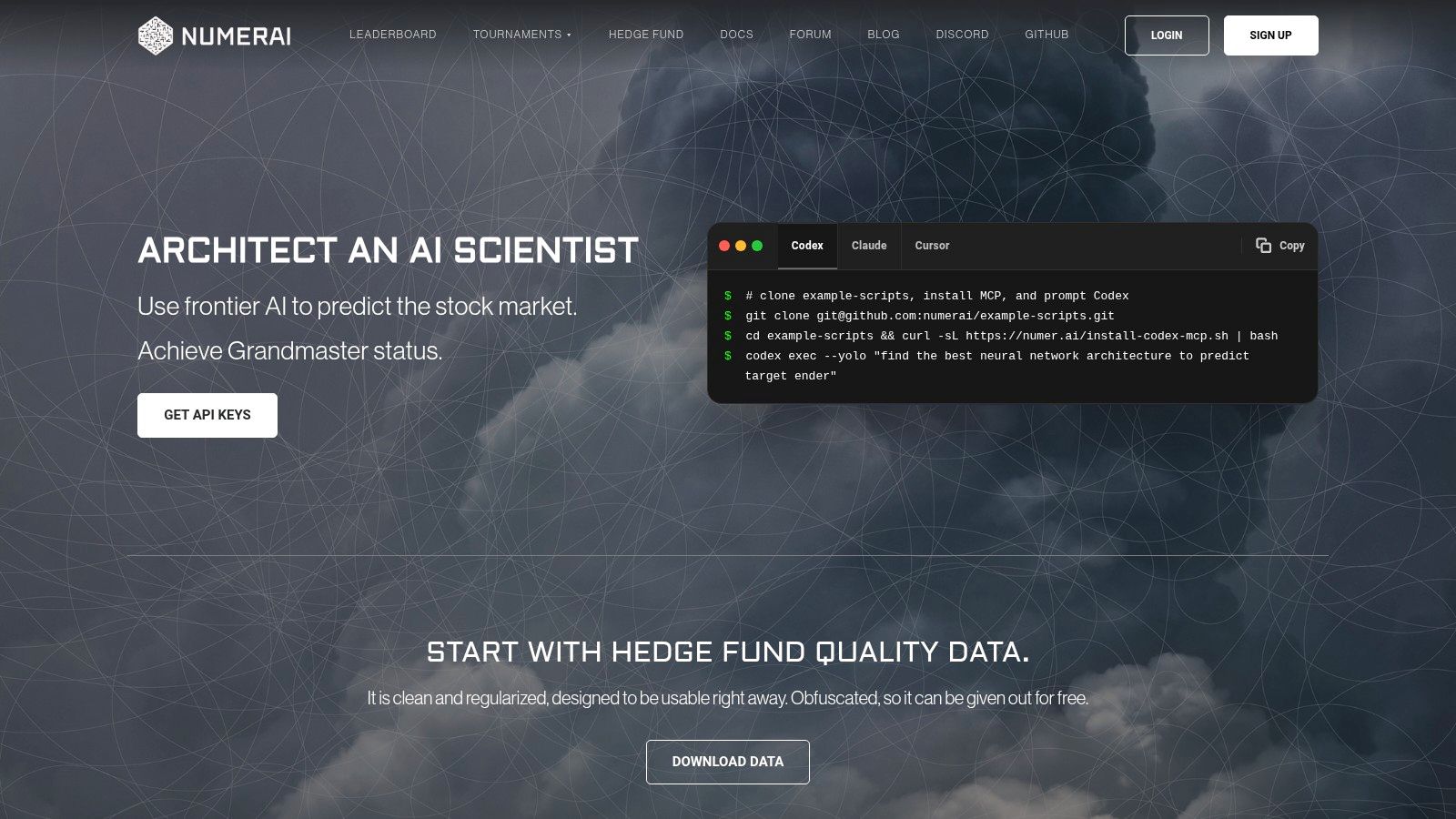
Numerai applies crypto incentives to a crowd-sourced model competition. Data scientists train models on encrypted datasets and submit predictions, while NMR is staked on those predictions. Model performance determines rewards or penalties, and a meta-model aggregates community signals for the fund's live strategy.
That structure gives Numerai a distinct AI connection. It isn't a decentralized GPU marketplace and doesn't primarily sell cloud capacity. Its central problem is coordinating external model builders around predictive signals while using staking to connect participation with model quality.
A token role tied to model submissions
NMR has a direct operational role in tournament participation because modelers can stake it behind predictions. The platform provides structured onboarding documentation, a competition pipeline, and access that is free to join with optional NMR staking, according to the supplied project notes. The design creates a measurable link between submissions and token use, but it also creates slashing risk when predictions underperform.
The project's strength is the clarity of that incentive connection. A participant can identify the model submission, the stake, the resulting performance, and the reward or penalty mechanism. The limitation is specialization. Participation requires machine-learning knowledge and ongoing work, so NMR doesn't represent a generic AI-sector proxy.
For charting, the asset ticker is NMR. The venue-specific record should still include the exchange prefix and quote pair, because the same ticker can appear differently across supported markets. A TradingView-compatible watchlist organized by AI category can include NMR, but an analyst should label it model competition and data science, not decentralized compute or AI agents.
Numerai is therefore best evaluated through two separate lenses: platform utility for modelers and market exposure through NMR. Keeping those fields separate prevents a strong product mechanism from being mistaken for a conclusion about token performance.
7. Virtuals Protocol (VIRTUAL)
Virtuals Protocol focuses on infrastructure for a society of AI agents and agent-to-agent commerce. Its official materials describe a framework for creating, deploying, and coordinating AI agents across digital environments, with the protocol positioned around agent interaction rather than GPU supply, cloud hosting, or model tournaments.
That makes VIRTUAL distinct from the other projects in this list. It is best understood as an AI-agent coordination and commerce layer, where the research question is not simply whether AI is involved, but how agents are structured, deployed, and allowed to transact within the protocol's ecosystem.
What to verify before import
For TradingView users, the practical step is straightforward: treat VIRTUAL as an asset ticker, not as a universal chart symbol. Before import, verify the current exchange listing, quote pair, exchange prefix, and exact TradingView-qualified symbol format. Readers should also confirm that the selected venue still supports the listing at the time of import.
Virtuals Protocol belongs in an AI watchlist when the goal is to track agent infrastructure and agent-to-agent commerce alongside other AI-related crypto categories. As with the rest of this list, project utility and symbol availability should be documented separately.
Top 7 AI Crypto Coins Comparison
| Project | Implementation complexity | Resource requirements | Expected outcomes | Ideal use cases | Key advantages |
|---|---|---|---|---|---|
| Artificial Superintelligence Alliance (FET) | Moderate to high, token migration and cross-chain coordination | Token holdings (FET), staking/gov tooling, cross-chain integration | Coordinated decentralized AI ecosystem across multiple project layers | Investors, integrators, researchers seeking unified decentralized AI infrastructure | Brings multiple AI projects under one framework; public roadmap and tokenomics |
| Bittensor (TAO) | High, permissionless subnets, node and validator roles | Node/validator infrastructure, ML models, staking, technical expertise | Incentivized ML contributions with rewards tied to model utility; subnet specialization | ML researchers/operators contributing models and participating in incentive networks | Native incentives for ML output; diverse, specialized subnets |
| Render Network (RENDER) | Moderate, marketplace integration and operator onboarding | GPU resources for providers or tokens for consumers; operator tooling | Distributed GPU rendering marketplace and emerging AI compute access | 3D artists, content creators, GPU providers, distributed rendering workloads | Real demand utility; clear operator tooling and marketplace model |
| Akash Network (AKT) | Moderate, bidding marketplace with deployment tooling | Provider compute (including GPUs), AKT for fees/staking, marketplace knowledge | Flexible cloud and GPU deployments with programmable cloud roadmap | Teams needing cost-effective GPU instances, censorship-resistant deployments | Practical path to flexible GPU access; active governance and roadmap |
| Arkham (ARKM) | Moderate, integrates AI/ML tagging, API, and marketplace | Platform/API access, data processing; ARKM for marketplace participation | On-chain entity and address research context for investigations and analysis | Traders, investigators, compliance teams needing attribution and monitoring context | Actionable blockchain intelligence; real-time API and Intel marketplace |
| Numerai (NMR) | High, tournament pipeline and staking workflows | ML expertise, compute for model training, NMR staking | Performance-linked tournament participation and aggregated meta-model input | Data scientists competing in prediction tournaments; quantitative teams | Direct link between token utility and model submissions; mature community |
| Virtuals Protocol (VIRTUAL) | Moderate, agent creation and coordination workflows | Protocol access, agent design/planning, ecosystem familiarity | AI-agent deployment and agent-to-agent commerce coordination | Builders, researchers, and users tracking AI-agent ecosystems | Clear focus on agent infrastructure and interaction design |
Turn the Shortlist Into a Clean TradingView Workflow
A useful AI crypto watchlist starts with classification, not ticker collection. Label each project by the problem it addresses: Bittensor for decentralized machine intelligence, Render for GPU rendering and compute, Akash for decentralized cloud, Arkham for on-chain intelligence, Numerai for model competitions, Virtuals Protocol for AI-agent commerce infrastructure, and the Artificial Superintelligence Alliance for a broad decentralized AI ecosystem. Those labels make it easier to compare projects with similar operational roles instead of treating every token as one undifferentiated narrative.
Market context also needs a date. Category definitions, listings, ticker conventions, and exchange support can change quickly. Market-cap fields should therefore be recorded with their source and date rather than copied into a permanent label.
Import discipline
Before importing a symbol, verify four fields:
Current ticker: Check whether the project uses a changed or transitional label, such as FET moving toward ASI on some venues.
Venue: Confirm the centralized exchange or other supported market that supplies the chart.
Pair format: Record the exact quote currency and TradingView-compatible form, such as
EXCHANGE:PAIR.Evidence date: Save the date and source for market capitalization, category, ecosystem, and listing context.
One project can require multiple venue-specific symbols. TAO, AKT, ARKM, NMR, RENDER, FET, and VIRTUAL may each have different pair availability and display conventions across venues, so a generic ticker shouldn't be imported as though it were universal.
For a larger symbol universe, TradingList's Standard watchlists can provide supported category or ecosystem lists. Custom crypto watchlists and ScreenerList can narrow those universes, DeltaList can compare a reference list with exchange or market variants, and FusionList can combine compatible lists into an exportable configuration. The daily refresh cycle can help reflect supported source changes, but the workflow still requires a publication-date check.
TradingList organizes symbols. It doesn't provide signals, predictions, portfolio recommendations, or financial advice, and it isn't an exchange, broker, or trading platform. That separation is useful because the analyst can evaluate network utility, liquidity context, ticker status, and chart availability without turning watchlist construction into an investment recommendation.
TradingList provides maintained, TradingView-compatible crypto watchlists organized by supported centralized exchanges, market-cap fields, categories, and ecosystems. For ai crypto coins, visit TradingList to build narrower symbol universes, compare venue variants, and export a cleaner watchlist after verifying each ticker and pair.