
How can a gaming token watchlist stay useful without becoming a pile of unrelated ticker symbols?
A usable gaming crypto coins list answers that question with a repeatable workflow, not a pile of ticker symbols. For research and monitoring, the hard part is not finding GameFi names. The hard part is separating infrastructure tokens from single-title exposure, checking where each asset trades, and standardizing symbols so the list imports cleanly into TradingView.
That distinction matters because gaming tokens do not behave as one uniform sector. Some track broader blockchain gaming infrastructure. Others rise and fall with the user activity, treasury design, or token emissions of a single game. If those assets sit in one undifferentiated watchlist, screening gets sloppy fast.
The practical approach is to build a source-driven watchlist, then maintain it like any other sector basket. Start with authoritative category pages, exchange listings, and project-level market checks. Then convert that research into a clean TradingView list with consistent exchange prefixes, naming rules, and review intervals. Traders who already do this for exchange coverage can apply the same process used in a Kraken coin list workflow for TradingView.
This article follows that approach. The seven tokens below are illustrative examples rather than recommendations or a ranked top-coins list. Together, they show how infrastructure, ecosystem, and single-game assets can be separated inside a TradingView research watchlist.
Table of Contents
- 1. Immutable (IMX)
- 2. Gala (GALA)
- 3. Axie Infinity (AXS)
- 4. The Sandbox (SAND)
- 5. Ronin (RON)
- 6. Beam (BEAM)
- 7. Pixels (PIXEL)
- Gaming Token Watchlist Roles Compared
- Putting Your Gaming Coin List to Work in TradingView
1. Immutable (IMX)

IMX illustrates the infrastructure side of the gaming sector. Its role is connected to gaming infrastructure, developer activity, and marketplace usage rather than the fate of a single title. In a research workflow, that makes it a useful contrast to a pure game-economy token.
That difference matters during screening. A watchlist built only by market cap tends to mix infrastructure, publisher ecosystems, and single-game assets into one noisy bucket. Using IMX as an infrastructure example helps separate those roles without treating either group as a trading signal.
How IMX can represent gaming infrastructure
IMX can serve as a reference for how an infrastructure token differs from assets tied to a single game economy. The purpose is classification: it helps researchers keep unlike exposures from being treated as one uniform gaming sector.
Example placements for IMX include:
- Core gaming watchlist: to keep a stable sector reference on every scan.
- Infrastructure subset: to compare it with chain, marketplace, and tooling tokens instead of with game-economy names.
- Exchange-specific list: to confirm symbol formatting, liquidity, and alert behavior by venue.
Practical rule: If a token reflects platform usage across multiple games or developer teams, classify it separately from tokens tied mainly to one in-game economy.
IMX is also a useful example for checking import hygiene across venues before scaling a larger gaming list into TradingView. Cross-check ticker naming, quote pairs, and exchange suffixes first. A maintained Kraken coin list for TradingView workflows helps reduce manual cleanup if IMX is part of an exchange-based gaming basket.
2. Gala (GALA)

GALA illustrates the operating layer of a gaming ecosystem rather than a pure infrastructure or metaverse-only example. Its main value here is as a classification test. If a watchlist groups all gaming tokens together without separating ecosystem tokens from infrastructure names, the list becomes harder to use.
Comparing GALA with game-specific and infrastructure tokens can help distinguish user-facing GameFi exposure from tooling and network-level activity. The comparison is intended to clarify watchlist roles, not to produce a trading signal.
How GALA behaves in a research workflow
A clean workflow places GALA in a function-based list rather than only a market-cap list. That keeps comparisons tighter. It also avoids the common problem where a watchlist becomes a loose collection of "gaming-adjacent" assets with little analytical cohesion.
Example placements for GALA include:
- Play-to-earn and ecosystem basket monitoring: to compare it with other user-economy tokens.
- Category watchlists: to watch how gaming exposure differs from adjacent metaverse assets.
- Exchange support review: to confirm where the symbol is tradable in a TradingView-compatible format.
GALA is better treated as an ecosystem-participation example than as a sector-wide proxy.
3. Axie Infinity (AXS)

AXS offers an example of a token tied more closely to one flagship game economy than to broad gaming infrastructure.
AXS illustrates a part of GameFi that broader infrastructure tokens cannot. Its price behavior is tied more tightly to one game economy, one community, and one ecosystem history. For researchers building a gaming crypto coins list, that makes it useful as a control chart for title-specific risk rather than a general proxy for the whole sector.
That distinction matters in practice.
In an illustrative watchlist structure, AXS can be separated from gaming infrastructure and exchange tokens. Mixing those groups makes relative strength work less reliable because the drivers are different. AXS reacts to player activity, ecosystem confidence, and renewed interest in the original play-to-earn cycle. IMX or RON can move on a different set of inputs.
How AXS represents single-game exposure
AXS helps illustrate a narrow but recurring distinction: project-specific exposure behaves differently from infrastructure and newer ecosystem exposure. Comparing those roles can make a research watchlist easier to interpret without turning the comparison into a recommendation.
The practical problem is symbol selection. Researchers often write down AXS as if the ticker alone is enough, but TradingView requires exchange-specific formatting. If the watchlist is being built from multiple source lists, symbol cleanup should happen before import, not after failed entries start piling up. A crypto screener workflow for sorting symbols, venues, and categories makes that process easier to standardize.
AXS can be grouped in three illustrative ways, depending on the research question:
- Legacy GameFi leaders: to track whether older play-to-earn names are regaining attention.
- Single-game economy tokens: to isolate assets with concentrated product risk.
- Ronin ecosystem exposure: to compare AXS with other tokens connected to the same chain and user base.
AXS is useful as a classification example rather than as a pure sector benchmark. The watchlist structure should make its single-title exposure obvious.
4. The Sandbox (SAND)

SAND can be classified as a gaming token, a metaverse proxy, or a creator-economy asset. That overlap makes it a useful classification example in a gaming crypto coins list.
SAND is less useful as a pure read on game-specific demand than AXS, and less useful as chain-level gaming exposure than RON. Its value for researchers comes from overlap. If SAND starts moving with gaming names, that suggests one type of risk appetite. If it starts trading more like virtual-world or user-generated-content narratives, that suggests another. A flat list of gaming tickers hides that distinction.
Where SAND fits in a watchlist structure
SAND can appear in more than one basket when each basket is labeled by research purpose. One list tracks gaming tokens with broad retail recognition. Another tracks metaverse and virtual-world assets. A third can sit inside a narrative-rotation group for traders watching capital move between infrastructure, legacy GameFi, and world-building tokens.
That setup matters because the same symbol can answer different questions depending on what surrounds it.
For TradingView workflows, SAND is also a good test case for symbol hygiene. Researchers often start with category labels from exchange pages, ranking sites, and token databases, then discover that the imported symbols are inconsistent across venues. Running SAND and similar names through a crypto screener workflow for exchange-specific symbol cleanup reduces failed imports and keeps the watchlist usable.
Example placements for SAND include:
- Gaming and metaverse overlap lists: to compare crossover narratives.
- Large liquid gaming-token groups: to monitor tradable names that attract broader attention than smaller titles.
- Narrative rotation baskets: to compare SAND against infrastructure tokens, single-game tokens, and adjacent virtual-world assets.
As noted earlier, broader gaming-token research often groups blockchain game assets with digital-economy tokens that connect in-game activity to tradable value. SAND fits that theme, but it works best as a classification check. If the watchlist makes that mixed exposure explicit, SAND adds context. If it sits in an undifferentiated list of gaming coins, it adds noise.
5. Ronin (RON)
RON illustrates a gaming token that behaves more like ecosystem infrastructure than a single-game asset. It provides a network-level example tied to game activity and developer participation across the Ronin ecosystem.
That makes it useful for a different job than AXS or SAND. If a watchlist only contains game-specific tokens, it can miss where capital is moving at the network layer. Ronin helps separate ecosystem strength from title-level momentum, which is a practical distinction when building a TradingView list meant for daily monitoring rather than casual browsing.
How RON represents ecosystem infrastructure
RON is useful as a classification anchor when the watchlist makes its network-level role explicit. The research distinction is between following a specific game economy and following the network that hosts gaming activity.
For TradingView research, separating network infrastructure from item-economy and reward-driven tokens makes the comparison easier to interpret.
Example placements for RON include:
- Gaming infrastructure lists for network and chain exposure
- Ecosystem-specific baskets for tracking Ronin-linked assets together
- Rotation watchlists that compare chain tokens against single-game tokens during shifts in narrative and liquidity
Mixing chain tokens, publisher-style ecosystem projects, and in-game economy tokens into one flat watchlist makes category comparisons harder than they need to be.
6. Beam (BEAM)
Beam adds another infrastructure-oriented example to a gaming crypto coins list. Its network role differs from the role of a single-game economy token, so it can be classified separately when the watchlist is organized by function.
Because the BEAM name can be ambiguous across data providers and venues, confirm that a selected market refers to the Beam gaming ecosystem before adding it to a TradingView watchlist. The broader classification principle remains useful: infrastructure tokens and in-game economy tokens represent different research contexts.
How to classify a specialized gaming infrastructure token
Beam can illustrate how a specialized infrastructure token fits a purpose-built list instead of a broad list of game-economy assets. That is a classification choice, not a judgment about project quality or future performance.
Example placements for Beam include:
- Infrastructure comparison list: grouped alongside IMX and RON.
- Specialized gaming network list: kept separate from single-game economy tokens.
That keeps the main screen manageable while preserving the distinction between token roles.
7. Pixels (PIXEL)
PIXEL provides an illustrative example of an in-game economy token that should not be confused with chain infrastructure. In watchlist design, that contrast helps researchers distinguish ecosystem monitoring from individual-game monitoring.
PIXEL also illustrates a recurring issue in GameFi research. Newer or narrower gaming assets may be easier to study in a separate research list than in a broad category list.
What PIXEL adds to a practical GameFi watchlist
One possible use of PIXEL is in an "emerging game tokens" basket. That basket should stay separate from the large-cap gaming list and from the infrastructure list. Once those lists are mixed together, alert overload starts quickly and the watchlist loses analytical precision.
Smaller gaming assets often have less consistent exchange coverage than larger category names. Keeping them in a separate research list makes the broader watchlist easier to maintain without turning inclusion into a judgment about the project.
A token can appear in a research example without becoming a recommendation.
Gaming Token Watchlist Roles Compared
| Project (Ticker) | Illustrative role | Comparison group | Watchlist note |
|---|---|---|---|
| Immutable (IMX) | Gaming infrastructure | RON and BEAM | Helps separate infrastructure from single-game exposure |
| Gala (GALA) | Gaming ecosystem | AXS and PIXEL | Illustrates a user-facing ecosystem role |
| Axie Infinity (AXS) | Single-game economy | Other title-specific tokens | Keeps concentrated product exposure visible |
| The Sandbox (SAND) | Gaming and metaverse overlap | Virtual-world and game-economy tokens | Useful when one asset spans several narratives |
| Ronin (RON) | Gaming network and ecosystem | IMX and BEAM | Separates network-level context from title-level context |
| Beam (BEAM) | Gaming infrastructure and network | IMX and RON | Confirm the intended gaming asset before adding a venue-specific market |
| Pixels (PIXEL) | In-game economy | AXS and GALA | Fits an illustrative list for narrower game tokens |
Putting Your Gaming Coin List to Work in TradingView
How do you turn a gaming crypto coins list into a structured TradingView research workspace?
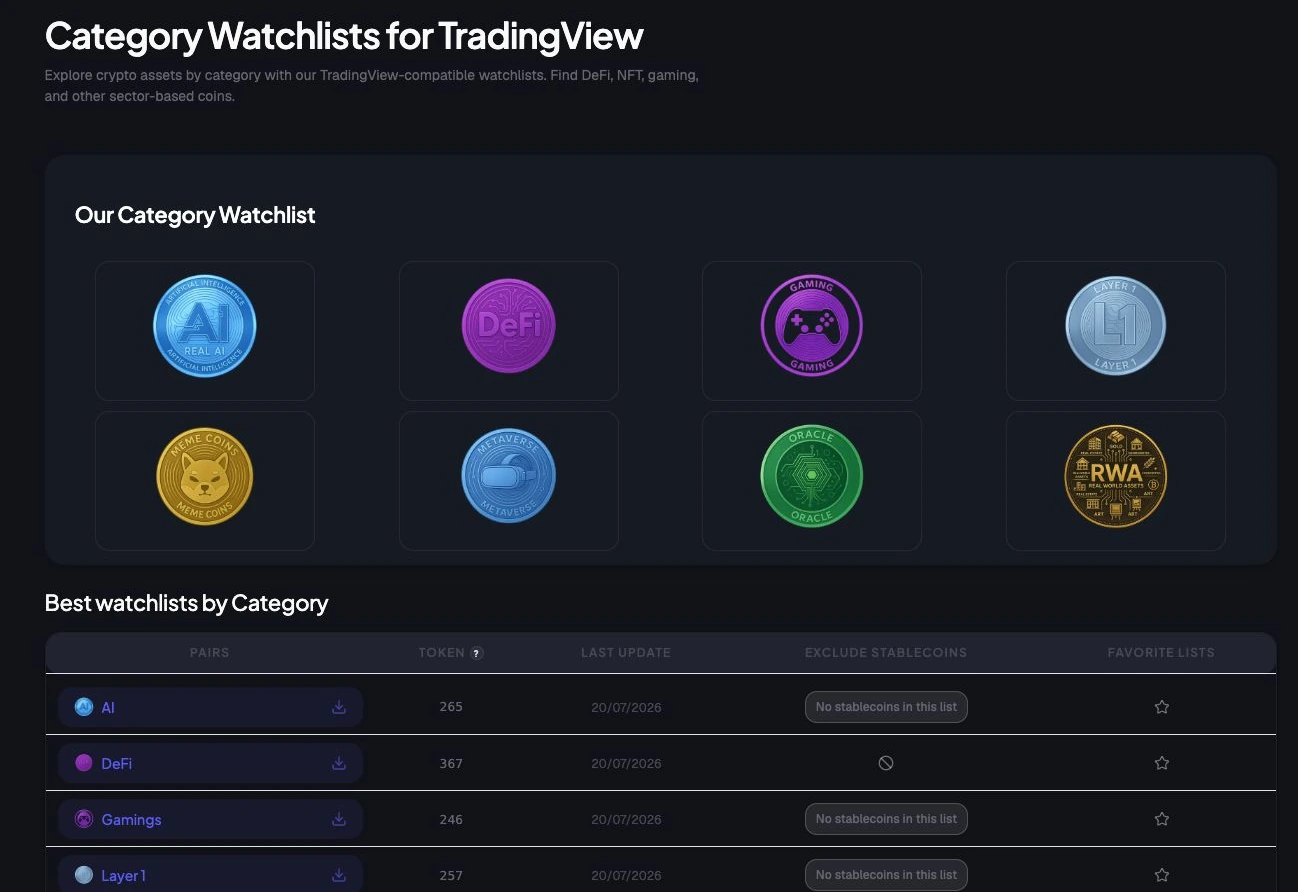
TradingList provides ready-to-import category watchlists for TradingView, including gaming-focused symbol sets. It helps organize and export a research universe; it does not decide which assets to trade or provide trading signals. Explore the TradingList category watchlists.
The answer is process. A research list becomes useful in TradingView only after the symbols are normalized for the right venue, split into workable groups, and reviewed often enough to catch pair changes, delistings, ticker migrations, and new entrants. Collecting token names is the easy part. Building a watchlist that stays accurate is the harder job.
A raw set of tickers such as IMX, GALA, AXS, SAND, RON, BEAM, and PIXEL is only a draft. TradingView expects exchange-specific market symbols. A researcher also needs to decide what the list is for before importing it. Chart review, scanner inputs, and alert routing usually need different list sizes and different levels of cleanup.
How to Import Your Watchlist into TradingView
The manual workflow is simple and reliable. Create a plain text file with a .txt extension. Put one TradingView-ready symbol on each line, such as BINANCE:IMXUSDT or COINBASE:GALAUSD. Then use TradingView's "Import list..." function to load the file into a watchlist.
Format matters. EXCHANGE:TICKER is the standard that prevents mismatches. A generic symbol like IMX can point to the wrong venue, the wrong quote currency, or fail to import cleanly. Researchers who monitor liquidity and price structure across exchanges usually standardize symbols before import, not after.
That approach matches how traders handle larger exchange-based universes. TradingView education materials describe watchlists as a way to monitor many assets at once, and exchange tutorials show practical import methods using text files, including this TradingView watchlist workflow video, this Bybit import-list example for Tether pairs, and this perpetual pairs import example.
Advanced Watchlist Management and Organization
Manual entry works for seven names. It breaks down once the list expands across spot pairs, perpetuals, multiple exchanges, and related ecosystems.
The main operational problem is maintenance. Gaming tokens change category labels, some pairs have weak liquidity on one venue and acceptable liquidity on another, and a token can belong to both a gaming basket and an L2 or sidechain basket. If the watchlist structure is loose, screening results become noisy and alert coverage starts to drift.
Combining and Customizing Lists
A practical setup usually includes several watchlists with different jobs. One can hold liquid gaming majors for daily chart review. Another can track smaller names and recent listings. A third can isolate ecosystem-specific assets, such as tokens tied to Ronin or Immutable.
Combining those lists by hand creates duplicate symbols, inconsistent quote pairs, and import files that need cleanup every time the universe changes. A better workflow is to maintain one master symbol set, then create derivatives for each use case. For example, a trader might keep one gaming master list, one liquid-only version for alerts, and one higher-risk version for exploratory scans.
TradingList's FusionList can combine saved watchlists into one TradingView-ready export. The tool supports list organization and cleanup; it does not select tokens or generate trading signals.
Suggested Watchlist Groupings
A flat list gets noisy fast. Grouping by decision use is more effective than grouping by narrative alone.
- By ecosystem: Separate Ronin, Immutable, and broader multi-chain gaming assets when chain exposure matters.
- By market cap and liquidity: Keep liquid core names apart from thinly traded tokens so scans and alerts are easier to trust.
- By function: Split infrastructure tokens such as IMX, RON, and BEAM from game-economy tokens such as AXS, GALA, and PIXEL.
- By instrument type: If you track both spot and perpetuals, keep them in different lists. Funding and liquidation behavior can distort comparisons.
This structure improves review speed. If infrastructure names are holding trend support while single-game tokens are losing relative strength, that is a different read from a broad sector move. Good list design makes that visible within minutes.
Monitoring and Maintenance Tips
Gaming watchlists need upkeep. Tickers change. Exchange support shifts. Category labels drift, especially when gaming overlaps with NFT, metaverse, AI, or ecosystem classifications.
A maintenance routine prevents silent errors. Review symbol formatting on a schedule. Check whether the pair still trades with enough volume to justify monitoring. Remove dead pairs quickly. Add new names only after confirming that the TradingView symbol matches the venue and quote currency you use.
Version control also helps. Keep archived text files by date or month so you can compare what changed instead of rebuilding the whole universe from memory. When researchers do this consistently, the watchlist stops being a static reference and becomes a working research environment for chart review, alerts, and sector rotation analysis inside TradingView.