
A trader opens TradingView, imports a carefully built crypto watchlist, and immediately gets the familiar mess. Some symbols load. Some fail. Some chart the wrong market. A few look right until alerts stop firing days later.
That problem usually gets blamed on formatting mistakes. Sometimes it is. More often, it's a data integrity issue hiding inside a watchlist task. Crypto symbols don't behave like stock tickers. They shift across venues, they depend on exchange-specific syntax, and they fail subtly when listings, pair conventions, or naming rules change.
For traders, researchers, educators, and advanced TradingView users, that changes the job. Building a watchlist isn't just collecting tickers. It's maintaining a clean symbol universe that TradingView can resolve, and that still makes sense after the next daily refresh cycle.
Table of Contents
- Why Your Crypto Watchlist Keeps Breaking
- Understanding Crypto Symbol Fragmentation
- How TradingView Reads Crypto Symbols
- The Hidden Work of Watchlist Maintenance
- Streamlining Your Workflow with Ready-to-Import Lists
- Focus on Analysis Not Data Entry
Why Your Crypto Watchlist Keeps Breaking
A common workflow starts the same way. A trader pulls a list of assets from an exchange page, a market-cap ranking, a category page, or a spreadsheet. Then those tickers get pasted into TradingView, and the result is frustratingly uneven.

Some entries fail because the exchange prefix is missing. Others fail because the pair delimiter is wrong. Others import, but point to a venue or market type the trader didn't intend. By the time the list is patched manually, the original goal of fast market review is already gone.
The failure usually starts before the import
The main mistake isn't usually inside TradingView. It starts upstream, when a trader treats crypto symbols as if they're universal labels. They aren't. In crypto, a ticker is only part of the identifier. The venue, pair convention, and exact formatting matter just as much.
A raw symbol list often mixes several incompatible formats at once:
- Generic asset tickers such as BTC or ETH that don't specify the trading venue
- Exchange-native pairs such as BTCUSDT that still aren't in TradingView-ready form
- Hyphenated pairs such as BTC-USD that may be valid on one venue but not another
- Contract labels that look similar to spot symbols but represent a different market
Practical rule: If a symbol list wasn't built specifically for TradingView, it should be treated as suspect until every entry is normalized.
Broken symbols create silent errors
The obvious problem is import failure. The less obvious problem is false confidence. A watchlist that imports partially can look usable while still carrying hidden damage. One invalid symbol can break a chart lookup. One wrong market can distort comparison work. One delisted pair can leave an alert attached to a dead entry.
That's why broken watchlists are more than an annoyance. They corrupt the review process itself. Traders rely on watchlists to define what gets scanned, charted, compared, and monitored. If the symbol layer is dirty, everything built on top of it inherits that weakness.
The fix isn't more patience with copy-paste cleanup. The fix is understanding why crypto symbols fragment in the first place.
Understanding Crypto Symbol Fragmentation
Crypto symbols look simple on the surface. They seem like the digital-asset version of stock tickers. That comparison breaks down fast. Traditional equities generally benefit from centralized ticker conventions, while crypto markets operate across many venues that each publish their own symbol rules.
According to CoinDesk trade data, the cryptocurrency market includes over 10,000 individual coins and more than 300,000 digital asset trading pairs, and those pairs vary across exchanges. That scale alone makes manual symbol handling fragile.
Why crypto symbols don't work like stock tickers
In stocks, traders usually think in one ticker for one company. In crypto, the same asset can appear in multiple quote currencies, multiple venues, and multiple market types. The asset name stays familiar. The tradeable symbol doesn't.
That creates three practical problems:
Exchange authority is fragmented Each venue decides how to label its own markets. There isn't a universal operator forcing one canonical pair syntax across the industry.
Pair structure changes by venue One exchange may use concatenated pairs. Another may use hyphens or slashes. Another may assign alternative naming conventions.
Spot and derivatives are easy to confuse A trader looking for one Ethereum market may find several variations that look related but serve different use cases.
A clean symbol workflow has to account for all three. That's also why broad discovery tools matter. A trader may begin with a screener, but the symbol universe still needs cleanup before it becomes a usable watchlist. That's where a structured source like this guide to a crypto screener workflow becomes useful as a complement to chart review.
Crypto Symbol Variation Across Exchanges Example Ethereum
The differences become obvious with a single asset.
| Exchange | Spot Market Symbol | Perpetual Futures Symbol |
|---|---|---|
| Binance | ETHUSDT | ETHUSDT PERP-style venue variation |
| Coinbase | ETH-USD | Venue-specific perpetual naming variation |
| Kraken | ETH/USD | Venue-specific perpetual naming variation |
The table reveals the core problem. Even before a platform-specific prefix is added, the symbol itself is already inconsistent. Slashes, hyphens, and concatenated pairs all describe roughly the same underlying asset relationship, but they aren't interchangeable strings.
A trader doesn't need more ticker lists. A trader needs a reliable method for deciding which symbol version belongs to which venue and which market.
That's why fragmentation isn't cosmetic. It's structural. Without normalization, duplicate entries creep in, valid pairs get missed, and watchlists stop reflecting the actual markets a trader intends to follow.
How TradingView Reads Crypto Symbols
A watchlist can look perfectly clean in a spreadsheet and still fail the moment it hits TradingView. The reason is simple. TradingView does not read “coins.” It reads fully qualified market identifiers.

That distinction matters more than traders expect. If a list says BTC, ETH, and SOL, a human can infer the intended markets. TradingView cannot. It needs the venue and the exact pair string in the format EXCHANGE:SYMBOL, such as BINANCE:BTCUSDT or COINBASE:BTC-USD. Finnhub's crypto symbols documentation shows this exchange-specific structure clearly.
The syntax has to be exact
A valid TradingView symbol includes two separate decisions. First, which venue you want. Second, how that venue names the market internally. Those are data integrity choices, not formatting preferences.
The parts that usually break are predictable:
- Exchange prefix such as
BINANCEorCOINBASE - Colon separator between venue and market
- Venue-native pair formatting such as
BTCUSDTversusBTC-USD - Correct delimiters and characters inside the pair itself
A single wrong character is enough to break symbol resolution. That is why symbol management turns into cleanup work so quickly. The asset may be correct, the exchange may be correct, and the imported string can still be unusable.
Examples make the failure pattern obvious:
- Works:
BINANCE:BTCUSDT - Works:
COINBASE:BTC-USD - Fails:
BTCUSDT - Fails:
BTC-USD - Fails:
BINANCE:BTC-USDif Binance lists that market under a different pair format
This is also why venue-specific source lists save time. If you are building around one exchange, a maintained reference like this Binance US coin list reduces guesswork before you import anything into TradingView.
TradingView reads strings, not intent
Traders often treat symbol entry as admin work. In practice, it behaves more like input validation. TradingView checks whether the string maps to a real market on a real venue. If it does, the chart loads. If it does not, there is no partial success.
That creates a common failure mode in mixed watchlists. A file may combine exchange tickers, screener exports, and hand-typed pairs from different naming systems. On review, the list looks complete. On import, it breaks because the strings were never normalized into one syntax standard.
The practical fix is straightforward:
- Store symbols in TradingView-ready format before import
- Keep one naming convention per file
- Verify delimiters manually when copying from exchange pages or spreadsheets
- Treat exchange prefixes as part of the identifier, not optional decoration
Clean imports come from exact strings, not close-enough strings.
The broader point is easy to miss. TradingView symbol handling exposes problems that already existed in the source data. The platform is strict, but that strictness is useful. It forces traders to separate asset ideas from executable market identifiers, and that separation is what keeps a watchlist usable under real trading conditions.
The Hidden Work of Watchlist Maintenance
The hard part isn't building a watchlist once. The hard part is keeping it usable after exchanges change listings, symbols get renamed, or a market disappears from the venue a trader watches.

Many traders discover this only after doing the work by hand. They collect assets from one site, verify them on exchange pages, then convert each one into TradingView format. The first version often looks clean. A few days later, edge cases start to show up.
Manual curation looks simple until it scales
Manual symbol management usually follows a rough pattern:
- Start with a coin universe from a market-cap page, exchange list, or thematic research set.
- Find the tradeable pair on the intended venue.
- Translate it into TradingView syntax with the exchange prefix.
- Import and test whether the chart resolves correctly.
- Repeat every time the universe changes.
That process is annoying at small scale and brittle at large scale. It also creates inconsistency across devices, accounts, teams, and saved workspaces. If two traders build “the same” watchlist separately, they often end up with different symbol sets.
A venue-specific reference can help reduce drift. For example, a trader narrowing a workspace to one exchange might start from a maintained Binance US coin list instead of trying to reconstruct the venue universe from scratch.
Static lists age faster than most traders expect
That matters because static watchlists encourage a false assumption. They imply that once a list imports, the problem is solved. It isn't. The list only reflects one point in time.
The real maintenance burden isn't typing symbols. It's validating that yesterday's symbols still map to today's markets.
This is why watchlist upkeep belongs in the same category as data hygiene. Traders already understand the need to clean OHLCV data, verify exchange coverage, and separate spot from derivatives. Symbol management deserves the same seriousness because it controls what enters the charting pipeline in the first place.
Streamlining Your Workflow with Ready-to-Import Lists
A trader usually notices the symbol problem at the worst possible moment. The watchlist imports, but half the rows fail, some pairs map to the wrong venue, and the cleanup job starts right when chart review should have started.
TradingList is one example of a workflow built around pre-formatted, TradingView-compatible symbol lists.
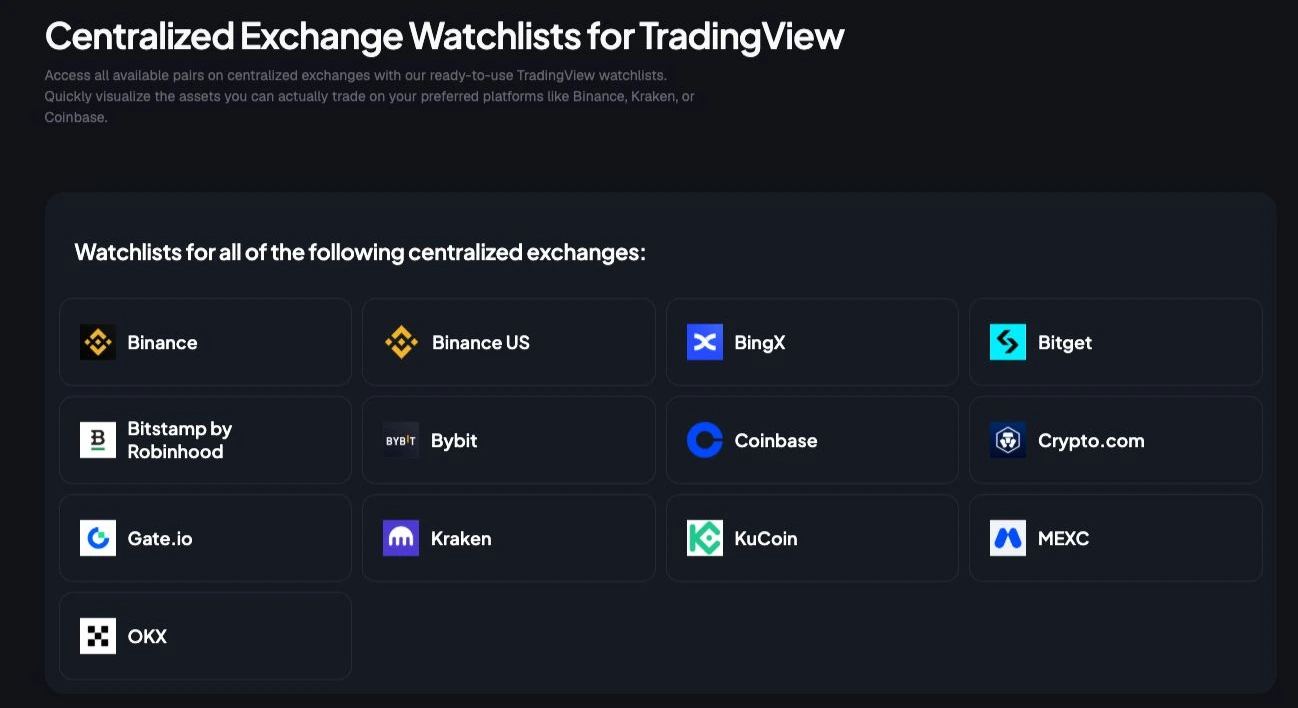
Ready-to-import lists reduce that failure rate by handling symbol formatting before the file reaches TradingView. That sounds minor until you have to fix exchange prefixes, pair syntax, duplicate assets, and category mixups across a few hundred rows. At that point, symbol management stops looking like admin work and starts looking like what it really is. Input control.
The practical advantage of pre-formatted lists
The benefit is not just speed. It is consistency.
A pre-formatted list gives the trader a symbol set that is already shaped for the platform, which means less manual translation and fewer chances to introduce errors while copying tickers from exchange pages, screeners, or old spreadsheets. It also creates a repeatable process. The same list can be imported into multiple workspaces, reused by a team, or refreshed without rebuilding the structure from scratch.
The operational gains are straightforward:
Less syntax cleanup Traders do not need to manually convert raw tickers into TradingView-ready symbols.
Fewer import mistakes Exchange and pair conventions are handled before import, which reduces avoidable failures.
Better repeatability across workspaces The same curated universe can support chart review, alerts, and screeners without a second formatting pass.
Cleaner refresh cycles Maintained lists can be updated as listings, delistings, and naming changes occur, instead of leaving stale symbols buried in a personal file.
That matters because the symbol layer sits at the front of the entire workflow. If the list is messy, everything downstream gets less reliable.
Better ways to organize a crypto symbol universe
Large watchlists feel productive, but they usually create noise. Smaller lists built around a clear purpose are easier to audit and easier to use.
Useful structures include:
| Watchlist type | Best use case |
|---|---|
| Exchange watchlists | Monitoring what is tradable on a specific venue |
| Market-cap watchlists | Separating larger assets from smaller or emerging names |
| Category watchlists | Tracking themes such as AI, gaming, Layer 1, meme coins, oracle, or RWA |
| Ecosystem watchlists | Comparing assets tied to one blockchain network or ecosystem |
This structure makes trade-offs visible. An exchange watchlist helps with execution reality. A category list helps with thematic rotation. An ecosystem list is better for relative strength work inside one network. One giant import file does none of these jobs well.
Custom workflows also benefit from tooling built for list control. Custom crypto watchlists help when coverage needs to match a specific strategy, desk, or research process. ScreenerList is useful for building and filtering narrower symbol universes. DeltaList helps compare a reference watchlist with exchange or market variants. FusionList combines multiple curated sets into one export without forcing the trader to reconcile everything manually.
These tools do not generate trade ideas. They reduce friction in the data preparation step so the analysis environment stays clean.
What an efficient TradingView workflow looks like
A practical workflow usually looks like this:
- Start with the market subset that matches the strategy.
- Organize that universe by exchange, category, ecosystem, or another useful filter.
- Export the list in TradingView-compatible format.
- Import it once and verify the coverage.
- Use the resulting watchlist for chart review, alerts, and scans.
For traders who build scanners around narrower universes, this guide to a TradingView screener watchlist workflow is a useful extension of the same process.
Efficient traders protect analysis time by standardizing symbol inputs before chart work begins.
That is the core shift. Ready-to-import lists save typing, but the bigger win is data integrity. A maintained symbol universe gives the trader a cleaner foundation, and that makes every chart, alert, and screen built on top of it more dependable.
Focus on Analysis Not Data Entry
Crypto symbol management looks minor until it starts breaking charts, polluting alerts, and fragmenting a workspace. Then it becomes obvious that the problem was never just list-making. It was data integrity.
Treat symbols like market data not admin work
A trader can still maintain everything manually. That approach isn't impossible. It's just expensive in attention, inconsistent over time, and poorly suited to a market where symbol definitions can shift across venues and categories.
The more professional approach is to treat crypto symbols the same way any serious analyst treats input data. They should be normalized, validated, structured for the platform being used, and revisited on a daily refresh cycle instead of assumed to be permanent.
Cleaner inputs lead to cleaner review processes
When the symbol layer is clean, the rest of the workflow gets simpler. Watchlists import properly. Screeners target the intended universe. Alerts attach to valid markets. Research sets stay coherent across exchanges, sectors, and ecosystems.
That doesn't make trading easier. It makes the environment more reliable. There's a big difference.
The traders who stay organized in TradingView usually aren't doing something mystical. They've just stopped spending valuable time rebuilding the plumbing underneath their charts.
TradingList helps traders, researchers, and advanced TradingView users work with cleaner crypto symbol universes instead of raw, inconsistent ticker dumps. The platform provides ready-to-import crypto watchlists for TradingView organized by exchange, market cap, category, and ecosystem, with standard watchlists, custom crypto watchlists, ScreenerList, DeltaList, and FusionList designed to support building, filtering, comparing, combining, and exporting maintained lists through a daily refresh cycle.