What do DePIN crypto coins represent beyond a volatile ticker on a chart? Decentralized Physical Infrastructure Networks use blockchain-based token incentives to coordinate real-world hardware, including storage systems, GPUs, wireless equipment, sensors, and edge devices. The seven projects below span decentralized storage, general compute, AI services, video processing, video delivery, and edge networks. Theta contributes two distinct tokens, THETA and TFUEL, so comparing them only by price or market capitalization misses the infrastructure differences that matter.
Market-cap tiers should be verified at publication because token prices, classifications, and project counts change. The more durable comparison is each network's infrastructure role, token function, operating model, and monitoring requirements. The workflow is straightforward: classify the assets, verify each symbol and exchange prefix, then build a focused TradingView-compatible watchlist. A generic ticker such as FIL isn't automatically a chart symbol. TradingView commonly requires a venue-specific format such as EXCHANGE:PAIR, and not every supplied token has universal venue support.
TradingList can help organize supported ecosystem or market-cap universes through a daily refresh cycle, but it doesn't replace venue verification. The list below is a research universe, not a ranking or signal list.
Table of Contents
- 1. Filecoin FIL
- 2. Arweave AR
- 3. Render Network RENDER
- 4. Akash Network AKT
- 5. Bittensor TAO
- 6. Livepeer LPT
- 7. Theta Network THETA and TFUEL
- 7-Way Comparison of DePIN Projects
- Build a Focused DePIN Watchlist
1. Filecoin FIL
Filecoin represents the storage side of DePIN. It operates as a decentralized storage marketplace where clients pay independent storage providers to store and serve data. Providers set ask prices, negotiate deals, post collateral, and use cryptographic proofs to demonstrate that contracted data remains available. The model is more operationally involved than buying a token, because storage reliability depends on provider performance and deal terms.
The network also supports Filecoin Plus, which incentivizes verified-data deals, along with multiple client and onboarding pathways. That combination makes FIL useful to monitor as an infrastructure asset whose central question is whether storage demand and provider capacity develop together.
What the token does
FIL supports payments, collateral, and economic coordination inside storage markets. The token's chart therefore belongs beside operational questions, including provider reliability, retrieval performance, deal activity, and the difference between advertised capacity and useful storage service.
For TradingView research, the asset label should distinguish the generic ticker from the selected venue pair. A watchlist entry such as EXCHANGE:FILUSDT is only an example of the formatting logic. The actual prefix and pair must be checked against the venue available in the TradingView search interface. The crypto ticker symbol guide can help researchers keep asset names, exchange prefixes, and pair formats separate.
Practical rule: Keep FIL in a storage-focused list, not in a broad “AI coin” group simply because the sector narrative overlaps with infrastructure.
Filecoin fits a large-cap or established infrastructure tier when the publication-time market-cap source places it there. Its watchlist role is different from compute tokens, even when both depend on physical hardware and operator economics.
Official network documentation and project materials are available through the Filecoin website.
2. Arweave AR
Arweave takes a different approach to decentralized storage. Its model centers on a one-time upfront payment intended to support long-term data retention through an endowment-like economic design. The network's permaweb orientation makes it particularly relevant for public applications, records, media, and static content that benefits from durable availability rather than frequent updates.
That distinction matters for comparison. Filecoin emphasizes storage and retrieval markets with negotiated provider deals, while Arweave emphasizes persistent publishing and a simpler upfront payment experience. Neither model should be treated as interchangeable with conventional private cloud storage. Privacy requirements, update frequency, file size, and retrieval expectations determine whether the design fits the use case.
A different storage watchlist label
AR belongs in a permanent publishing and public-data subgroup. Its operational signals include network fees, application activity, developer usage, and the economics behind long-term retention. Upfront costs can also be affected by AR's market value and the network's pricing calculations, so a chart-only review doesn't explain the user experience.
The TradingView workflow should preserve AR as a distinct symbol even when a market-cap list contains both storage projects. Researchers can normalize the asset name as Arweave, the generic ticker as AR, and the selected venue symbol as something like EXCHANGE:ARUSDT only after checking the venue's actual notation. That prevents a category label from being mistaken for a tradable pair.
The Arweave website provides the project's network and developer context. For watchlist construction, AR is best grouped with storage infrastructure but labeled separately from marketplace-based storage. That classification gives researchers a clearer way to compare token behavior with the network's intended use.
3. Render Network RENDER
Render Network connects GPU providers with creators and AI users who need decentralized rendering and compute. The network's infrastructure role is narrower than general cloud hosting. It focuses on GPU-intensive workloads, including rendering and AI-related media tasks, where idle hardware can be coordinated into a distributed service layer.
The token transition is a central research detail. Render migrated from the legacy ERC-20 RNDR asset to the Solana SPL token RENDER. Its Burn-Mint Equilibrium links network use and operator compensation: users burn RENDER for render credits, while node operators receive newly minted RENDER for completed work. A watchlist that mixes RNDR and RENDER without labels can therefore create a misleading historical or venue comparison.
Symbol migration is part of the analysis
RENDER belongs in an AI and GPU compute watchlist, with a separate note for legacy RNDR references. Researchers should verify whether a chart represents the current Solana-based asset, a legacy market, or a venue that uses an alternate naming convention. A symbol such as EXCHANGE:RENDERUSDT is a formatting example, not a universal listing claim.
The crypto screener guide is relevant when a researcher needs to narrow a broader supported market universe before checking symbols manually. The important control is normalization. The list should store the project name, current ticker, legacy ticker where relevant, chain context, and verified TradingView symbol as separate fields.
Render's official documentation and network information are available through the Render Network website. In a market-cap comparison, RENDER may sit in a larger or middle tier depending on the publication date. The tier is secondary to the infrastructure classification, because GPU compute exposure and token migration history make RENDER a different research instrument from storage assets.
4. Akash Network AKT
Akash Network is a permissionless marketplace for containerized compute. Providers bid to run workloads, while users describe requirements through deployment manifests and interact with the network through command-line and software-development tools. Leases and payments are recorded on-chain, giving the marketplace a more explicit infrastructure and pricing mechanism than a token that only represents ecosystem membership.
AKT supports staking, governance, and gas. The network's operating model makes it particularly relevant for researchers studying general-purpose compute rather than only creative rendering or AI model services. Workload portability can be useful for containerized applications, but onboarding still requires more DevOps knowledge than a managed platform.
What to monitor beyond the ticker
A practical AKT watchlist should include notes for provider geography, workload type, lease activity, and GPU availability. Compute supply can vary by region and provider, so a rising token chart doesn't establish that a specific workload can be deployed reliably. Likewise, cost comparisons depend on workload requirements and shouldn't be generalized across all cloud use cases.
AKT can be placed in a compute infrastructure tier, beside RENDER but not merged with it. RENDER centers on GPU rendering and media-oriented jobs, while Akash presents a broader container marketplace. That distinction helps analysts compare similar narratives without treating their products as identical.
The Akash Network website provides deployment and ecosystem documentation. For TradingView formatting, the generic asset label should remain AKT, while a venue-specific entry might follow the pattern EXCHANGE:AKTUSDT. The exact exchange prefix and pair need confirmation before import, particularly when a watchlist combines centralized-exchange universes with ecosystem-based lists.
5. Bittensor TAO
Bittensor coordinates independent AI subnets rather than one narrowly defined physical service. Miners provide models or other AI services, validators evaluate outputs, and incentive flows direct resources toward subnet activity. TAO supports staking and delegation, while subnet-specific alpha pools and Dynamic TAO add a more complex layer for emissions and perceived subnet value.
That design places Bittensor at the intersection of AI infrastructure, tokenized coordination, and subnet-level markets. The network's useful research question isn't whether TAO is rising. It's whether individual subnets attract meaningful participation, produce dependable outputs, and maintain incentives that operators can understand.
Why TAO needs a separate research bucket
TAO should sit in an AI services group rather than being filed alongside general compute without qualification. Akash supplies a marketplace for workloads, and Render supplies GPU-oriented rendering and compute. Bittensor coordinates specialized AI services through subnet participants and validator scoring. Those are related infrastructure themes, but their operating models differ.
The token model also increases the need for documentation checks. Staking, delegation, validator selection, subnet mechanics, and evolving Dynamic TAO rules can change how a researcher interprets price and participation. A normalized record should identify TAO as the primary asset while preserving subnet names in research notes rather than treating every subnet as a separate coin.
The Bittensor website provides network and operator resources. A TradingView-compatible symbol might use a pattern such as EXCHANGE:TAOUSDT, but the venue-specific symbol must be confirmed. TAO may occupy a higher market-cap tier than some specialized DePIN assets, yet market-cap size doesn't remove the need to examine subnet-level variation.
A broad AI label hides the key distinction. The hardware, service, validator process, and payment path should be recorded separately.
6. Livepeer LPT
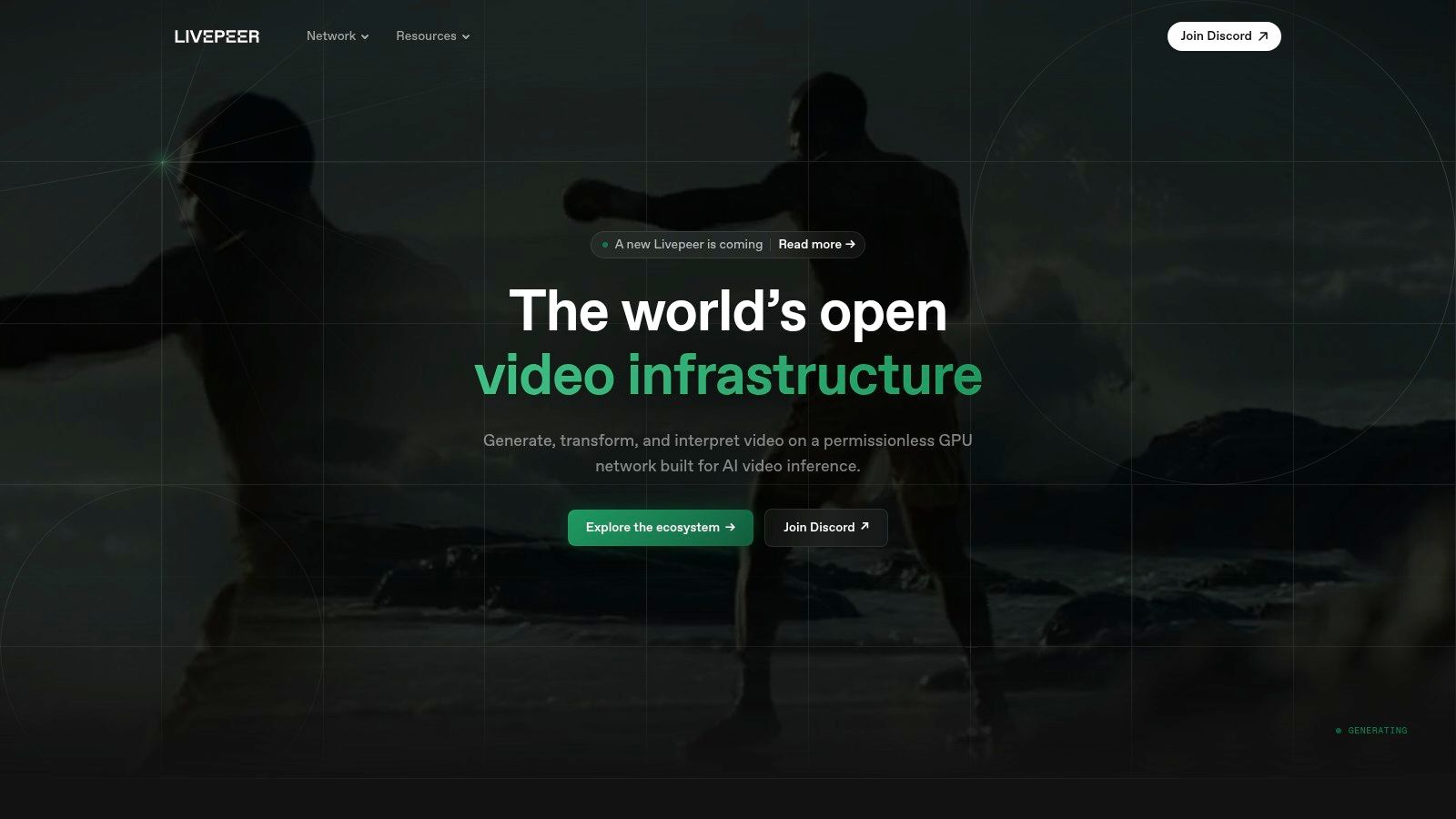
Livepeer focuses on decentralized video transcoding and emerging AI media compute. GPU operators, known as orchestrators, perform media tasks, while delegators stake behind operators. Performance affects work assignment, making operator quality part of the network's service model rather than an incidental feature.
LPT coordinates staking, operator selection, and governance. Video work can be priced per pixel, with dollar-denominated support for operators, while Livepeer Studio provides a commercial API and published tooling for applications that don't want to interact directly with the raw network.
Tracking media compute separately
LPT belongs in a video and media infrastructure category. That label keeps it distinct from Render's creative rendering focus and Theta's edge delivery model. Livepeer's infrastructure processes and transforms media, while Theta is oriented toward distributing video and sharing edge resources.
A useful charting record can include LPT's generic ticker, the selected venue pair, and a note that Studio pricing may differ from direct network pricing. An example such as EXCHANGE:LPTUSDT demonstrates the EXCHANGE:PAIR structure only. It shouldn't be imported until the exchange prefix and pair are verified in TradingView.
The market heat map guide can support broader visual market review when LPT is being compared with other supported category assets. It doesn't turn a heat map into a signal or establish that a token's market movement reflects usage.
The Livepeer website documents the protocol, Studio services, and operator ecosystem. In market-cap terms, LPT should be assigned to its publication-time tier rather than assumed to be a top or middle asset. The more durable classification is decentralized video processing, with operator capacity and workload economics tracked alongside the price chart.
7. Theta Network THETA and TFUEL
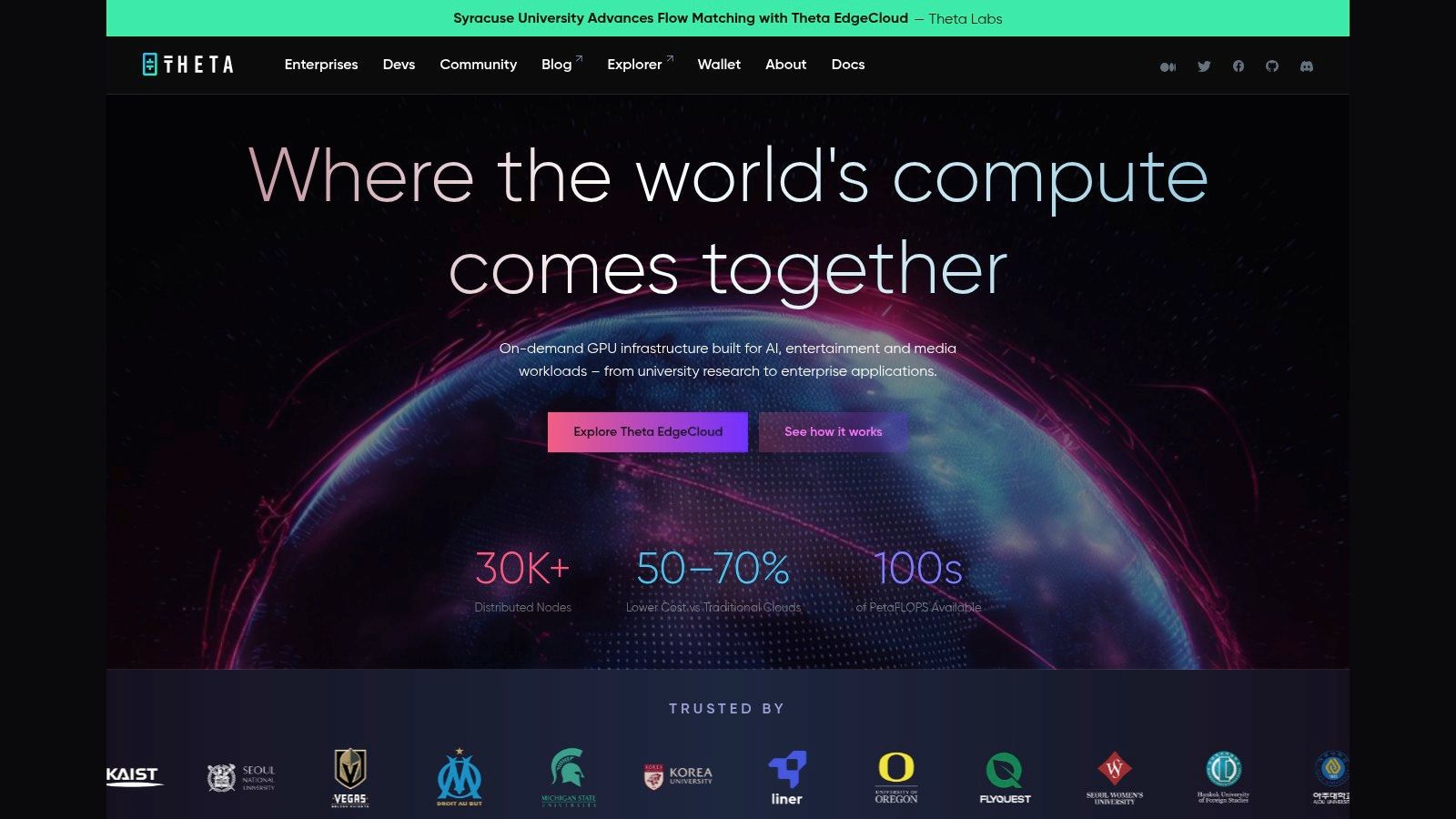
Theta Network combines distributed video delivery with edge participation and GPU or AI compute. Its dual-token design requires careful watchlist construction. THETA is used for staking and governance, while TFUEL serves operational, reward, and fee functions.
That separation makes Theta different from single-token networks such as Livepeer or Akash. Edge participants can contribute to video distribution and other network services, while EdgeCloud and the Metachain architecture extend the ecosystem toward AI, media compute, and application chains. Service availability and application footprint can vary by region and across evolving network products, so the asset pair should be monitored with ecosystem notes rather than treated as a simple one-token thesis.
Keep governance and operations separate
THETA and TFUEL should have separate TradingView rows. A researcher might use entries following the patterns EXCHANGE:THETAUSDT and EXCHANGE:TFUELUSDT, but the actual venue symbols must be checked before import. Combining them under “Theta” loses the distinction between staking and governance exposure on one side and operational fees and rewards on the other.
Theta fits an edge and media infrastructure group. It overlaps with Livepeer around video, but Livepeer emphasizes transcoding and media compute, while Theta emphasizes edge delivery and distributed resource participation. The comparison becomes more useful when both tokens are labeled by function.
The Theta Network website provides network context and product documentation. Market-cap tiering should be checked at publication, especially because dual-token ecosystems can be counted differently depending on the data source. A clean watchlist should record both symbols, their roles, and the venue-specific formatting used for each.
7-Way Comparison of DePIN Projects
| Platform | Implementation complexity | Resource requirements | Expected outcomes | Ideal use cases | Key advantages | Primary limitations |
|---|---|---|---|---|---|---|
| Filecoin (FIL) | Moderate–High (deal tooling, collateral) | Large storage, bandwidth, provider collateral | Decentralized production-grade storage marketplace | Archival and enterprise storage, large dataset hosting | Flexible provider pricing, geographic diversity, mature tooling | Deal onboarding learning curve; retrieval performance varies |
| Arweave (AR) | Low (simple upload/permaweb UX) | One-time upfront fee (AR), minimal client tooling | Permanent, immutable public data persistence | Censorship-resistant publishing, static sites, permanent archives | One-time payment model, durable permaweb hosting | Poor fit for private/frequently changing data; price volatility risk |
| Render Network (RENDER) | Moderate (credit model, token migration history) | GPU providers, credit/token management, job specs | Decentralized GPU rendering and AI compute marketplace | 3D rendering, GPU-heavy AI jobs, creator workflows | Purpose-built for GPU tasks; burn-mint credit model | Pricing transparency varies by job; migration added complexity |
| Akash Network (AKT) | Moderate–High (DevOps-heavy, manifests) | Container hosts, compute (CPU/GPU), CLI/SDK tooling, staking | On-chain marketplace for containerized compute leases | Containerized apps, batch compute, cloud-cost optimization | Competitive pricing, workload portability, global providers | Requires DevOps knowledge; GPU supply can be spotty |
| Bittensor (TAO) | High (subnets, evolving tokenomics) | Model providers, validators, staking/delegation mechanics | Market-driven AI subnet ecosystem and incentives | Specialized AI subnets, research networks, experimental AI services | Flexible on-chain incentives, subnet specialization | Complex/evolving tokenomics; variable subnet reliability |
| Livepeer (LPT) | Moderate (orchestrator setup; Studio simplifies) | GPU/transcode nodes, bandwidth, LPT staking | Decentralized video transcoding and media compute | Live streaming, video platforms, media pipelines | Mature tooling, predictable billing options, production history | Orchestrators need GPU and ops expertise; pricing variants |
| Theta Network (THETA / TFUEL) | Low–Moderate (edge nodes, dual-token model) | Edge devices/GPU, THETA staking, TFUEL for operations | Edge video delivery and shared GPU/AI compute | Streaming CDN, edge compute, distributed GPU sharing | Purpose-built for streaming, clear THETA/TFUEL roles | Evolving ecosystem; regional availability and reward variability |
Build a Focused DePIN Watchlist
These seven projects form a more useful research map when grouped by infrastructure function. Filecoin and Arweave belong to decentralized storage, though Filecoin uses negotiated storage and retrieval markets while Arweave emphasizes persistent public data. Render and Akash belong to compute, with Render focused on GPU rendering and Akash focused on containerized workloads. Bittensor represents coordinated AI services through subnet markets. Livepeer covers decentralized video processing, while Theta covers edge delivery and a dual-token media and compute ecosystem.
Market-cap tiers add context but shouldn't replace those classifications. DePIN has moved from a niche infrastructure narrative into a tracked crypto category. CoinGecko-based reporting said it was tracking nearly 250 projects with a combined market capitalization of about $19.2 billion by September 2025, compared with roughly $5.2 billion a year earlier (CoinGecko category reporting). That expansion doesn't establish which network has durable demand.
The sector has also been highly cyclical. CryptoRank-based reporting described a peak near $20.2 billion in March 2024 followed by a fall to about $3.46 billion, an approximately 82.9% drawdown (sector market-history reporting). This is why a watchlist should preserve publication dates and source notes instead of treating market-cap tiers as permanent labels.
A repeatable TradingView workflow looks like this:
Verify the market-cap tier: Check the publication-date source and record whether the asset is treated as large, middle, or smaller tier.
Confirm the venue symbol: Search the intended exchange in TradingView and verify the current prefix and pair.
Normalize migrations: Keep RENDER separate from legacy RNDR references.
Separate dual-token systems: Keep THETA and TFUEL in distinct rows with their different functions.
Label infrastructure roles: Use storage, compute, AI, media, or edge labels rather than one undifferentiated DePIN folder.
Record source changes: Note ticker changes, venue changes, and documentation updates beside the watchlist record.
TradingList can be an optional workflow aid when its supported ecosystem, category, market-cap, or centralized-exchange lists match the research need. Standard watchlists provide maintained symbol universes by supported exchange, market cap, category, or ecosystem. Custom crypto watchlists narrow supported market-cap, category, or ecosystem filters. ScreenerList builds a symbol list from market filters, DeltaList compares a reference list with exchange or market variants, and FusionList combines several watchlists into one exportable configuration.
These tools organize and export TradingView-compatible symbols. They don't provide signals, predictions, portfolio advice, or financial advice, and they aren't an exchange, broker, or trading platform.
TradingList provides maintained, ready-to-import crypto watchlists organized by supported centralized exchange, market capitalization, category, and ecosystem. Researchers building a DePIN universe can use its supported filters and daily refresh cycle to organize symbols before verifying venue-specific pairs in TradingView, so visit TradingList to explore the available workflow.