
Most advice about crypto ticker symbols starts from the wrong premise. It treats a ticker as if it's a unique, stable identifier. In crypto, that assumption breaks quickly.
A symbol like ETH can be useful shorthand, but it isn't enough to identify what should be charted, traded, screened, or imported into TradingView. Crypto markets don't have a single central registry for symbols, venues format pairs differently, and fake or duplicate tickers can exist. A trader who types a bare ticker into a platform is often relying on incomplete context.
That matters because the symbol universe is large and fragmented. Thousands of crypto assets trade across hundreds of venues, so symbol cleanup and maintenance are real workflow problems rather than naming annoyances.
Table of Contents
- Why Most Crypto Ticker Symbols Are Misleading
- The Anatomy of a Crypto Symbol
- Decoding Exchange-Specific Naming Conventions
- Mastering the TradingView Symbol Format
- Common Symbol Pitfalls and How to Avoid Them
- Best Practices for Building a Crypto Watchlist
- Simplifying Watchlist Management with TradingList
- Frequently Asked Questions
Why Most Crypto Ticker Symbols Are Misleading
A stock ticker usually works inside a clearer listing system. Crypto ticker symbols don't. They behave more like labels than permanent identifiers.
The problem starts with non-uniqueness. Crypto ticker symbols lack a single central registry, so the same short code can collide across venues or represent different assets in different contexts. Koinly's guide notes that even a code like WBTC can refer to distinct assets, which makes ticker plus exchange plus instrument verification necessary before placing an order or reconciling data through Koinly's explanation of crypto ticker symbol collisions.
A second problem is context dependency. A trader isn't usually working with a ticker alone. The underlying object in a chart or watchlist is a venue-specific market. That means the practical symbol is closer to a pair such as BTCUSD, BTCUSDT, or ETHUSD, and that pair only makes sense when tied to a specific exchange.
The symbol is not the asset
When traders say "the ticker," they often blur three different things:
- The asset name: Bitcoin, Ether, Solana.
- The ticker label: BTC, ETH, SOL.
- The venue-specific tradable market:
COINBASE:BTCUSD,BINANCE:BTCUSDT, or another exchange-pair combination.
That blur causes bad watchlists and bad charts. The platform may return a valid result, but not the one intended.
Practical rule: A crypto ticker symbol should be treated as a starting hint, not as final identification.
Fragmentation changes the workflow
As the number of venues, instruments, and token implementations grows, symbol handling becomes part of data quality control rather than clerical work. If the identifier is wrong, every downstream chart, alert, scan, and comparison can also be wrong.
The Anatomy of a Crypto Symbol
A useful way to handle crypto ticker symbols is to split them into layers. Most mistakes happen when those layers get compressed into one mental shortcut.
Three layers that traders often merge
The first layer is the underlying asset. That's the economic object being discussed, such as Ethereum.
The second layer is the ticker label. For Ethereum, that's usually ETH. This is the human-friendly shorthand used in exchange interfaces, chart search, commentary, and watchlists.
The third layer is the tradable pair. That's the asset quoted against something else, such as ETHUSD or ETHUSDT. Once the pair is connected to a venue, it becomes actionable for charting and trading.
A clean mental model looks like this:
| Layer | Example | What it means |
|---|---|---|
| Asset | Ethereum | The underlying crypto asset |
| Ticker | ETH | The label traders recognize |
| Pair | ETHUSD | The market being quoted |
| Venue-specific symbol | COINBASE:ETHUSD |
The exact market feed used in TradingView |
This distinction matters because a trader can be correct about the asset and still pull the wrong market feed.
The verification step that actually matters
For on-chain token verification, neither a ticker nor a contract address on its own provides enough context. The reliable identifier is the blockchain network plus contract address, cross-checked against an official project source or a reputable block explorer.
For a centralized-exchange market, the relevant identity is different: confirm the exchange, base asset, quote asset, and instrument type. A contract address may help confirm the underlying token, but it does not identify the exact spot or derivatives market shown in TradingView.
Practical rule: Verify on-chain tokens by network and contract address; verify exchange markets by venue, pair, and instrument type.
A robust workflow looks like this:
- Identify the context: Decide whether you are validating an on-chain token or a venue-specific market.
- For a centralized exchange: Confirm the exchange, base asset, quote asset, and instrument type on the venue or in TradingView.
- For an on-chain token: Confirm both the blockchain network and contract address using an official source and a block explorer.
- Add the qualified symbol: Only add the exact exchange-prefixed market to the TradingView watchlist.
This separation prevents a valid token address from being mistaken for a complete market identifier, and it prevents a familiar ticker from being treated as proof of token identity.
Decoding Exchange-Specific Naming Conventions
Different exchanges describe the same economic idea with different strings. That's normal in crypto, but it creates friction for charting and importing symbols.
Why the same asset appears under different strings
A symbol usually combines a base asset and a quote market. The base asset is what is being bought or sold. The quote market is what it's priced against, such as USD or USDT.
The formatting varies by venue. Some exchanges or data tools use separators. Others remove them. Some systems use BTC, while selected legacy, API, or derivatives contexts may use XBT. The result is that a trader may understand the market but still type the wrong symbol string.
Gate's glossary makes the more defensible point: a symbol can be unique within one platform without being globally unique. Prefixes, pair formats, and instrument labels therefore need to be checked against the venue rather than inferred from the ticker alone, as explained in Gate's glossary entry on trade symbols.
Common Crypto Symbol Formats by Exchange
| Exchange | Spot Pair Symbol | TradingView Prefix |
|---|---|---|
| Binance | BTCUSDT | BINANCE |
| Coinbase | BTCUSD | COINBASE |
| Kraken | BTCUSD | KRAKEN |
A few practical observations come from that table.
- Binance-style notation often uses stablecoin quotes such as
USDT, which makes the pair longer. - Coinbase-style notation often looks cleaner for fiat-quoted pairs such as
BTCUSD. - Kraken notation requires a current lookup. Kraken has used
BTCfor most spot-facing contexts since 2021, whileXBTremains in selected API, futures, OTC, and export contexts, according to Kraken's currency-code documentation.
For traders working across venues, that means a "Bitcoin chart" isn't one thing. It's a family of venue-specific feeds that may use different quote currencies, slightly different naming, and different market structures.
A narrower exchange-specific reference helps when building a venue-based watchlist. The Kraken coin list guide is a useful example of how symbol universes become more manageable once they're scoped to one centralized exchange instead of treated as a single global set.
Exchange-specific naming isn't noise. It's part of the instrument definition.
Mastering the TradingView Symbol Format
TradingView adds one more layer of structure. A platform search may look forgiving, but repeatable workflows depend on using the exact format it expects.

What TradingView expects
TradingView's official import documentation requires a .txt file, symbols with their exchange prefix, and entries separated by commas. For repeatable imports, use the exact symbol that TradingView lists for the selected venue rather than assuming that a format from another data provider will resolve the same way in TradingView's import and export guide.
In practice, the full venue-specific expression is typically:
EXCHANGE:PAIR
Examples:
BINANCE:BTCUSDTCOINBASE:ETHUSDKRAKEN:BTCUSD
The left side identifies the data venue. The right side identifies the market on that venue.
Examples that reduce symbol search errors
The easiest way to avoid malformed symbols is to build them from components.
- Start with the exchange prefix. If the market is on Binance, begin with
BINANCE:. - Use the venue's pair convention. For spot Bitcoin against Tether, write
BTCUSDT, notBTC-USDT. - Combine them into one string. That produces
BINANCE:BTCUSDT.
For perpetuals, the naming can include a venue-specific suffix such as PERP. A trader should still treat the exchange prefix as mandatory context, because the pair string alone isn't enough to distinguish one feed from another.
A few patterns help:
- Spot market example:
COINBASE:BTCUSD - Stablecoin-quoted market:
BINANCE:ETHUSDT - Institutional-style Bitcoin code:
KRAKEN:BTCUSD - Perpetual contract notation: use the exact exchange-supported pair name, then attach the exchange prefix
Search results can hide formatting mistakes. A saved watchlist exposes them later.
A symbol that appears to work during ad hoc search can still break alerts, scripts, or imports if the string isn't standardized.
Common Symbol Pitfalls and How to Avoid Them
Most symbol errors don't come from complex quant logic. They come from basic identifier hygiene. When the symbol is wrong, the analysis can still look clean, which makes these mistakes costly.

Where most symbol mistakes happen
The first failure point is the ticker collision. Because crypto ticker symbols do not have a single central registry, the same short code can represent different assets. Treat the exchange, pair, instrument type, blockchain network, and contract address as separate fields instead of relying on the ticker label alone.
The second failure point is the dead symbol. A token may be delisted, renamed, or reorganized, while the old entry remains in a watchlist, spreadsheet, or script. If that list isn't reviewed, the trader may keep scanning markets that no longer matter.
The third failure point is format drift. A symbol copied from one platform often doesn't conform to another platform's syntax. That creates silent errors during imports and script calls.
A maintenance checklist that works
A disciplined workflow reduces most of these errors.
- Verify more than the ticker: Check the exchange, base asset, quote asset, and instrument type before using a symbol operationally.
- Confirm token identity: For on-chain tokens, validate the blockchain network and contract address against an official source and a block explorer before mapping the token to a market.
- Review listing changes: Monitor exchange notices and corporate-action-style updates for renames, delistings, and reorganizations. Bitget's overview notes that relying on the ticker alone isn't sufficient for safe handling and reconciliation, and that contract addresses are required for token uniqueness in Bitget's explanation of ticker changes and verification.
- Remove stale entries quickly: Old symbols create confusion in scans and alerts even when they no longer trade.
- Test imported symbols: Open a sample of imported markets in TradingView rather than assuming every line resolves correctly.
A trader who wants broader screening discipline can also review a crypto screener workflow before building large symbol sets. The key point isn't the tool. It's the habit of treating the symbol universe as a maintained dataset instead of a static list.
Best Practices for Building a Crypto Watchlist
A strong watchlist is a controlled working universe with a clear purpose. The right size depends on whether the list supports broad research, exchange coverage, thematic monitoring, or a focused daily review.
A watchlist should have a defined purpose
There is no universal ideal number of symbols. A broad research or exchange-coverage list can contain many markets, while an active daily-review list may be intentionally smaller.
The important constraint is purpose. Define what the list is for, keep comparable markets together, and separate active-review symbols from research candidates when that makes the workflow easier to maintain.
A practical review list should include markets the user can compare consistently. That usually means staying within a defined scope such as one exchange, one quote convention, one market-cap range, or one supported research theme.
Practical ways to organize the list
A durable watchlist usually uses one of these structures:
- By market-cap tier: Large-cap names for liquidity review, then separate mid-cap and smaller-cap lists for more selective scanning.
- By supported category: Layer 1, gaming, AI, infrastructure, or other categories that the research process already uses.
- By ecosystem: Grouping symbols by network affiliation helps when comparing relative behavior inside one blockchain ecosystem.
- By venue: A Coinbase list and a Binance list often work better than one mixed list if execution or charting depends on exchange-specific availability.
That structure matters more than most traders expect. A list grouped by logic is easier to scan, easier to maintain, and easier to rebuild when symbols change.
For traders using TradingView workflows, a TradingView screener watchlist guide is a useful reference point for organizing lists around actual review tasks rather than around raw ticker accumulation.
The best watchlist is the one a trader can maintain every day without guessing what each symbol represents.
A good operational habit is to keep one active review watchlist and separate overflow lists for research candidates. That avoids bloating the primary list while preserving ideas worth revisiting later.
Simplifying Watchlist Management with TradingList
Manual symbol handling breaks down once the market universe gets large, venue-specific, and subject to frequent listing changes.
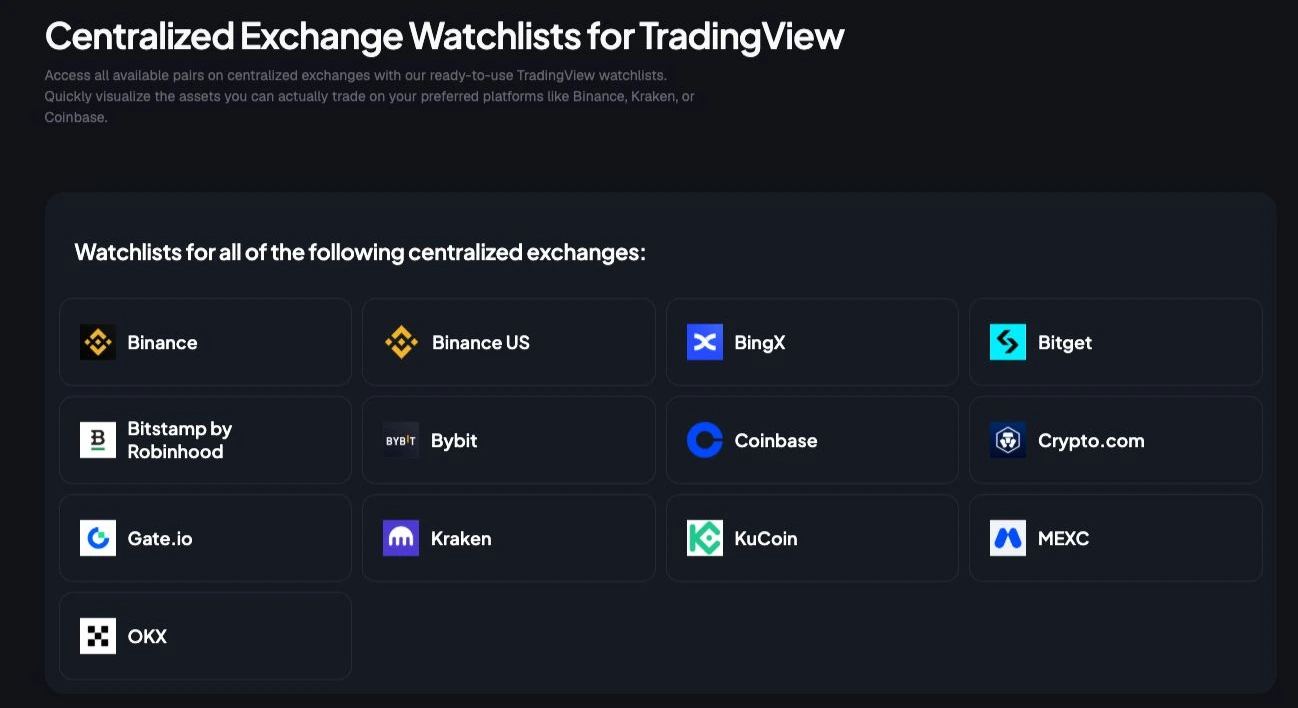
Where manual maintenance breaks down
The basic constraint is scale. Venue listings, pair names, and market availability change over time, so rebuilding the same symbol universe manually increases maintenance work. TradingList addresses this with a daily refresh cycle; it is not a real-time market feed.
That doesn't mean every trader needs every asset. It means the raw symbol universe is too fragmented to clean repeatedly by hand without introducing errors.
What a structured workflow should handle
A structured watchlist workflow should focus on symbol organization, not prediction. In practice, that means:
- Maintained standard watchlists: Organized by centralized exchange, market cap, supported category, or ecosystem.
- Custom crypto watchlists: Narrower lists built from supported market-cap, category, or ecosystem filters.
- ScreenerList: A way to build a symbol list from market filters.
- DeltaList: A way to compare a reference watchlist with exchange or market variants.
- FusionList: A way to combine several lists into one exportable configuration.
TradingList prepares and exports these lists; it does not synchronize existing TradingView watchlists or manage alerts inside a user's TradingView account.
For advanced TradingView users, the value is simple. A tool such as TradingList helps structure TradingView-compatible symbol universes so they can be filtered, compared, combined, and exported without rebuilding the same exchange-prefix and pair-format logic each time.
The practical use case isn't "find better trades." It's "keep the symbol layer clean enough that charting, scanning, alerts, and list-based review start from the right inputs."
Frequently Asked Questions
Is BTC different from XBT
BTC and XBT are two labels used for Bitcoin, but their usage is platform-specific. BTC is the widely adopted ticker. XBT follows an ISO-style naming convention, but it is not an officially assigned ISO 4217 currency code for Bitcoin; ISO has stated that decentralized digital currencies not issued by monetary authorities could not be assigned ISO 4217 codes.
Kraken has used BTC for most purposes since 2021 and retains XBT in selected API, futures, OTC, log, and history-export contexts. Always use the symbol currently shown by the venue and TradingView for the exact market you want to monitor, as documented by ISO and Kraken.
Why isn't a simple ticker list enough for TradingView
Because TradingView works with venue-specific symbols. A bare ticker such as ETH doesn't tell the platform which exchange feed or quote market should be used.
How should a trader verify an unfamiliar token
First identify the context. For an on-chain token, verify the blockchain network and contract address against an official source and a block explorer. For a centralized-exchange market, confirm the venue, pair, and instrument type. Do not rely on the ticker label alone.
What's the safest way to import a large watchlist into TradingView
Use a clean .txt file containing exact venue-qualified symbols, with entries separated by commas, as described in TradingView's official import guide.
A TradingView watchlist can contain no more than 1,000 symbols. If a logical universe is larger, split it into multiple files or watchlists before import, following TradingView's documented watchlist limit. After importing, open a sample of symbols to confirm that the venue, pair, and instrument type resolve as expected.
TradingList helps traders and researchers work with cleaner TradingView-compatible crypto symbol universes. Its maintained watchlists and list-building tools support centralized-exchange, market-cap, supported category, and ecosystem workflows without turning watchlist management into a manual cleanup project. Explore the workflow at TradingList.