
Why do traders keep asking for Base chain tokens when Base itself has no native token?
That question exposes a real gap in how many market participants think about ecosystems. On some networks, the chain and the headline asset are basically the same story. On Base, they aren't. The chain uses ETH for gas, yet an entire token economy has formed on top of it. For researchers, that changes how ecosystem exposure should be defined. For traders, it changes how symbols should be discovered, grouped, and monitored.
Most explainers stop at architecture. Most watchlist guides stop at ticker formatting. The more useful view connects both. A trader who doesn't understand Base's no-token design will misread what "Base tokens" are. A researcher who understands the design but tracks symbols poorly will still end up with a messy workflow.
Table of Contents
- What Are Base Chain Tokens?
- Understanding Base's No-Token Architecture
- The Universe of Tokens on Base
- Top Base Tokens and Their Market Impact
- Building Your Base Ecosystem Watchlist in TradingView
- Integrating Base into Your Research Workflow
What Are Base Chain Tokens?
Base chain tokens are the tokens deployed on Base, not a native Base protocol coin.
That sounds obvious once stated plainly, but the wording trips people up because many traders expect a blockchain ecosystem to revolve around a chain-level asset. Base breaks that pattern. When someone says "Base tokens," they're usually referring to the ERC-20 assets issued and traded on the network, not a fee token issued by the chain itself.
A useful analogy is geographic rather than technical. "Manhattan businesses" doesn't mean Manhattan has one master business. It means many separate companies operate there. Base works the same way. The ecosystem consists of many distinct assets that happen to live on the same network.
Why the wording confuses people
Part of the confusion comes from how people build mental shortcuts.
On Polygon, many traders instinctively tie ecosystem activity back to MATIC. On Avalanche, they think in terms of AVAX plus the projects built there. On Base, that shortcut fails. There's no single native coin that stands in for the whole network. So "Base chain tokens" becomes a category label, not a single ticker.
Practical rule: On Base, chain exposure and token exposure aren't the same thing. A trader needs to separate network usage from the ERC-20 assets that capture attention inside the ecosystem.
That distinction matters in daily work. If a desk wants to monitor Base as an ecosystem, it can't just chart one symbol and call the job done. It needs a token universe.
What traders are really tracking
In practice, traders usually mean one of four things when they ask about Base chain tokens:
- Ecosystem assets: Tokens launched directly on Base and associated with its on-chain activity.
- Thematic clusters: DeFi, social, AI, infrastructure, and other subgroups that form inside the network.
- Liquidity venues: The exchange-listed symbols that provide actual chartable and tradable access.
- Relative rotation: Which Base-linked names are gaining attention compared with assets from other ecosystems.
This is why the topic matters beyond education. The challenge isn't only defining the category. The challenge is building a clean way to follow it without mixing native Base assets, bridged representations, exchange-specific tickers, and unrelated symbols that happen to share similar names.
Understanding Base's No-Token Architecture
Base was designed so users pay gas in ETH, not in a native Base token. That one design choice explains most of the confusion around the phrase "Base chain tokens."

Why the wording confuses people
According to Base's documentation, Base uses ETH as its currency and is an EVM-compatible Layer 2 network.
That means Base should be thought of less like a separate country with its own currency and more like a high-speed economic zone that still uses Ethereum's money for transaction fees. The road system is different. The settlement layer underneath is still Ethereum.
For experienced traders, the practical implication is simple. The absence of a native token isn't a missing piece. It's the point of the design. Coinbase chose a structure that removes one extra asset from the user journey. A user doesn't need to acquire an additional gas token before interacting with the chain.
What ETH does on Base
ETH on Base functions like the universal payment method for network operations. It pays for execution. It doesn't represent the entire ecosystem.
That distinction matters because traders often blur three different layers:
| Layer | What it represents | Base example |
|---|---|---|
| Gas asset | What pays transaction fees | ETH |
| Settlement architecture | How transactions are processed and secured | Optimistic Rollup on the OP Stack |
| Ecosystem tokens | ERC-20 assets issued on the chain | DeFi, social, AI, and other Base-native tokens |
Once those layers are separated, Base becomes much easier to analyze.
Base isn't unusual because it lacks tokens. It's unusual because the chain itself doesn't ask traders to care about a separate protocol coin just to use the network.
That affects wallet UX, onboarding, and research framing. It also changes the usual valuation habits. On many chains, analysts treat the native token as the center of gravity. On Base, much of the interesting action sits one layer above that, inside the token universe built on top of the chain.
For watchlist builders, this architecture creates a practical problem. Since there isn't one obvious "Base" ticker to anchor the ecosystem, symbol selection has to start with a taxonomy. Which tokens belong to Base's ecosystem? Which are available on the exchanges relevant to a trader's charting setup? Which symbols use consistent exchange prefixes? Those questions are workflow questions, not just technical ones.
The Universe of Tokens on Base
The term Base chain tokens refers to the ERC-20 universe built on Base. It doesn't refer to a chain-level coin.

A location-based category, not a chain coin
Base chain tokens refers to the ERC-20 universe associated with the Base ecosystem, including areas such as DeFi, social, and AI tokens, rather than a single native asset.
That framing is the one traders should keep. Base tokens are "on-Base" assets. They are not "the Base token."
This changes how a researcher should group exposure. On another chain, a watchlist might start with the native token and then expand outward. On Base, the grouping starts with the ecosystem map itself. The list is assembled from projects, categories, and exchange listings.
How traders should segment the ecosystem
A useful way to think about the Base token universe is by function, not by chain mythology.
- DeFi names: These are the tokens tied to trading, liquidity, or lending activity on Base. They matter because they often reflect where capital is clustering inside the ecosystem.
- Infrastructure assets: Cross-chain, middleware, and tooling projects often provide a cleaner read on network-level utility than meme-heavy flows do.
- Social and consumer tokens: Base has attracted attention partly because it supports applications that don't fit the old DeFi-only mental model.
- AI and narrative-driven assets: These tend to move fastest when attention rotates into thematic trading rather than pure on-chain utility.
- Meme and cultural tokens: These can dominate conversation even when they don't represent the deepest infrastructure layer of the chain.
A trader doesn't need to believe every category has equal long-term value. The point is organizational. If the ecosystem is tracked as one undifferentiated blob, important rotations get hidden. A DeFi-led move looks different from an AI-led move. Infrastructure resilience looks different from meme speculation.
This is also why ecosystem analysis on Base often feels noisier than expected. Without a native token acting as the default benchmark, the market's attention fragments across many assets. Good monitoring requires clean segmentation before any chart analysis even begins.
Top Base Tokens and Their Market Impact
How do you trade an ecosystem seriously when the chain itself has no native token to chart?

That is the practical challenge with Base. On chains with a flagship asset, traders often use one token as the quick proxy for sentiment, liquidity, and narrative strength. Base does not offer that shortcut. If you want a read on market structure, you have to study the token set built on top of the network.
Why Base became impossible to ignore
Base's ecosystem has grown into a broad set of listed assets and narratives. For traders, the important point is not a single headline number. A changing ecosystem makes it useful to organize symbols by category, exchange availability, and role.
That changes the job. Instead of asking, "What is the Base token doing?" the better question becomes, "Which Base-linked assets are absorbing attention and capital right now?"
A useful cross-check for exchange-specific symbol selection is this Binance.US coin list guide, because Base-related assets do not appear on every venue with the same ticker coverage, liquidity profile, or execution quality.
Token examples that show how Base trades in practice
A useful contrast inside the ecosystem is between Axelar (AXL) and AIXBT. Those examples help because they represent very different types of exposure.
AXL sits closer to infrastructure. Traders watching it are often looking for signs of cross-chain usage, interoperability demand, and whether the Base ecosystem is becoming part of broader on-chain routing. AIXBT sits closer to an AI-driven narrative trade, where attention, theme momentum, and social reflexivity can matter as much as protocol usage.
That split is what makes Base worth tracking as a basket rather than a single story.
A good analogy is a sector screen in equities. You would not use one semiconductor stock to summarize all of tech. In the same way, one Base token cannot summarize consumer activity, infrastructure adoption, AI speculation, and liquidity conditions across the chain.
For market impact, this is more significant for traders than headlines about a hypothetical future chain token. The tradeable information is already here, dispersed across existing assets. Relative strength between infrastructure names and narrative names can tell you more about the state of the ecosystem than any abstract debate about whether Base should launch a native asset later.
A mature Base watchlist should therefore include tokens that perform different jobs inside the network, not just the names posting the loudest short-term move. That approach closes the gap between architecture and execution. Base may not have a native token, but traders still need a workable proxy system. In practice, that means organizing the ecosystem as a set of representative assets you can chart, compare, and monitor in TradingView.
Building Your Base Ecosystem Watchlist in TradingView
The hardest part of tracking Base isn't understanding the concept. It's maintaining a usable symbol set inside TradingView once the ecosystem starts expanding across exchanges, categories, and naming conventions.
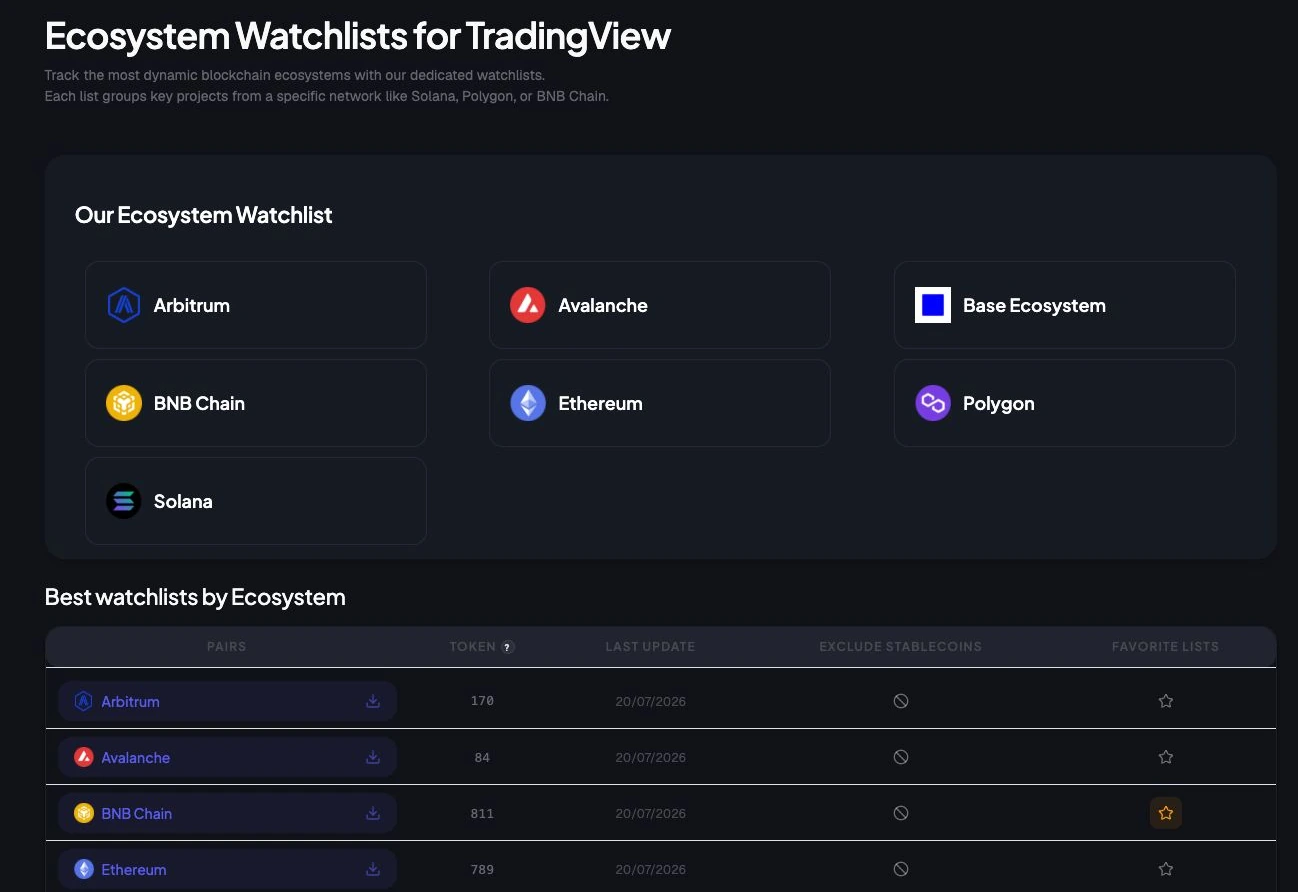
The following TradingList interface example illustrates a structured watchlist workflow; it does not provide a trading signal or recommendation.
Why Base watchlists break so easily
Base creates a specific operational problem for advanced TradingView users. Since there isn't one native chain token to anchor the ecosystem, the symbol universe has to be assembled manually from many project tokens. That process breaks in familiar ways:
- Ticker inconsistency: The same asset may appear with different exchange prefixes depending on venue.
- Coverage drift: New listings appear, others disappear, and old lists stop matching the market.
- Category overlap: One token might belong to Base, AI, and infrastructure at the same time.
- Import friction: Even a good list becomes useless if the file format doesn't match TradingView's rules.
TradingView is strict about imports. According to TradingView's watchlist import documentation, the import file must be in .txt format and symbols must be prefixed by their exchange and separated by commas.
That requirement matters because many traders maintain symbols in spreadsheets, research notes, or exchange exports that aren't directly compatible. The logic of the list may be right while the formatting is still wrong.
A cleaner import workflow for advanced users
For Base ecosystem tracking, the cleanest workflow starts with structure rather than symbol collection. The list should first answer what kind of universe it is.
A professional setup usually separates at least three list types:
| Watchlist type | What belongs in it | Why it helps |
|---|---|---|
| Ecosystem list | Tokens identified as part of the Base ecosystem | Keeps network-level monitoring focused |
| Exchange list | Only symbols available on a chosen venue | Reduces dead charts and unavailable pairs |
| Category overlay | Base tokens filtered by a supported theme such as AI | Makes internal rotation easier to spot |
The practical advantage of a purpose-built list service is that it reduces the manual cleanup between those categories. TradingList is relevant here as a workflow tool because its Base Ecosystem watchlist provides an import-ready starting point, alongside crypto watchlists organized by exchange, market cap, category, and ecosystem, with symbol sets maintained through a daily refresh cycle.
Its product surfaces fit different stages of Base research without turning the process into a signal product:
- Standard watchlists: Useful when a trader wants a clean ecosystem or exchange-specific starting universe.
- Custom crypto watchlists: Better for desks that want a narrower Base list shaped around a chosen exchange and trading pair.
- ScreenerList: Relevant when the goal is to define a cleaner symbol universe before screening. A related workflow appears in this guide to the crypto screener process.
- DeltaList: Helpful for comparing one symbol universe against another, such as Base versus a separate ecosystem set.
- FusionList: Useful when combining selected watchlists into one exportable configuration.
Workflow rule: The less time spent cleaning symbols, the more time remains for comparing structures, charting relative strength, and validating research.
There are also two practical limits advanced users should remember even before import:
- Plan access matters: TradingView's current paid plans are Essential, Plus, Premium, and Ultimate. Check your plan's current eligibility before importing a list, using TradingView's pricing page.
- Import format matters: The final TradingView import file must be a .txt file with exchange-prefixed symbols separated by commas, according to TradingView's import documentation.
That combination explains why Base watchlist management often feels more annoying than expected. The ecosystem itself is nuanced, and the charting platform expects clean inputs. If the symbol universe isn't organized by ecosystem, exchange, and category before import, the result is usually a cluttered workspace with broken entries and inconsistent coverage.
Integrating Base into Your Research Workflow
Base forces a more disciplined research model because the ecosystem doesn't collapse into one native ticker. The chain uses ETH for gas. The tradable opportunity set sits in the ERC-20 layer above it. Anyone tracking Base seriously needs a process that reflects that separation.
The strategic takeaway for traders and researchers
Discussion of a hypothetical future Base token remains speculative and should not be treated as a current market thesis.
That matters conceptually, but it shouldn't distract from the current market structure. Traders don't need to wait for a hypothetical future protocol asset to study Base. The ecosystem already exists as a diverse set of on-chain tokens, each with different roles, venues, and liquidity profiles.
Why workflow discipline matters more on Base
Base is the kind of ecosystem where sloppy monitoring creates false conclusions. If a watchlist mixes exchange-specific tickers incorrectly, category comparisons become unreliable. If a researcher tracks only the loudest meme names, the infrastructure layer disappears. If the list isn't maintained, the analysis gets stale before the thesis does.
A stronger workflow usually has three habits:
- Separate architecture from assets: The chain design explains usage. The token list explains what can be monitored and traded.
- Use segmented universes: Ecosystem, category, and exchange views should sit alongside each other rather than inside one giant list.
- Maintain import-ready formatting: A list that can't be imported cleanly into TradingView isn't operationally useful.
For users who want a more organized TradingView process around ecosystem and screener workflows, a practical reference is this guide to the TradingView screener watchlist setup.
The broader point is simple. Base rewards traders and researchers who treat symbol organization as part of the research stack, not as clerical cleanup after the fact. In a no-token architecture, the map matters more because there is no single default asset to follow.
TradingList helps traders, researchers, educators, and advanced TradingView users build cleaner crypto workflows with ready-to-import watchlists organized by exchange, market cap, category, and ecosystem. Its standard watchlists, custom crypto watchlists, ScreenerList, DeltaList, and FusionList are built to help users filter, compare, combine, and export structured symbol universes for TradingView without presenting signals or predictions. For teams that want less manual ticker cleanup and a more reliable daily watchlist process, TradingList is worth a closer look.