
Why track Avalanche ecosystem coins if the ecosystem itself doesn't behave like a single token list?
That's the gap most guides miss. Avalanche has a multi-chain design, subnet fragmentation, exchange-specific listings, and a gas model that still centers AVAX even when the traded asset isn't AVAX. For traders using TradingView, the hard part usually isn't finding a coin name. It's turning messy ecosystem labels into a clean, venue-specific symbol universe that can be imported and monitored.
This guide focuses on that workflow. It reviews seven practical sources for Avalanche ecosystem coins, from ecosystem aggregators to chain-native validation tools, then maps each one to a TradingView-compatible process. Avalanche's architecture includes the X-Chain, C-Chain, and P-Chain, and supports customized subnets, a structure associated with rapid finality, often under one second, and low fees according to CryptoRank's Avalanche ecosystem overview. That design creates opportunity, but it also creates watchlist noise if symbols aren't normalized by exchange and chain context.
Table of Contents
- 1. TradingList
- 2. CoinGecko
- 3. CoinMarketCap
- 4. Avascan
- 5. Dexscreener
- 6. Pangolin DEX
- 7. Coinranking
- Avalanche Ecosystem Coins, 7-Source Comparison
- Next Steps for Your Avalanche Watchlist
1. TradingList
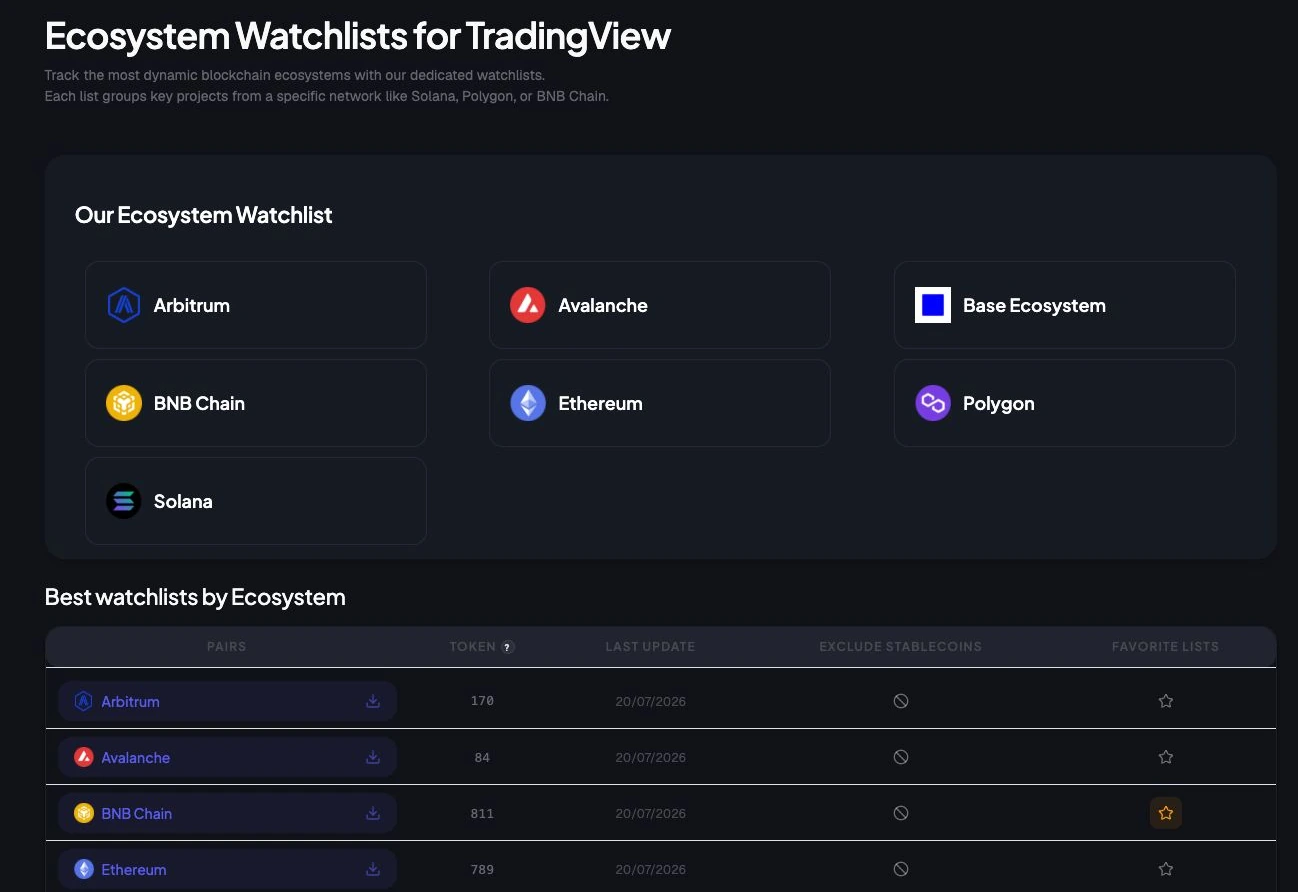
TradingList is the strongest starting point when the goal isn't just research, but building a usable TradingView watchlist from Avalanche ecosystem coins. Its role is narrow and practical. It organizes TradingView-compatible crypto symbols by centralized exchange, market cap, supported category, and ecosystem, then exports them in a format that fits charting and list-based review without manual ticker cleanup.
That matters because Avalanche ecosystem labels often blur together assets that are native to Avalanche, assets bridged onto Avalanche, and assets associated with Avalanche subnets but not broadly listed on centralized venues. TradingList works best after that market ambiguity has already been reduced to exchange-tradable symbols.
Why it fits the Avalanche workflow
The workflow advantage is formatting. TradingView uses venue-specific syntax such as BINANCE:AVAXUSDT or BYBIT:AVAXUSDT, not just a generic coin ticker. Availability depends on the exchanges and pairs covered at the time of review, which makes exchange normalization more important than ecosystem labeling alone. TradingList is built around that exact friction point.
A practical setup often looks like this:
- Start with an ecosystem list: Pull an Avalanche-focused symbol universe rather than rebuilding it by hand.
- Narrow by venue: Keep only the exchange prefixes relevant to the trading desk or teaching environment.
- Combine contexts: Merge an Avalanche ecosystem list with market-cap or exchange lists when monitoring majors alongside ecosystem names.
- Export clean symbols: Import the resulting file into TradingView without reformatting pair names.
Practical rule: A generic ticker like
AVAXisn't a TradingView watchlist symbol.BINANCE:AVAXUSDTis.
The service also includes relevant workflow tools. TradingView watchlist workflows with ScreenerList help when a trader wants to start from market filters instead of a prebuilt list. DeltaList is useful when an analyst wants to compare a reference Avalanche list against exchange variants. FusionList helps merge several lists into one exportable file without duplicate clutter.
Where it helps and where it stops
TradingList isn't an exchange, broker, advisor, or signal product. It doesn't provide price predictions or portfolio advice. Its scope is symbol organization for TradingView-compatible workflows.
Commercial plans can change, so current availability and pricing should be checked on the TradingList pricing page. The update model is a daily refresh cycle, not a real-time feed.
Avalanche watchlists fail most often at the symbol layer, not the thesis layer. A strong coin list still breaks if exchange prefixes and pair formatting aren't cleaned before import.
The main limitation is also its design choice. Traders still need outside sources for contract validation, subnet context, and on-chain discovery before deciding what belongs in the list.
2. CoinGecko

CoinGecko's Avalanche Ecosystem category is one of the fastest ways to survey Avalanche ecosystem coins at category level. It's useful for broad coverage, especially when an analyst needs coin pages, tags, markets, and contract references in one place before deciding whether a token belongs in a TradingView watchlist.
Its strength is breadth, not final formatting. CoinGecko helps answer, “Which assets are currently grouped with Avalanche?” It doesn't fully answer, “Which of these belong in a centralized-exchange watchlist for TradingView?”
Best use inside an Avalanche research stack
CoinGecko is most helpful early in the workflow, before symbols are normalized. Avalanche ecosystem categories can contain a large and changing set of assets. That scale explains why a broad category page is useful. There are too many associated assets to track manually from memory.
CoinGecko also helps surface a recurring problem. Category membership can include bridged assets or tokens that are multi-chain rather than Avalanche-specific. That's where many “top Avalanche ecosystem coins” lists get sloppy.
- Use it for category discovery: Good for spotting names attached to Avalanche that may deserve deeper review.
- Use it for contract cross-checking: Helpful before moving to a chain-native explorer.
- Don't treat category inclusion as listing proof: A token can appear in the category without being convenient to monitor on a preferred centralized venue.
Avalanche ecosystem labels are not the same thing as tradable TradingView symbols. Aggregators show membership. Traders still need venue confirmation.
For watchlist work, CoinGecko is a feeder source. It generates candidates. It shouldn't be the last validation step.
3. CoinMarketCap

CoinMarketCap's Avalanche Ecosystem view is better than many category pages when pair-level verification matters. It gives a sortable ecosystem view, then pushes quickly into markets and exchange pairs for each asset. That makes it useful for checking whether an Avalanche-associated token has centralized-exchange coverage worth bringing into TradingView.
In this way, many traders can save time. CoinMarketCap won't clean the symbol for import, but it often makes it easier to see whether the symbol exists in the right market context.
Where pair-level validation matters
Avalanche's native token AVAX has a hard-capped maximum supply of 720 million tokens and is used for transaction fees, staking, and as the basic unit of account across Avalanche Layer 1 chains, according to the AVAX token page from Avalanche. That centrality creates a second-order effect. Some tokens associated with the ecosystem are economically dependent on AVAX even if they aren't priced or discussed that way in guides.
That's why pair verification matters. A token may belong to the ecosystem, but its liquid centralized-exchange pair might still be limited or absent.
A practical workflow looks like this:
- Check ecosystem inclusion first: Use the category page to identify candidates.
- Open the asset's market list: Confirm whether the token has centralized-exchange pairs relevant to the intended watchlist.
- Normalize into TradingView syntax: Convert a market like AVAX/USDT into a venue-specific symbol such as
BINANCE:AVAXUSDT. - Filter with a watchlist builder: A crypto screener workflow helps when the goal is to reduce the list to exchange-supported, chart-ready symbols.
The main caution is lag. Category composition can fall behind fast listing changes, and some assets may have several chain implementations attached to the same ticker identity. For watchlist building, CoinMarketCap is strongest as a verification layer, not a single source of truth.
4. Avascan
Avascan is the most useful source in this list when the question is authenticity, not ranking. For Avalanche ecosystem coins, that's a major distinction. A token can be discussed on aggregators, appear on social feeds, and still need on-chain confirmation before it deserves a place in a research watchlist.
Avascan gives that chain-native check. It focuses on Avalanche itself, including token pages and lists across C-Chain and X-Chain assets. That makes it the best tool here for proving a token exists where the trader thinks it exists.
Best for provenance checks
Avalanche supports customizable Layer 1 networks with independent settings, a structure that can make the boundary of an “Avalanche coin” less obvious.
Avascan helps answer three questions that market aggregators often leave blurry:
- Is the token native to Avalanche infrastructure?
- Which chain context is relevant, C-Chain or another Avalanche environment?
- Does the contract and transfer history support the token's claimed identity?
Validation cue: If the token contract, holders, or transfer history don't line up on Avascan, the problem isn't the watchlist. The problem is the asset selection.
This matters even more because many guides flatten Avalanche into a single-chain story. Avascan makes the chain distinction visible. After validating the asset, the next step is symbol translation. A chain contract address is not the same thing as a TradingView symbol, and a guide to crypto symbol formatting in TradingView is often the missing bridge between explorer data and a usable watchlist.
Avascan's limitation is obvious. It's not designed as a market-ranking product, and it doesn't offer a one-click path to a clean TradingView import. It's a provenance tool. That's exactly why it belongs in the stack.
5. Dexscreener
Dexscreener's Avalanche page is where early discovery happens. It's the most useful source in this list for spotting Avalanche tokens before they become stable fixtures on broader market aggregators or centralized-exchange watchlists.
That early visibility comes with trade-offs. Dexscreener is excellent for pair discovery and pool activity. It's weak as a final input for TradingView-compatible imports because DEX pair identifiers don't map cleanly to centralized-exchange symbols.
Useful for discovery, weak for direct import
Avalanche-related token and pair availability can change quickly. For watchlist builders, discovery should be followed by venue confirmation.
For watchlist builders, the practical takeaway isn't the price range itself. It's that Avalanche is active enough to generate new token and pair turnover quickly. Dexscreener helps surface that turnover before a centralized-exchange listing confirms broader accessibility.
- Best for new pair discovery: Useful when a token is trading on Avalanche DEX venues before it appears elsewhere.
- Best for liquidity sanity checks: Pair activity can show whether a token has meaningful trading depth.
- Not sufficient for watchlist import: DEX contracts and pools still need centralized-exchange mapping if the end goal is a TradingView watchlist of standard exchange symbols.
A second caution matters even more for retail traders. Gas requirements depend on the relevant Avalanche network: AVAX is used for Primary Network fees, while a dedicated Avalanche Layer 1 can use its own gas token. A token may appear active on Dexscreener, yet wallet execution can still fail if the relevant network fee requirements are not met. That distinction is one reason discovery and usability should never be treated as the same step.
6. Pangolin DEX

Pangolin's token listing documentation is less useful for ranking coins than for filtering junk. That's a different job, and an important one. Traders researching Avalanche ecosystem coins often don't need another popularity page. They need a maintained reference point tied to an actual Avalanche trading venue.
Pangolin provides that curation signal. It isn't broad enough to define the whole ecosystem, but it is useful for separating commonly recognized assets from low-quality noise.
A curation layer, not a final watchlist
The network's multi-chain design has practical implications. Assets can operate in separate chain contexts and may not appear in a standard ecosystem watchlist unless they map to exchange-listed pairs relevant to the intended workflow.
Pangolin can help reduce false positives because a DEX-maintained token list reflects assets that have at least passed through a listing and verification process relevant to that venue.
- Good for legitimacy checks: A listed token has usually cleared a more practical hurdle than simple aggregator inclusion.
- Good for contract capture: JSON-style token lists can provide canonical metadata for further validation.
- Weak for direct TradingView use: Token list standards aren't exchange-prefixed TradingView symbols.
Pangolin also shouldn't be mistaken for a complete market map. A token missing from Pangolin isn't automatically irrelevant. It may trade elsewhere, live in a subnet-specific context, or be more visible on centralized venues than on Pangolin itself.
7. Coinranking

Coinranking's Avalanche ecosystem page is the leanest source in this list. That's its advantage. When CoinGecko and CoinMarketCap produce noisy or overinclusive candidate sets, Coinranking can serve as a tie-breaker. It gives a narrower, fast-scanning view of Avalanche ecosystem coins without pulling the user into as much surrounding data.
That makes it useful late in the process, not early. It won't replace deeper validation, but it can help confirm whether a token is broadly recognized enough to stay in a working list.
Best as a tie-breaker source
Avalanche ecosystem labels can expand and change over time, which makes a repeatable validation process more useful than treating a category page as a final watchlist.
Coinranking is useful precisely because it doesn't try to be the only answer.
When data aggregators disagree on whether a token belongs in an Avalanche list, the safest move is usually to downgrade it from “core watchlist” to “candidate for validation.”
AVAX can be a useful reference asset when reviewing the ecosystem, but each candidate still needs its own identity and venue checks.
Coinranking's limitation is metadata depth. It's lighter than the larger aggregators, and it still doesn't export TradingView-ready symbols directly. Its best role is final sanity checking.
Avalanche Ecosystem Coins, 7-Source Comparison
| Item | Implementation complexity | Resource requirements | Expected outcomes | Ideal use cases | Key advantages |
|---|---|---|---|---|---|
| TradingList | Very low, ready-to-import TradingView lists, minimal setup | Web access; optional subscription for advanced features | Exchange-specific, import-ready watchlists refreshed daily | Rapidly build TradingView universes, venue monitoring, reproducible scans | Pre-formatted symbols, multi-dimension lists, advanced merge/compare tools |
| CoinGecko, Avalanche Ecosystem | Low to medium, browse or use CSV/API then map symbols | Web account for CSVs; API available with rate limits | Comprehensive token list with contract addresses and metadata | Contract/address lookup, assembling seed lists, metadata sourcing | Broad coverage, rich coin pages, frequent updates |
| CoinMarketCap, Avalanche Ecosystem | Low to medium, browse or export, manual mapping needed | Account for CSV export; Pro API for higher usage | Market-centric listing with pair coverage and supply metrics | Pair-level verification, mapping exchange symbols, liquidity checks | Extensive exchange/pair coverage and supplementary metrics (FDV, supply) |
| Avascan, Explorer & token lists | Medium, on-chain explorer workflows or API integration | API access or manual lookups; on-chain expertise helpful | Authoritative contract data, creation dates, holders and transfers | On-chain validation, de-duping fakes, provenance audits | Chain-native, definitive token provenance and on-chain detail |
| Dexscreener, Avalanche chain page | Low, web-based discovery, no formal export to TradingView | Web access; manual mapping to TradingView tickers | Real-time DEX pair discovery with liquidity and volume signals | Discovering new tokens, checking tradable depth and liquidity | Live multi-DEX coverage, early signals for new listings, free/no login |
| Pangolin DEX, token list | Medium, JSON/token-list usage and conversion required | Access to token-list JSON; developer familiarity useful | Curated list of Pangolin-traded tokens with canonical contracts | Quality-filtering tokens for Pangolin trading, canonical address sourcing | Curated/verified token list, community-driven verification, standard format |
| Coinranking, Avalanche ecosystem | Low, lightweight browsing and manual preparation | Web access; smaller dataset than major aggregators | Compact ranked list for quick corroboration of coverage | Fast validation when aggregators disagree, quick scans | Lightweight UI, fast ranking view for tie-breaking validation |
Next Steps for Your Avalanche Watchlist
What turns a long Avalanche token list into a watchlist you can use in TradingView? Usually, it is not broader coverage. It is stricter filtering, cleaner symbol mapping, and a repeatable review process by source type.
The practical goal is simple: separate discovery from validation, then separate validation from watchlist formatting. Aggregators are useful for finding candidates and checking market context. Chain data is better for confirming identity. Venue data helps answer a different question. Can the token be monitored through real pairs with enough trading activity to matter for your workflow?
A workable process looks like this:
- Build a candidate pool: Start with CoinGecko, CoinMarketCap, Dexscreener, or Coinranking to collect Avalanche-tagged assets.
- Verify token identity: Check contracts, chain placement, and token provenance with Avascan, then compare against Pangolin listings where DEX relevance matters.
- Test market usability: Confirm whether the asset maps to exchange pairs that TradingView supports, and note where symbol normalization or manual exclusions are required.
- Format for monitoring: Convert the approved list into a TradingView-compatible structure, grouped by your actual use case such as majors, DEX-discovered names, research-only assets, or higher-risk microcaps.
That last step is where many Avalanche lists break. Ecosystem membership does not guarantee usable market data, and a token with clear Avalanche ties can still fail watchlist inclusion if exchange coverage is thin, pair naming is inconsistent, or liquidity is too shallow for alert-based monitoring.
A better watchlist is often smaller. Analysts get cleaner comparisons across venues. Educators get reproducible ticker sets. Traders get fewer broken alerts and less manual editing of EXCHANGE:PAIR entries. Category tags also help. A "DEX discovery" bucket should be reviewed differently from a "CEX-supported large cap" bucket, because the risk profile, update frequency, and symbol stability are not the same.
For Avalanche ecosystem coins, TradingList is most useful at the final assembly stage: turning validated token sets into import-ready watchlists aligned with TradingView formatting, exchange coverage, and category-based monitoring needs. That makes it easier to maintain separate lists for liquid core assets, newly discovered DEX names, and contract-verified tokens that still need venue confirmation.