
A miner is a person, machine, or system that extracts or produces value through specialized work. In a proof-of-work blockchain, miners assemble candidate blocks and search for a qualifying hash; when the network accepts a valid block, the successful miner can receive newly issued coins and transaction fees. In modern English, the word can also describe specialized military, biological, mechanical, and data-related roles.
But what does miner mean when a crypto trader sees the term in a market report, blockchain dashboard, or company filing? The answer depends on context. A miner might operate underground, search for patterns in data, build tunnels for military purposes, or run computing equipment that competes to add blocks to a proof-of-work blockchain.
That distinction matters because the crypto meaning describes an active network participant, not someone who merely owns coins. It also points to a broader change in the industry. Mining began as a description of individual physical labor, while modern cryptocurrency mining increasingly involves specialized hardware, power contracts, facilities, and infrastructure capital.
Table of Contents
- The Core Meaning of Miner Across Contexts
- How the Word Miner Evolved Over Seven Centuries
- How Blockchain Miners Validate Transactions
- Mining Economics and the Shift to Industrial Scale
- Mining Versus Staking and Other Validation Methods
- Why Miners Matter to Crypto Traders and Analysts
- Building Miner-Related Watchlists for TradingView
The Core Meaning of Miner Across Contexts
At its broadest, a miner is one who mines. Mining means extracting something valuable from a difficult environment. The extracted value might be coal or metal from rock, a strategic advantage from a tunnel, a pattern from a dataset, or cryptocurrency created through computational work.
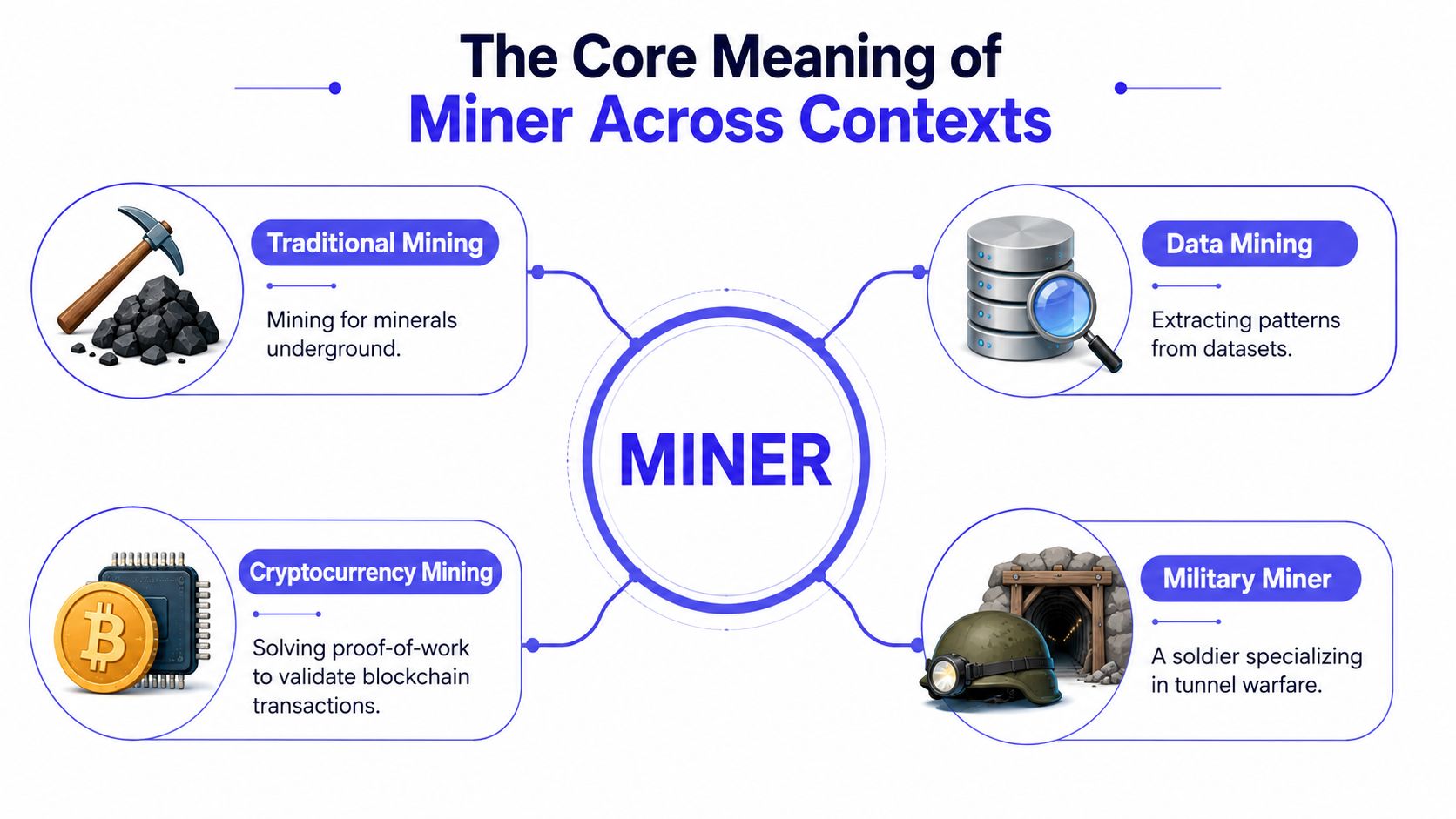
The surrounding subject usually identifies the intended meaning:
- Traditional mining: A miner works in a mine, commonly extracting coal or metallic ores. This remains the central everyday dictionary meaning. Dictionary.com's definition of miner also records broader occupational and technical uses.
- Military engineering: A miner may be a person who places military mines or specializes in tunnel warfare. The meaning developed from the use of mines in siege operations.
- Biological and reference usage: “Miner” can appear in names for organisms that consume or tunnel within plant material, as well as in other specialized terminology recorded by dictionaries. Merriam-Webster's entry for miner demonstrates why the noun can't be interpreted without its domain.
- Cryptocurrency: A miner is a person, computer, node, company, or software system that performs proof-of-work computations, helps create blocks, and supports transaction validation. PCMag's crypto-miner definition distinguishes this active role from passive coin ownership.
The shared idea is effort exchanged for extracted value. A physical miner spends labor and equipment to recover material. A crypto miner spends computing power and electricity to compete for block rewards and transaction fees.
For traders, the crypto sense is the important one because miner activity can affect network security, coin issuance, and the financial condition of mining companies. The term also appears in compound phrases such as “Bitcoin miner,” “mining pool,” “miner revenue,” and “miner capitulation.” Each phrase refers to participants in the proof-of-work production process rather than to a general investor category.
How the Word Miner Evolved Over Seven Centuries
What connects a medieval tunnel worker, an industrial mining machine, and a Bitcoin mining rig? Each applies specialized effort to reach value that is hidden, difficult to obtain, or protected by a barrier.
The occupational meaning of miner appears in English by about 1300, describing someone who dug for metals or minerals or excavated military mines. A related Middle English form for a mine worker appears between 1225 and 1275. The word passed through Old French forms such as mineour and minour, reflecting both material extraction and siege warfare, as recorded in Etymonline's entry for miner.
| Period | Evolution of the term |
|---|---|
| Around 1300 | English usage describes people digging for minerals or excavating military mines. |
| 14th century | The related verb expands to digging, undermining, and extracting material. |
| Industrial era | Machinery and organized infrastructure scale physical mining operations. |
| Late 20th century | Data mining extends the extraction metaphor to pattern discovery. |
| 2009 onward | Bitcoin applies the term to proof-of-work block production. |
Medieval miners could recover resources from the ground. In military settings, they dug beneath fortifications to weaken walls or create access. The same noun therefore developed an occupational meaning and a military meaning, both tied to working below the surface.
English gained a related meaning of to mine by the mid-14th century, followed by “to extract by mining” in the late 14th century. The concept remained stable: a person uses tools, time, and skill to reach something valuable that is not readily available.
Language clue: The crypto meaning isn't a disconnected metaphor. It preserves the older idea of extracting value through specialized work.
Industrialization shifted mining from individual labor toward machinery, organized operations, and large-scale infrastructure. Later, the noun expanded again. A machine could mine automatically, a soldier could place explosive mines, and a digital system could “mine” information or cryptocurrency.
Blockchain usage extends this history rather than replacing it. A Bitcoin miner does not remove metal from rock. Instead, mining equipment consumes scarce electricity and computing capacity while searching a large space of possible results. For traders, that shift from physical labor to capital-intensive infrastructure helps explain why miner-related assets often reflect equipment costs, energy access, competition, and operating scale.
How Blockchain Miners Validate Transactions
Proof-of-work mining works like a competitive puzzle race, but the puzzle has a precise technical purpose. Miners gather pending transactions, construct candidate blocks, and search for a valid block hash below the network's target. Glassnode's proof-of-work mining guide explains how computational power, block production, difficulty, and miner rewards interact.
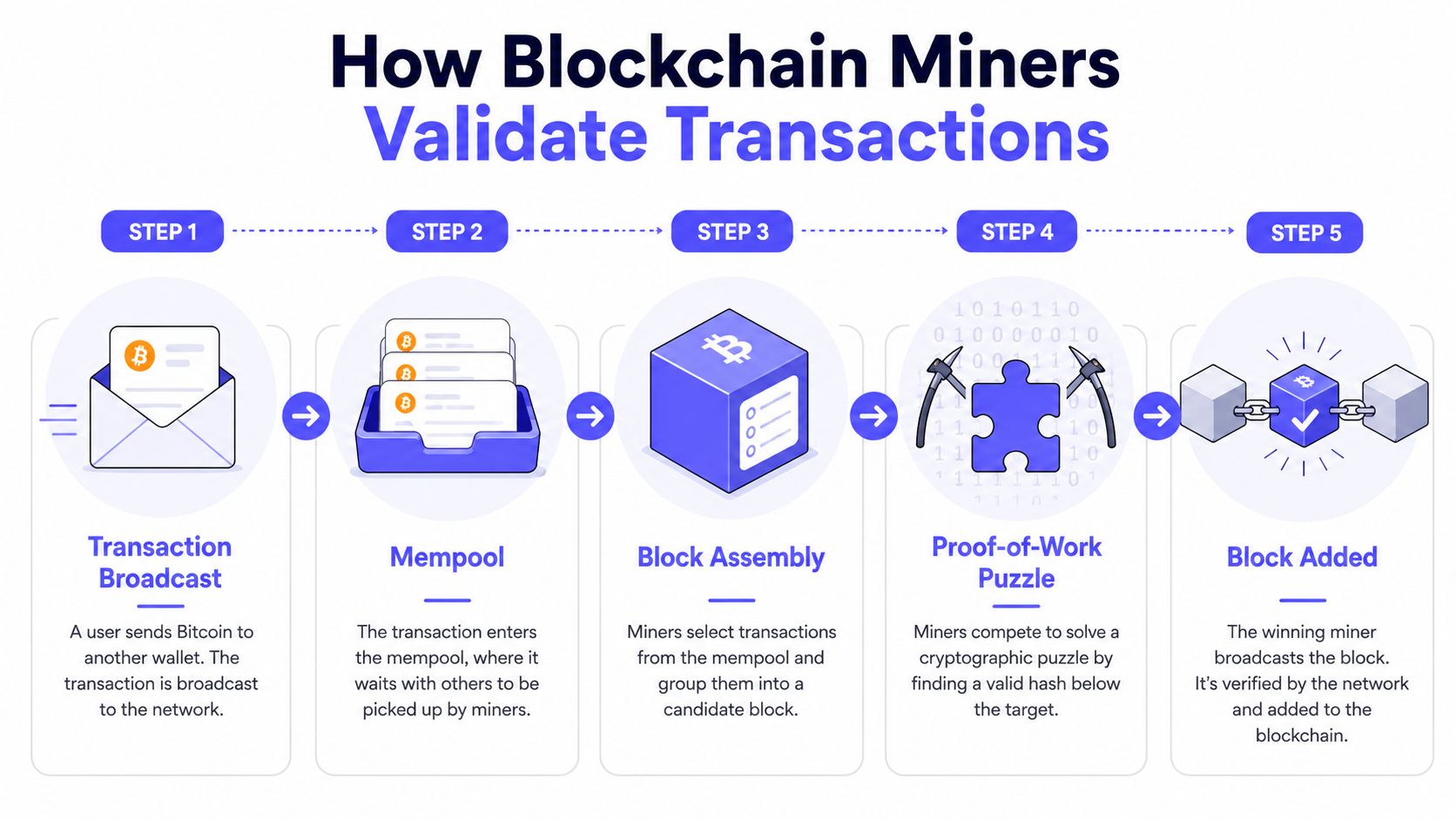
The proof-of-work sequence
Transactions are broadcast. A user signs and sends a transaction to the network. Nodes check basic rules before treating it as eligible for inclusion.
Pending transactions wait for selection. Miners examine available transactions and choose which ones to place in a candidate block. Fee considerations can influence that selection, although a miner still has to produce a block that satisfies the protocol.
A candidate block is assembled. The block contains transaction data, a reference to the previous block, and information miners can vary while searching for a valid result.
Computers search for a qualifying hash. Miners repeatedly change a value and calculate hashes. The winning condition is a hash below the network target, not a pattern chosen by the miner.
The network accepts or rejects the result. When a miner finds a qualifying block, other participants verify the proof and the transactions. If the block follows the rules, nodes can add it to their copies of the chain.
The computational race makes rewriting transaction history difficult because an attacker would need to reproduce the required work and compete with the honest network. Mining therefore performs two jobs at once: it helps process transactions and contributes to blockchain security.
Difficulty keeps the process from accelerating without limit. Bitcoin recalibrates mining difficulty every 2,016 blocks, roughly every two weeks, so the average block interval stays near 10 minutes. The Bitcoin Developer Guide documents this adjustment schedule and the relationship between block production and difficulty.
A trader interested in transaction denominations may also benefit from understanding what sats do in Bitcoin transactions, since miners process transactions that use the network's smallest commonly discussed unit.
Mining Economics and the Shift to Industrial Scale
Why does the word miner now describe an infrastructure operator as often as an individual worker? In 2026, Bitcoin mining increasingly resembles an industrial power and computing business. As of August 3, 2026, Hashrate Index reported a seven-day network hashrate average of about 932 EH/s and USD hashprice of $32.10 per PH/s/day, equivalent to about $0.0321 per TH/s/day. These dated figures illustrate the pressure created by greater competition: more machines share the opportunity to earn revenue, while electricity and equipment still require payment.
Hashrate measures the computing power competing across the network. Hashprice measures the revenue available to each unit of that power. If hashrate rises while hashprice falls, an operator must produce more computing work for less revenue. Profitability then depends on efficiency, electricity contracts, equipment performance, financing, maintenance, and access to capital.
Why difficulty changes the operating model
Bitcoin targets a schedule based on 2,016 blocks multiplied by 10 minutes, or about 14 days. The protocol compares the expected duration with the time required for the previous period, as described in the Bitcoin Developer Guide.
This mechanism keeps block production broadly consistent as computing power enters or leaves the network. More machines cannot make Bitcoin issue blocks indefinitely faster. Higher participation eventually leads to higher difficulty, which can push less efficient operators out of the market.
Mining revenue combines the block reward with transaction fees when the network accepts a valid block. The process also releases newly issued coins into circulation, as explained by Fidelity's overview of crypto mining. A miner's financial result therefore reflects coin revenue and fees after power, hardware, financing, maintenance, cooling, and facility costs.
From hobby equipment to infrastructure
The older image of one person running a graphics card no longer describes Bitcoin mining at scale. Large operators coordinate specialized machines, cooling systems, power procurement, facility construction, and treasury decisions. Some mining companies are also pursuing AI compute, while their existing sites may provide access to power and data-center capacity. Hashrate Index's AI and high-performance computing coverage tracks this diversification as a separate infrastructure trend.
For traders, this changes how a mining company should be assessed. Bitcoin price and network difficulty still matter, but so do power availability, hardware utilization, financing conditions, and demand for computing capacity. The term's evolution mirrors the industry's shift from individual labor toward capital-intensive infrastructure.
Market interpretation: “Miner” increasingly describes an operator of productive infrastructure, not simply an individual running a computer at home.
Mining Versus Staking and Other Validation Methods
Mining and staking both support blockchain consensus, but they use different scarce resources. Proof-of-work mining commits computing power and electricity to a competitive search. Proof-of-stake validation commits capital in the form of staked assets, with validators selected under the network's rules to propose or attest to blocks.
The distinction matters because traders sometimes use “miner,” “validator,” and “delegator” interchangeably. They aren't interchangeable roles. A miner performs proof-of-work computations. A validator participates in a proof-of-stake system. A delegator assigns stake or voting power to a validator without necessarily operating the validating infrastructure.
| Dimension | Proof-of-Work Mining | Proof-of-Stake Validation |
|---|---|---|
| Primary resource | Computing power and electricity | Staked network assets |
| Hardware | Specialized mining equipment and supporting infrastructure | Validator server infrastructure, depending on the protocol |
| Selection method | Competitive search for a valid proof | Protocol-based selection among eligible stakers or validators |
| Reward structure | Newly issued coins and transaction fees when a block is accepted | Protocol rewards and fees under the network's staking rules |
| Main penalty model | Operating losses, equipment depreciation, and power costs | Depending on the protocol, missed rewards, penalties, or loss of stake under slashing rules |
| Entry profile | Requires access to suitable hardware, power, and operations | Requires eligible stake, technical operation, or delegation access |
| Security assumption | Rewriting history requires substantial computational work | Misbehavior can put committed stake at risk |
Proof-of-work can provide an open computational competition, but access to efficient hardware and inexpensive electricity shapes who can compete economically. Proof-of-stake removes the need for that mining race, yet it introduces different questions about stake concentration, validator performance, delegation, and penalties.
The word mineable usually signals that new units enter circulation through a proof-of-work process. The word stakeable points toward a system where participants commit assets to help secure the network. Those labels don't by themselves determine whether an asset is attractive. They identify the network's validation and issuance model, which traders can then analyze alongside liquidity, governance, market structure, and risk.
Why Miners Matter to Crypto Traders and Analysts
Miners matter because they sit at the intersection of network security, coin issuance, transaction processing, and operating economics. A trader doesn't need to operate mining hardware to understand that changes in miner conditions can influence market narratives and the behavior of listed mining companies.
Several signals deserve separate treatment:
- Hashprice: Falling hashprice can indicate tighter revenue conditions for mining capacity. It becomes more meaningful when examined with hashrate, difficulty, energy costs, and the coin's market price.
- Miner reserves: Changes in the amount of coins held by miners can provide context for potential selling pressure, treasury management, or working-capital needs. A reserve movement isn't automatically bearish or bullish.
- Capitulation: Forced shutdowns, machine sales, or distressed financing can signal that inefficient operators are leaving the market. The interpretation depends on whether the event is temporary or structural.
- Issuance events: Changes in block rewards can alter revenue expectations, making production costs and balance-sheet strength more important for mining companies.
- AI and high-performance computing exposure: Diversification can connect public miners with technology and data-center narratives, creating correlations that don't come solely from cryptocurrency price action.
A researcher should separate network-level data from company-level data. Network hashrate and difficulty describe the competitive environment. A public miner's debt, power contracts, machine fleet, treasury policy, and non-mining business describe that company's operating exposure.
For chart-based research, the crypto screener workflow can help organize a symbol universe before comparing miner-related assets, mineable cryptocurrencies, or adjacent infrastructure names. A clean list doesn't generate signals or forecasts. It makes it easier to apply the same chart layouts, indicators, and review process across a defined group.
A useful analytical question is not “Are miners bullish?” It's “Which part of the mining system changed, and which assets are directly exposed to that change?” That framing reduces the risk of treating every miner headline as the same event.
Building Miner-Related Watchlists for TradingView
A TradingView workflow starts with symbol identity. A generic ticker such as BTC identifies an asset concept, while a TradingView-compatible symbol such as EXCHANGE:PAIR identifies a venue-specific market. Exchange prefixes and pair formatting must remain consistent, or the imported list may point to an unintended market or fail to match the intended chart.
A practical miner-related universe can contain separate groups rather than one oversized list. Public mining companies and crypto assets should remain distinct because they use different symbol universes:
- Public mining companies: Maintain these separately in TradingView using supported equity symbols. TradingList's documented product scope does not supply equity watchlists.
- Mineable cryptocurrencies: Group proof-of-work assets by supported crypto exchange or market-cap filter.
- Mining-adjacent crypto assets: Keep related crypto categories separate from direct mining exposure so the comparison remains clear.
For the supported crypto groups, TradingList's Standard watchlists organize symbols by centralized exchange, market capitalization, category, or ecosystem. Custom crypto watchlists narrow those universes through supported market-cap, category, or ecosystem filters. ScreenerList builds a symbol list from market filters, while FusionList combines several watchlists into one exportable configuration.
This TradingView screener watchlist workflow is useful when a trader needs to move from a filtered symbol universe to a consistently formatted charting list. DeltaList can compare a reference watchlist with exchange or market variants, which helps identify differences between venue-specific and broader research sets.
TradingList uses a daily refresh cycle for supported updates when source data is available. Users should still review ticker changes, exchange availability, and symbol mapping before relying on a list for alerts or recurring analysis.
TradingList provides maintained, TradingView-compatible watchlists organized by centralized exchange, market cap, supported category, and ecosystem, plus tools for filtering, comparing, combining, and exporting symbol universes. Traders, researchers, and educators can visit TradingList to build a cleaner miner-related watchlist workflow without treating the service as an exchange, broker, signal provider, or financial adviser.