
The evidence should make any discussion of trading for a living cautious from the start. A study of individuals who day traded Brazilian equity futures found that 97% of those who persisted for more than 300 days lost money, while only 1.1% earned more than the Brazilian minimum wage and 0.5% earned more than the starting salary of a bank teller (SSRN study summary).
That study did not examine crypto markets, and its findings should not be treated as a crypto success-rate forecast. It does, however, illustrate why a decision to depend on speculative trading income needs stronger evidence than a profitable month or an attractive backtest.
This guide is educational and general. It does not provide individualized financial, tax, or legal advice, and it does not suggest that trading can reliably replace employment income.
Table of Contents
- What Trading Research Can and Cannot Tell You
- Before Considering Full-Time Crypto Trading
- Building and Testing a Trading Process
- A Risk-First Feasibility Framework
- A Daily TradingView Workflow
- Records, Taxes, and Professional Advice
- A Staged Decision, Not a Fixed Timeline
What Trading Research Can and Cannot Tell You
Research on retail day trading is useful when it is read with its market, period, and sample intact. It is much less useful when a percentage from one venue is turned into a universal claim about every trader or asset class.
The evidence comes from specific markets
The Brazilian study followed people who began day trading equity futures between 2013 and 2015. Its results are evidence about that population and that market structure. They do not establish the probability of success for spot crypto, perpetual futures, swing trading, or any other crypto strategy.
A separate long-running study of day traders on the Taiwan Stock Exchange found that only a small group of previously profitable and highly experienced traders earned predictably positive net returns. The published paper reports that this group represented less than 3% of active day traders on an average day (Oxford Academic).
The responsible conclusion is narrow: durable profitability was rare in the studied markets, and most participants did not demonstrate it. These studies are warnings about evidence and survivorship, not templates for expected crypto returns.
A rare profitable group is not a roadmap
Knowing that a small profitable group existed does not explain how a new participant can join it. Historical performance can reflect skill, market conditions, luck, selection effects, or a combination of them. A result also needs to survive fees, slippage, taxes, changing liquidity, and changes in the strategy itself.
A decision about full-time trading therefore starts with personal evidence:
- rules that can be stated before a trade;
- results measured after realistic costs;
- enough observations to include more than one market regime;
- a record of deviations between the plan and actual execution;
- clear conditions for reducing risk or stopping.
None of those checks guarantees future profitability. They only make the decision less dependent on anecdotes.
Before Considering Full-Time Crypto Trading
Quitting a job is not a trading milestone. It is a household-finance and risk decision with consequences outside the trading account.
Evidence must cover different conditions
A backtest is a starting point, not proof of live performance. It can be distorted by hindsight, overfitting, unavailable historical data, unrealistic fills, or repeated optimization.
A more credible review separates several layers:
- Historical test: Were the rules applied without using information that would not have been available at the time?
- Forward observation: Did the logic continue to behave as expected on unseen data?
- Small-scale live execution: Did spreads, slippage, latency, and human decisions change the result?
- Regime review: Was the process observed during different volatility, liquidity, and trend conditions?
- Failure review: Is there a defined response when results move outside the expected range?
The goal is not to prove that losses will disappear. It is to understand how and why the process can fail before household income depends on it.
Living expenses and trading capital serve different purposes
Money needed for housing, food, taxes, healthcare, debt, or emergencies should not depend on the next setup. When essential expenses rely on trading outcomes, pressure can change position sizing, exits, and the willingness to stop.
Some financial education articles use capital rules of thumb to illustrate this pressure. An Interactive Brokers Campus article discusses one model based on annual expenses, but it is third-party material from AlgoTrading101 and assumes consistently strong performance. An Investopedia checklist discusses substantial reserves in the context of U.S. stock trading and U.S. regulations.
Those figures are not crypto requirements and should not be copied into a personal plan as universal thresholds. The useful principle is the separation itself: trading capital, living reserves, tax obligations, and emergency funds solve different problems.
Building and Testing a Trading Process
A trading process begins as a hypothesis and becomes a set of rules that can be checked after the session. If the rules cannot be described clearly, the results cannot be evaluated consistently.
Turn an idea into testable rules
A basic specification should identify:
- the instrument and venue;
- the timeframe;
- the condition that creates a candidate;
- the entry and invalidation logic;
- the exit logic;
- the maximum exposure allowed by the plan;
- the information recorded after execution.
The wording should be precise enough that two reviews of the same historical example reach the same conclusion. If every exception is explained only after the outcome is known, the method is not yet testable.
A crypto screener workflow can help organize the candidate universe before chart review. Screening narrows attention; it does not create an edge or turn a candidate into a recommendation.
Include costs and execution friction
Gross backtest results can overstate what remains after trading. The review should account for the actual fee schedule, bid-ask spreads, slippage, funding payments where applicable, market impact, and the possibility that an order is not filled as modeled.
A practical test is to make the assumptions less favorable and observe whether the conclusion changes. If a strategy only works with perfect fills or unusually low costs, its apparent edge may be too fragile for live use.
A journal should distinguish between:
- a valid setup executed according to plan;
- a valid setup executed poorly;
- a trade that never met the rules;
- a model failure caused by changed market behavior.
That separation is more informative than a simple win rate.
A Risk-First Feasibility Framework
There is no single number that makes trading safe or turns uncertain returns into a salary. A feasibility review is better organized around dependencies and failure conditions.
There is no universal capital threshold
Capital needs vary with household expenses, jurisdiction, tax treatment, strategy capacity, expected drawdowns, trading costs, liquidity, leverage, and the instruments used. A universal dollar threshold hides those differences.
Instead of starting with a return target, start with questions that can be documented:
| Area | Evidence to review | Failure condition |
|---|---|---|
| Trading process | Results after realistic costs across different conditions | The method depends on one regime or repeated rule changes |
| Household resilience | Essential expenses funded independently from trading | A losing period forces withdrawals or larger risk |
| Risk controls | Predefined exposure, loss, and drawdown limits | Limits are changed after losses |
| Operations | Reliable venue access, records, security, and backups | One account or platform failure stops the process |
| Decision quality | Journaled adherence to written rules | Income pressure changes execution |
This framework does not produce a recommended account size. It shows which assumptions need evidence before any transition is considered.
Crypto adds market-specific risks
Crypto markets can trade continuously, but continuous access does not remove risk. It adds operational demands that differ from a conventional employment schedule and from regulated stock-market examples.
Relevant risks include:
- sudden volatility and gaps in available liquidity;
- leverage and liquidation risk in derivatives;
- exchange outages, withdrawal restrictions, or insolvency;
- custody and account-security failures;
- stablecoin and counterparty risk;
- funding-rate and basis changes;
- fragmented pricing across venues;
- regulatory and tax changes.
No workflow eliminates these risks. A risk-first process identifies which ones are accepted, limited, transferred, or avoided.
A Daily TradingView Workflow
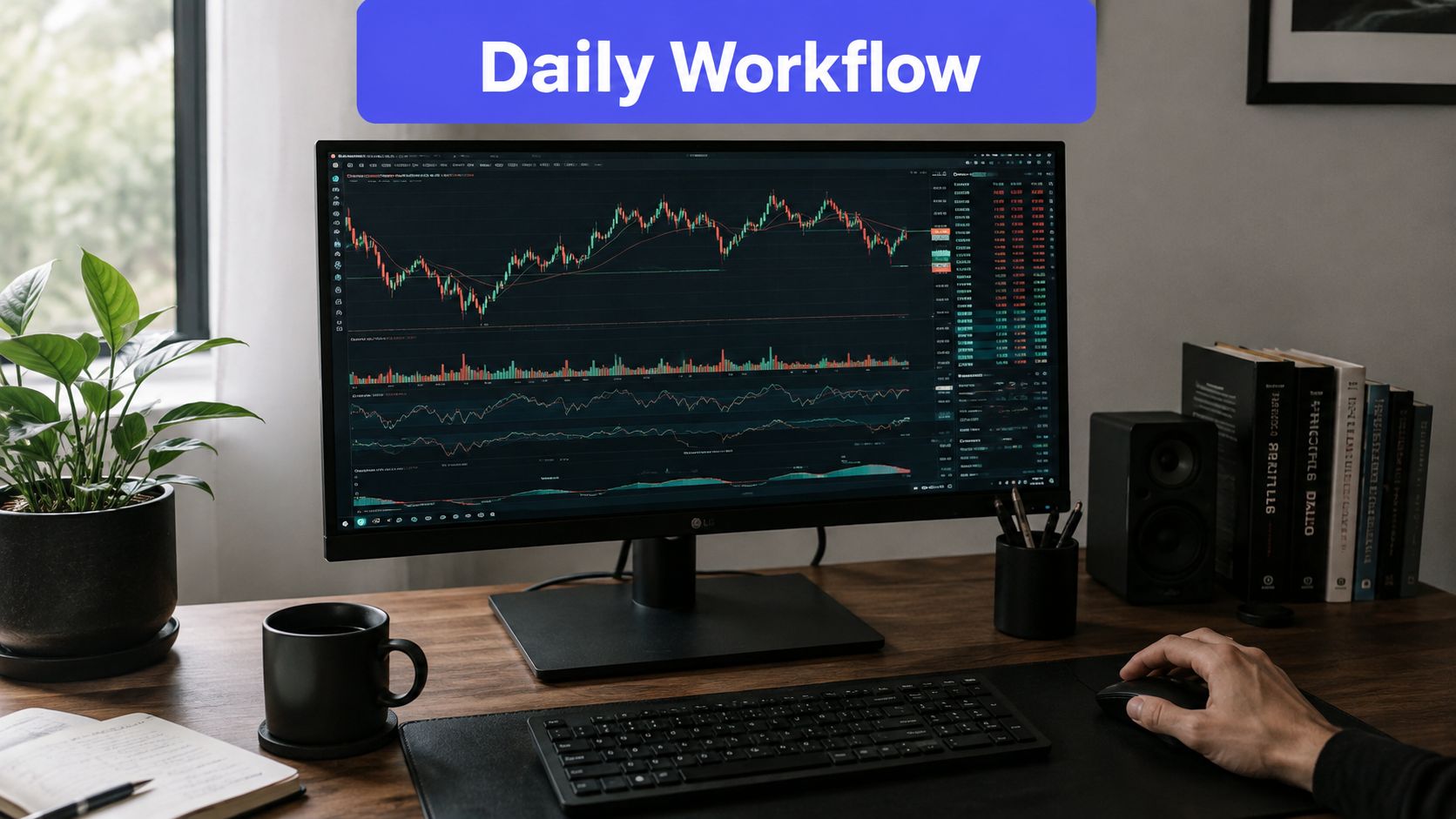
A repeatable workspace helps separate market observation from impulsive execution. The purpose of the routine is consistency and auditability, not prediction.
The session begins before any order
A practical pre-session routine can include:
- review open risk and account constraints;
- define the exchanges, market types, or categories in scope;
- load the relevant symbol universe;
- screen for candidates using the documented rules;
- remove symbols that fail liquidity or venue requirements;
- write the invalidation condition before execution.
The official TradingView watchlist import guide explains that imported watchlists use a .txt file with exchange-prefixed symbols separated by commas.
For large-cap research, a blue-chip crypto watchlist guide can help frame the label without treating it as a safety rating. For venue-specific notation, the crypto symbols guide explains why a generic ticker is not the same as a TradingView identifier such as EXCHANGE:PAIR.
Execution and review need the same discipline
The session record should capture the setup, planned invalidation, execution, costs, result, and any departure from the rules. It should also record a decision not to trade when no valid setup appears.
A watchlist helps organize what gets reviewed. It does not rank assets by expected return, predict direction, or improve a strategy by itself.
Records, Taxes, and Professional Advice
Trading activity can generate a large volume of records. The exact reporting obligations depend on the country, residence, activity, instruments, and legal structure involved.
Tax treatment depends on jurisdiction
In the United States, the IRS states that digital assets are treated as property for federal income-tax purposes (IRS digital-assets guidance). That statement should not be generalized to every jurisdiction.
A useful operational record may include timestamps, asset quantities, transaction identifiers, fees, acquisition information, disposal proceeds, transfers, and the venue used. Whether a particular event is taxable, deductible, reportable, or subject to a specific accounting method requires current local guidance.
A trading journal and a tax ledger serve different purposes. Records should be detailed enough for a qualified professional to reconstruct the activity under the applicable rules.
Entity choices are local legal decisions
A sole proprietorship, company, partnership, or other structure can change reporting, liability, and administrative obligations. The appropriate choice depends on local law and personal circumstances.
Software, data, internet access, and other operating expenses may receive different treatment across jurisdictions. Do not assume that an expense is deductible because it supports trading activity. Obtain advice from a qualified local tax or legal professional.
A Staged Decision, Not a Fixed Timeline
There is no evidence-based calendar that makes a trader ready after a fixed number of months. The transition should depend on demonstrated conditions rather than time served.
Use evidence gates instead of calendar promises
Possible gates include:
- the process is documented and has not been repeatedly redesigned after losses;
- live results have been reviewed after realistic costs;
- the record includes materially different market conditions;
- drawdowns remained within predefined limits;
- essential living costs remain independent from trading;
- operational, custody, security, and tax procedures are documented;
- there is a clear condition for reducing size, pausing, or ending the attempt.
Time is still relevant because meaningful evidence cannot be created instantly. But elapsed time alone does not prove a repeatable edge.
A practical self-audit
Before considering any move toward full-time trading, ask:
- Can the method be explained without referring to recent outcomes?
- Does the record separate luck, model assumptions, and execution errors?
- Are costs and failed fills included?
- Are losses bounded by rules written in advance?
- Can household finances tolerate a long period with no trading income?
- Are platform, custody, security, and tax risks addressed?
- Is there a predefined exit plan if the evidence deteriorates?
A “no” answer is information, not a challenge to increase risk.
Final reality check
Trading for a living may be possible for a small minority, but neither academic evidence nor a workflow tool can promise that outcome. The more responsible question is whether the available evidence justifies exposing personal finances to uncertain and potentially substantial losses.
TradingList helps crypto traders and advanced TradingView users organize TradingView-compatible crypto watchlists by exchange, market cap, supported category, or ecosystem. This can reduce manual list preparation and keep a chart-review routine consistent. It does not provide signals, predict prices, or determine what to buy or sell.
See TradingList for ready-to-import crypto watchlists and tools designed around symbol organization rather than performance claims.