AI infrastructure has moved from a technical curiosity to an industrial measurement problem. A Yale-led analysis published in July 2026 examined 380 trillion AI tokens consumed between January 2024 and April 2026, with the dataset representing 2% of monthly global AI usage. The same structural shift is reaching crypto markets, where traders increasingly evaluate projects linked to decentralized compute, data coordination, model access, and machine intelligence.
“Token artificial intelligence” therefore has two meanings. In machine learning, a token is a unit of text or other data processed by a model. In crypto markets, an AI token is a blockchain asset associated with an artificial-intelligence project or network. The strongest analysis connects both meanings: it asks whether a crypto token is exposed to genuine demand for computation, inference, data, or coordination, rather than merely carrying an AI-themed label.
Table of Contents
- Why Token Artificial Intelligence Matters for Crypto Traders
- How AI Models Process and Measure Tokens
- AI Crypto Project Types and Their Token Models
- Tokenomics Risks and Unit Economics Reality
- Building TradingView Watchlists for AI Token Monitoring
- Using Structured Watchlists for Risk Management
- Practical Workflow for Tracking AI Token Markets
Why Token Artificial Intelligence Matters for Crypto Traders
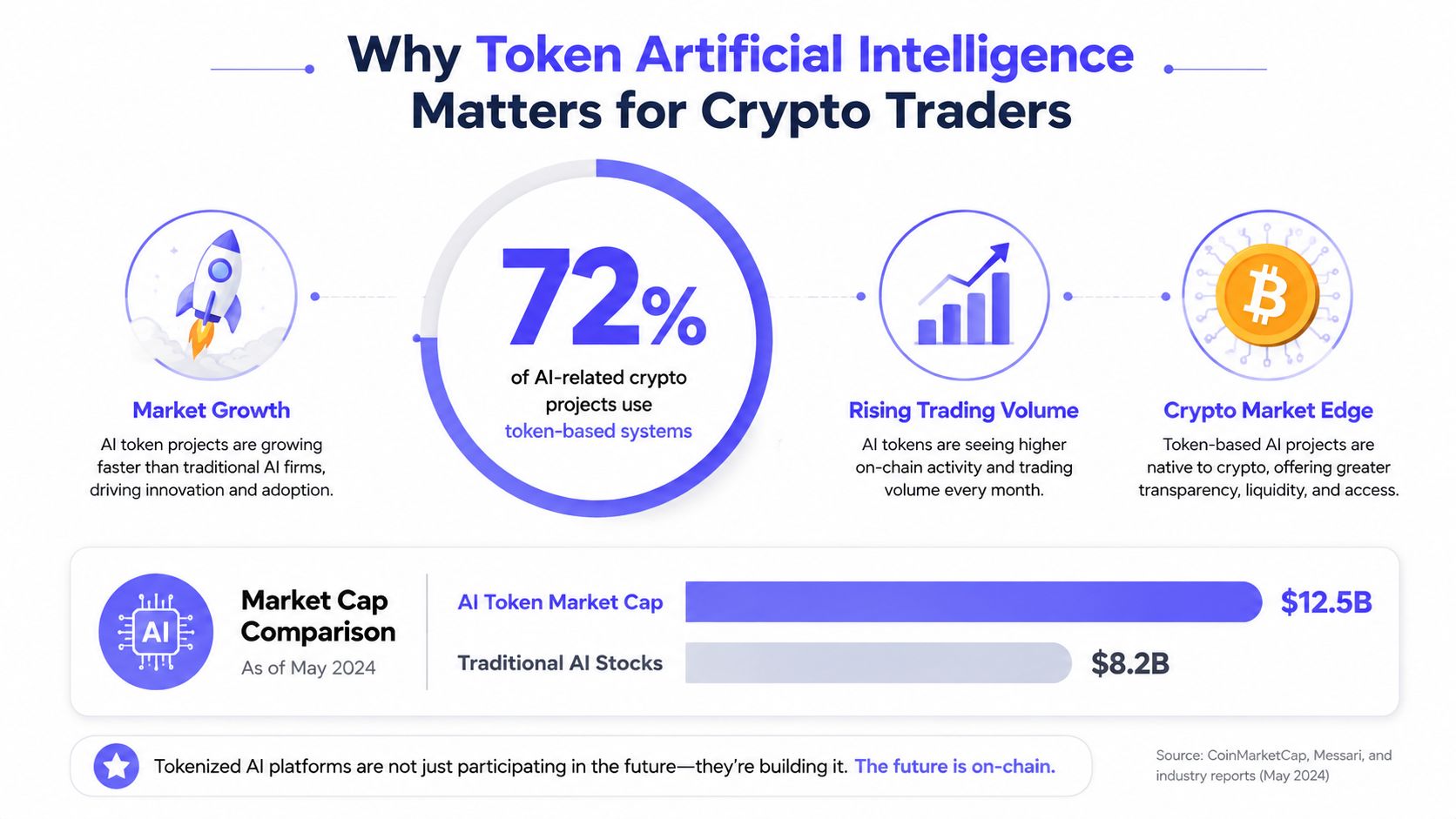
The scale of token consumption changes how traders should frame the AI crypto sector. AI tokens aren't only speculative instruments tied to a popular narrative. Depending on the project, they may provide access, coordination, staking, or governance functions related to compute markets, model services, data systems, or applications built around machine intelligence. Growth in AI-model token consumption does not, by itself, prove demand for or value capture by a crypto token. That doesn't make every AI token valuable. It does make the sector worth analyzing through usage mechanics and network economics.
The training history shows why tokens became economically important. The 2017 Transformer paper helped move natural-language processing away from recurrent architectures and toward attention-based systems. Training data then expanded rapidly, from about 10 billion tokens for GPT-2 in 2019 to 300 billion for GPT-3 in 2020, 780 billion for PaLM in 2022, 1.4 trillion for Chinchilla in 2022, and a reported 15 trillion for Meta's LLaMA-3 by 2024, as documented in a Carnegie Mellon lecture on scaling.
The bridge between AI usage and crypto value
The crypto thesis depends on whether rising AI activity creates demand that a blockchain network can capture. A decentralized compute protocol might coordinate suppliers and buyers. A data network might reward collection, validation, or licensing. An application token might provide access or governance, although access alone doesn't guarantee that demand flows back to token holders.
The distinction matters because token consumption can rise while a project's token economics remain weak. A network may process activity without producing sustainable fee demand, or it may distribute rewards faster than real usage supports. Traders should separate industry growth, network usage, and token value capture instead of treating them as interchangeable.
Research rule: AI adoption is a sector thesis. A token investment thesis requires an additional link between usage and ownership.
Why the sector attracts rotation capital
Global AI usage has expanded beyond training benchmarks into real-time inference. Goldman Sachs Research projects that token consumption could rise 24-fold to 120 quadrillion tokens per month between 2026 and 2030 as AI agents spread across consumer and enterprise workflows, according to its forecast for AI agents and technology cash flow. That projection is not a valuation model for any crypto asset. It is a reason to monitor whether AI-related blockchain projects gain measurable economic roles as workloads become more complex.
How AI Models Process and Measure Tokens
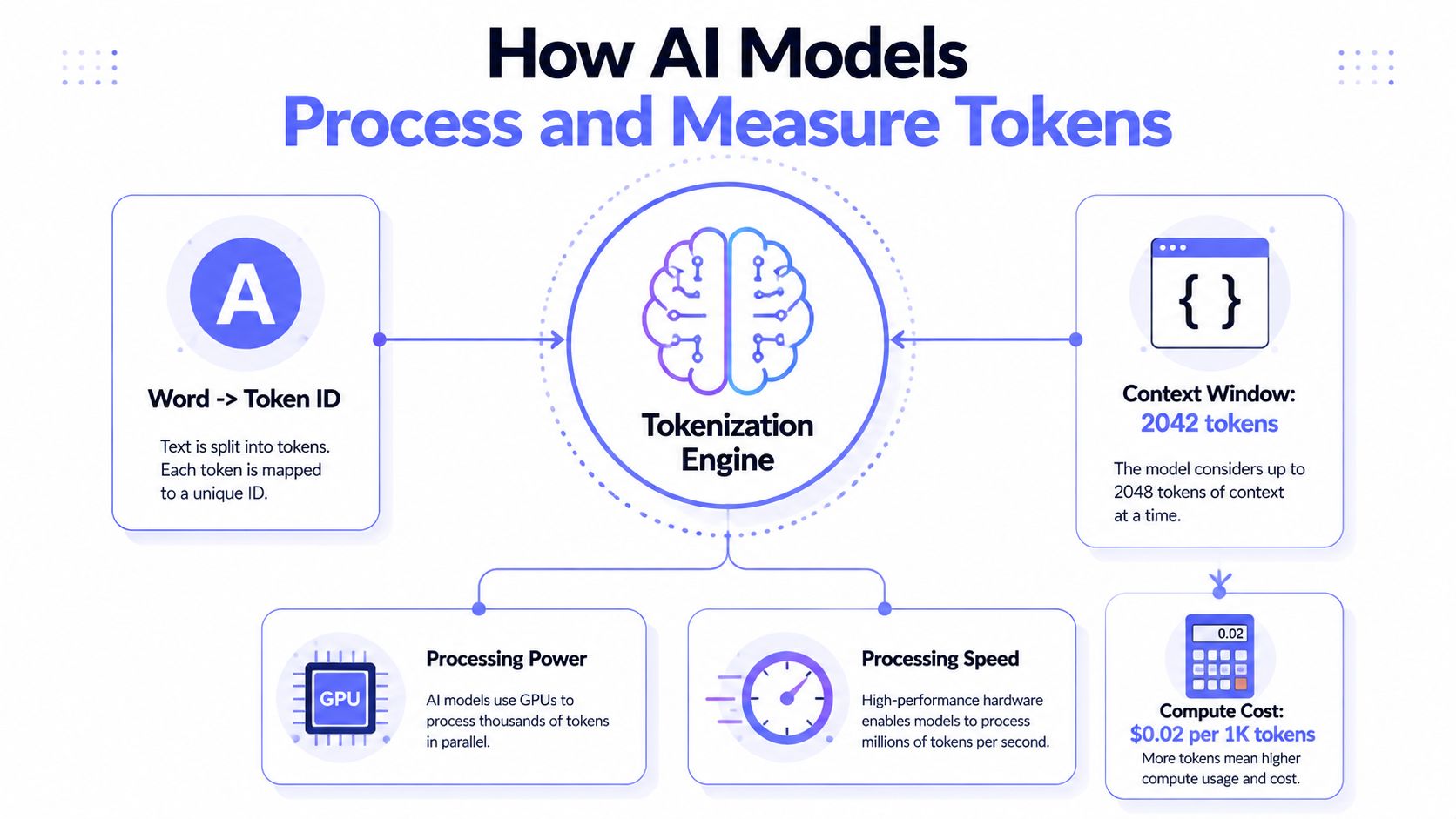
A model doesn't read text as a human reader does. A tokenizer converts text into numerical identifiers, often splitting words into smaller units. A familiar word may map to one unit, while an uncommon term, code fragment, symbol sequence, or poorly supported language may require several. The model then processes those token IDs through its architecture.
That conversion affects economics directly. More tokens for the same source material mean longer sequences, more attention work, and less usable space inside a context window. Research on independent tokenization treats tokenizer design as a first-class model decision because domain alignment can improve compression, throughput, and downstream quality, as described in research on independent tokenization for large language models.
Context windows aren't the same as reliable memory
A context window is the amount of tokenized material a model can accept in a single interaction. It works like a desk. A larger desk can hold more documents, but that doesn't mean the analyst will retrieve every relevant page accurately, particularly when documents are long, repetitive, or complex.
Long-context benchmarks show that advertised context length does not guarantee stable retrieval and reasoning across an entire window. Effective capacity varies by model, task, prompt structure, and information position, so a large nominal window should not be treated as equally dependable at every length, as shown in the ICLR study Needle Threading: Can LLMs Follow Threads Through Near-Million-Scale Haystacks?.
That distinction matters for AI infrastructure projects. A protocol marketing large context support may still face practical limits involving retrieval, latency, memory, and cost. Traders evaluating claims about model access should ask whether the project measures nominal capacity or dependable performance under realistic workloads.
Why tokenizer design becomes a tokenomics issue
Tokenizer efficiency changes the amount of infrastructure needed to serve a workload. If a domain's language, code, or symbols fragment into many units, the service may consume more compute for the same user request. A better-aligned tokenizer can make the same information cheaper to process and can leave more room for relevant evidence.
Crypto projects that sell model access or compute should therefore be evaluated through delivered utility per token, not only advertised model size. The crypto ticker symbol guide is useful for the market-monitoring side of this problem because traders also need to distinguish a generic ticker from a venue-specific symbol when comparing AI assets across exchanges.
AI Crypto Project Types and Their Token Models
AI crypto projects should be compared by the economic job their tokens perform. A decentralized compute network, a data-validation protocol, and an application-layer asset may all use AI branding, but their sources of demand and failure modes differ. The key question is whether users need the token for a recurring network action, or whether the token mainly provides governance or narrative exposure.
The categories below are analytical rather than a ranking of projects. A project can occupy more than one category, and token utility can change as a protocol develops.
AI token project comparison
| Project Type | Token Utility | Value Capture Mechanism | Risk Profile |
|---|---|---|---|
| Decentralized compute network | Payment, access, collateral, or coordination for distributed compute | Fees may accrue through demand for compute, subject to supplier quality and utilization | High infrastructure and execution risk. Token demand can lag capacity growth |
| AI model marketplace | Access to models, inference services, or marketplace coordination | Usage fees and settlement activity may create demand if the token remains necessary | Competition can compress prices. Users may prefer stable payment rails |
| Data and validation protocol | Rewards, staking, data contribution, or validation participation | Demand may reflect the quality, scarcity, and verification of usable data | Sybil activity, weak data quality, and reward inflation can dilute economics |
| AI application token | Access, governance, incentives, or application-specific functions | Value depends on recurring users and whether access requires the token | Strong application competition and rapid product obsolescence |
| Governance-focused AI asset | Voting, proposal submission, or treasury coordination | Indirect capture through governance influence rather than direct revenue | Governance value can remain speculative if participation doesn't control scarce resources |
Utility isn't the same as value capture
A token can have a clear use and still fail to capture the network's economic growth. For example, a service may accept a token for access but immediately convert it into another asset, limiting the amount of value retained by token holders. A protocol may also subsidize usage with emissions, producing impressive activity while hiding weak willingness to pay.
Traders should map four links before treating an AI token as infrastructure exposure:
- User demand: Who uses the network, and what problem does it solve?
- Token requirement: Must users hold, spend, stake, or lock the asset?
- Fee destination: Who receives payments, and what portion returns to the token economy?
- Supply response: Do emissions, releases, or incentives offset demand growth?
The last question often receives less attention than product announcements. A growing service can still produce poor token performance if supply expands faster than economically meaningful demand. Conversely, a smaller network with clearer settlement mechanics may deserve closer monitoring than a widely discussed project with uncertain value capture.
A token model should be read as a cash-flow map, even when the protocol doesn't distribute conventional cash flow.
Tokenomics Risks and Unit Economics Reality
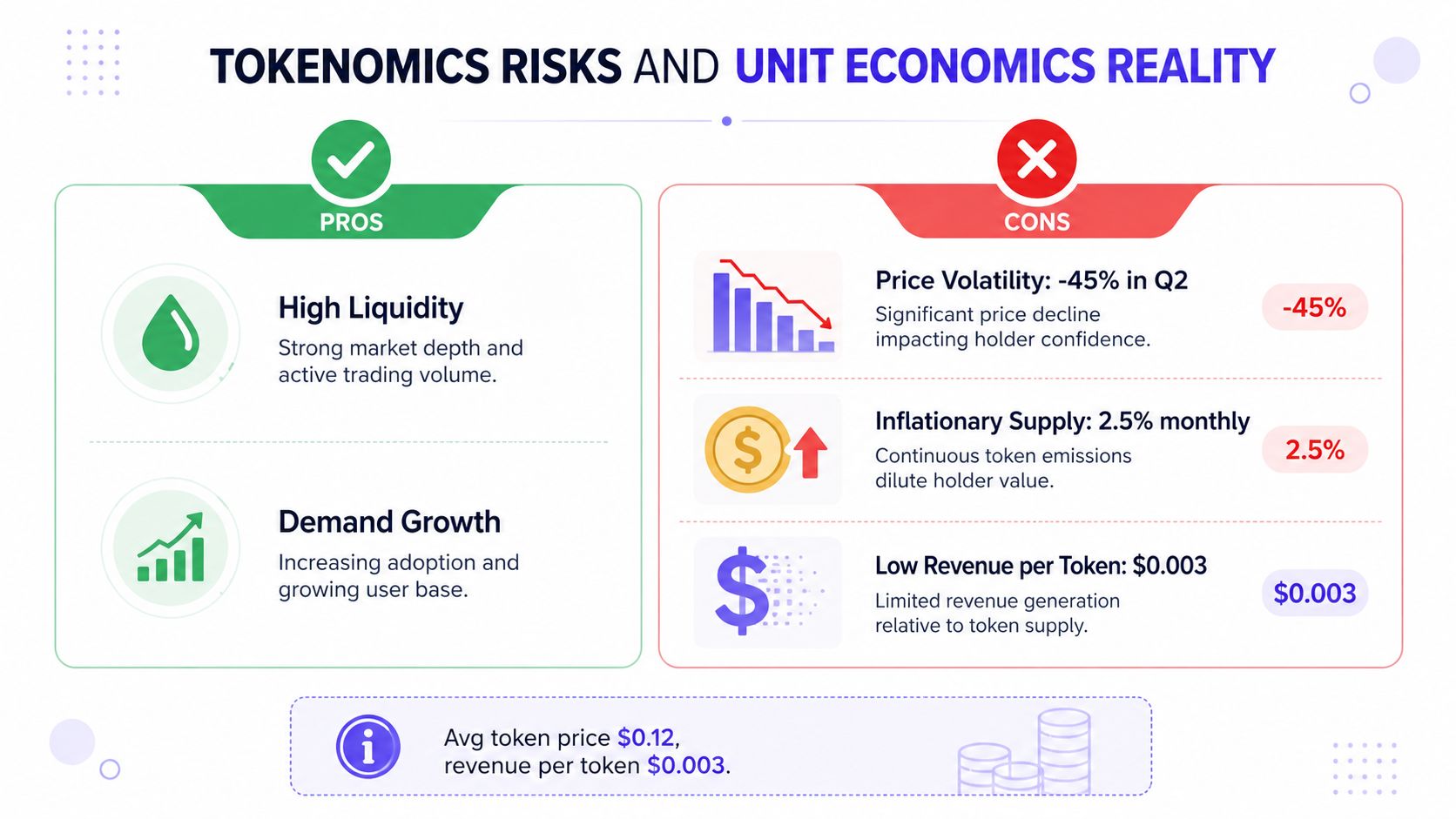
The central mistake in AI token analysis is assuming that rising token consumption automatically creates rising token value. The evidence points to a more complicated relationship. Token demand can grow rapidly while prices for processing fall, leaving projects to compete on utilization, reliability, model quality, and infrastructure efficiency.
An analysis of OpenRouter data reported that weekly token usage increased by more than 3,800% between August 2024 and August 2025. That change reflects activity observed on OpenRouter rather than the entire global market. Goldman Sachs Research separately projected that AI-agent consumption could reach 120 quadrillion tokens per month by 2030, highlighting the scale of potential demand without establishing the economics of any crypto token.
Volume growth can conceal margin pressure
When unit prices decline, a protocol must process more activity to maintain the same revenue. That creates a demanding test for AI infrastructure tokens. Growth in raw usage is constructive only if the network can retain utilization, control service costs, and preserve a reason for participants to use its token.
Agentic workloads make the question harder. The 2026 Yale-led study reported that more than half of the AI tokens in its OpenRouter dataset involved agentic systems by 2026. Multi-step systems can generate repeated model calls, tool interactions, and recovery attempts, which may increase consumption per task. They can also intensify competition among providers because users care about completed outcomes, latency, and total cost rather than token volume alone.
A practical unit-economics checklist
- Usage quality: Separate subsidized or incentivized calls from paid demand.
- Pricing power: Track whether the service can maintain prices as competing models improve.
- Token necessity: Test whether customers can bypass the token without losing meaningful functionality.
- Supply discipline: Review emissions, release schedules, staking rewards, and treasury distributions.
- Participant economics: Compare what compute suppliers, validators, or data contributors earn with what the network collects.
The blue-chip crypto framework can help provide a comparative market context, but it shouldn't be used to label an AI token safe. AI infrastructure remains exposed to technology shifts, regulatory uncertainty, liquidity changes, and rapid competitive displacement.
Building TradingView Watchlists for AI Token Monitoring
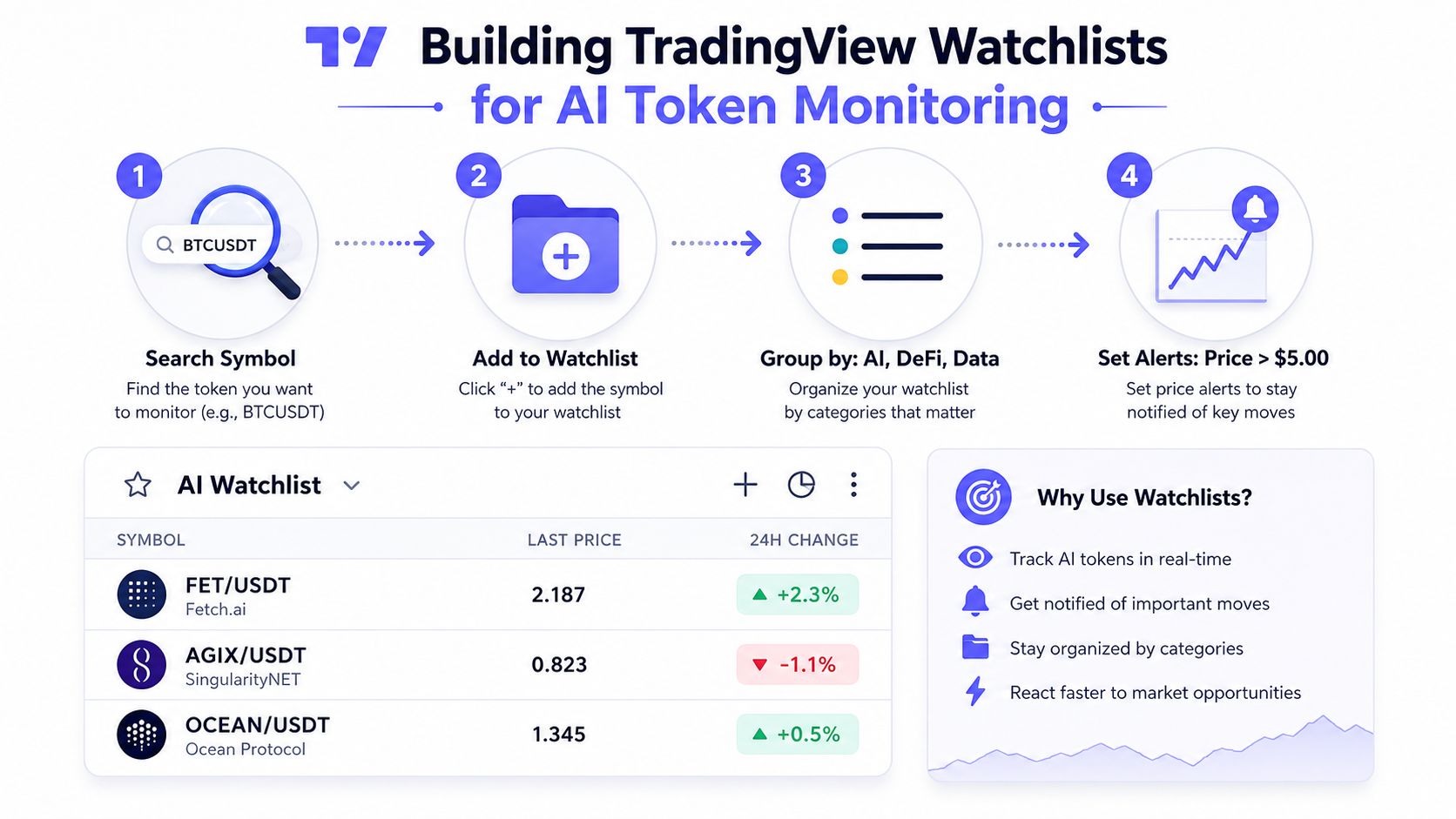
A useful AI token watchlist begins with symbol accuracy. TradingView-compatible imports require an exchange prefix and comma-separated values in a .txt file, so formatting is a mechanical constraint covered by TradingView's watchlist instructions. A ticker such as FET does not identify a venue. A venue-specific symbol uses the form EXCHANGE:PAIR, for example BINANCE:FETUSDT, when that symbol is supported.
Build the universe in layers
Begin with the broad market universe, then narrow it to match the monitoring question. TradingView's Crypto Coins Screener provides fields such as market cap, 24-hour volume, circulating supply, social dominance, category, and technical rating. Traders can filter those fields before adding symbols, as shown in the TradingView Crypto Coins Screener. The TradingView screener and watchlist guide provides a related workflow for turning those filters into reusable lists.
Separate the resulting universe into practical views:
- Venue lists: Symbols available on a selected centralized exchange for execution-aware monitoring.
- Market-cap lists: Large, mid-sized, and smaller groups based on the tiers available in the selected data source.
- Category lists: AI-related assets alongside data, infrastructure, or application classifications where supported.
- Ecosystem lists: Assets grouped by blockchain ecosystem to compare network-specific exposure.
TradingView's CRYPTOCAP ecosystem includes groupings such as AI.C, RWA.C, DEPIN.C, LAYER1.C, SMARTCONTRACTS.C, and MEME.C. Each represents the capitalization of the top 100 cryptocurrencies in its named category or ecosystem, according to TradingView's CryptoCap symbol announcement.
Normalize before importing
Check the exchange prefix, quote currency, pair availability, and delimiter before uploading. Mixing a bare ticker with a venue-specific symbol can create inconsistent charts, duplicate assets, or unresolved symbols.
TradingList supports this preparation as a productivity workflow rather than a market signal. Its standard and custom crypto watchlists organize supported assets by centralized exchange, market cap, category, or ecosystem. ScreenerList builds symbol lists from market filters. DeltaList compares one reference exchange and quote pair with up to five other exchanges using the same pair, identifying tokens present on a compared exchange but absent from the reference. FusionList combines lists into one exportable configuration. The workflow is designed around a daily refresh cycle when source data is available and sufficiently reliable.
Using Structured Watchlists for Risk Management
A watchlist doesn't manage position risk by itself. It does, however, determine which comparisons a trader can make before a decision. An undifferentiated list encourages attention to whichever chart is moving fastest. A structured list makes it easier to ask whether the move belongs to an AI subsector, an ecosystem, a market-cap tier, or a single venue.
TradingView supports analysis of watchlists by symbol type, sector, exchange, and currency, according to its watchlist analysis documentation. That organization creates a practical hierarchy for AI token research:
- Sector view: Compare AI-related assets with adjacent crypto categories.
- Ecosystem view: Check whether strength is concentrated in one blockchain environment.
- Venue view: Identify whether an apparent move appears across supported centralized exchanges or only on one venue.
- Size view: Separate broad sector participation from activity concentrated in smaller assets.
Concentration becomes visible through comparison
Suppose several AI assets rise together, but only one ecosystem group confirms the move. That pattern suggests a narrower exposure than a broad sector rotation. If large-cap assets remain stable while smaller assets accelerate, the trader can classify the event as a risk-on rotation rather than assuming that AI infrastructure fundamentals changed across the entire market.
The same structure helps with correlation risk. A trader may hold several tokens with different names but similar exposure to model access, decentralized compute, or one blockchain ecosystem. Grouping by category and ecosystem reveals that apparent diversification may be thematic concentration.
Portfolio discipline: Different tickers don't necessarily represent different risks. Watchlists should expose shared drivers before capital is allocated.
Use lists as review controls
A repeatable review can compare the same groups over time, check venue-specific availability, and separate research candidates from assets that merely attract attention. It can also prevent chart selection from becoming an informal prediction engine. Alerts may notify a trader that a condition occurred, but the watchlist doesn't explain why it occurred or whether the underlying economics justify a response.
That distinction protects the workflow from a common error: treating clean organization as evidence of quality. A well-formatted list improves visibility. It doesn't validate a protocol, establish liquidity, or reduce the volatility of an AI token.
Practical Workflow for Tracking AI Token Markets
A trader monitoring token artificial intelligence can begin with four lists: a supported centralized-exchange universe, a market-cap grouping, an AI category list, and an ecosystem comparison. The trader then checks whether a price move appears across the broader category or only within one venue, while keeping infrastructure, application, and governance-oriented assets separate.
A second pass uses the screener to narrow the candidates by available market fields and technical filters. The resulting symbols can be compared against the reference list with DeltaList, while FusionList can combine selected venue and category groups into one TradingView-compatible export. The purpose isn't to predict the next winner. It's to make the same comparisons consistently.
Daily review matters because listing and naming changes can affect a symbol universe. The daily refresh process can help maintain the working list when supported source data is available and sufficiently reliable, but traders still need to verify symbols inside TradingView before relying on charts or alerts. The workflow should also record why an asset belongs in the list, whether its token is necessary for the network, and what evidence would invalidate the thesis.
The durable edge is procedural, not prophetic. AI token markets may benefit from expanding usage, but falling unit prices, supply growth, competition, and weak value capture can separate useful networks from attractive narratives. Structured watchlists give traders a practical way to monitor that separation without treating organization as financial advice.
TradingList provides maintained, TradingView-compatible crypto watchlists organized by supported centralized exchanges, market-cap tiers, categories, and ecosystems. Traders can use its Standard watchlists, Custom crypto watchlists, ScreenerList, DeltaList, and FusionList to filter, compare, combine, and export AI-related symbol universes, so visit TradingList to build a cleaner monitoring workflow.