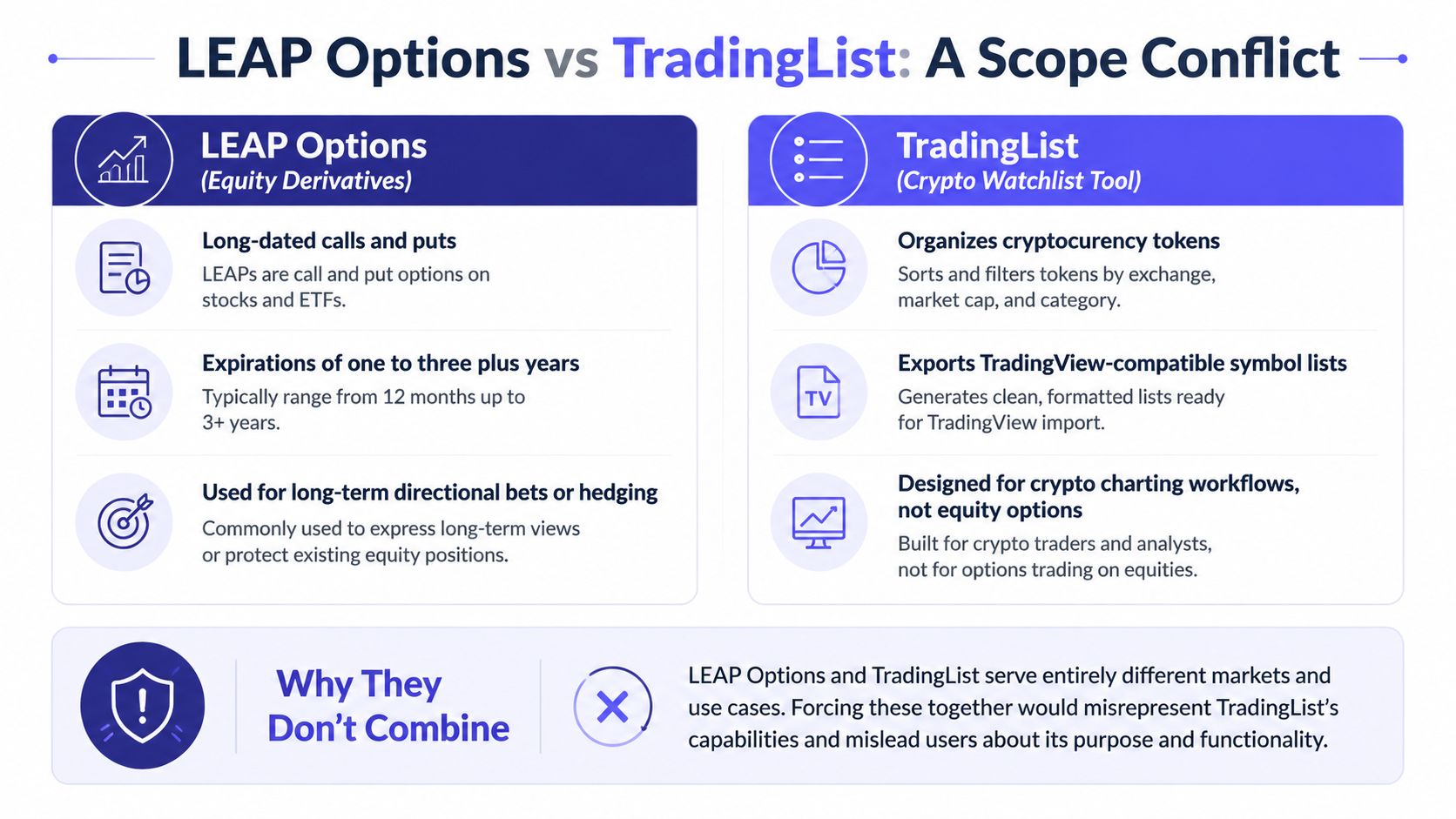
LEAP options and crypto watchlists can appear in the same market-research routine, but they solve different problems. LEAP options are long-dated equity, ETF, or index calls and puts, while TradingList organizes TradingView-compatible cryptocurrency watchlists. They do not represent the same market, instrument, or software function.
This guide compares the two workflows, summarizes the contract mechanics that distinguish LEAPS, and explains where crypto watchlist organization can support market review—and where it has no legitimate role in options pricing or execution.
Table of Contents
- 1. LEAP options and TradingList serve different workflows
- 2. LEAPs are long-dated standardized options
- 3. TradingList organizes crypto symbols, not options contracts
- 4. Combining the topics can create false product expectations
- 5. TradingList is not an options tool
- 6. Crypto derivatives research can use watchlists within clear limits
- 7. Choose the appropriate workflow
- Workflow Comparison: LEAP Options Research vs TradingList
- Keep LEAP Research and Crypto Watchlists Separate
1. LEAP options and TradingList serve different workflows
The central conflict is simple. A LEAP trade is an options position on an equity, ETF, or index, while TradingList is a crypto symbol-organization workflow for TradingView-compatible watchlists. A two-year call on AAPL involves an underlying share price, strike, premium, expiration, implied volatility, exercise terms, and an options chain. A TradingList configuration involves selecting supported cryptocurrency symbols, applying market or ecosystem filters, and preparing a watchlist for chart review.
Those activities can inform separate research processes, but they shouldn't be described as one integrated product experience. A trader may study AAPL options through an options broker and separately maintain a crypto watchlist for BTC, ETH, or other supported assets. The existence of both workflows doesn't mean a crypto list can display, price, execute, or manage an equity-options contract.
The practical boundary
A credible editorial treatment should assign each tool a narrow job:
- LEAP research: Analyze the equity or ETF, option chain, strike, expiration, premium, Greeks, liquidity, and payoff.
- Crypto research: Organize supported cryptocurrency symbols by centralized exchange, market capitalization, category, or ecosystem.
- Execution: Use an appropriate broker or derivatives venue, not a watchlist organizer.
- Risk management: Define maximum acceptable loss, assignment exposure, liquidity limits, and exit conditions independently for each asset class.
TradingList's publisher and product scope makes that distinction important. It isn't an exchange, broker, trading platform, signal provider, or financial adviser. Positioning it as an equity-options tool would turn a useful separation of workflows into an inaccurate product claim.
Practical rule: A symbol list can organize what deserves chart review. It can't replace an options chain, contract analysis, broker, or risk plan.
2. LEAPs are long-dated standardized options
LEAPS means Long-Term Equity Anticipation Securities. Cboe introduced LEAPS in 1990, creating a listed long-dated contract class that could extend as far as three years, as described in Cboe's history of options innovation. Their defining feature is not a special payoff formula. LEAPS retain the standard call-and-put structure, but their expiration gives a directional or hedging thesis more time to develop.
The Options Industry Council describes LEAPS as long-term equity and index options available from nine months up to three years in duration in its basics FAQ. Equity and ETF LEAPS are American-style, which means the holder may exercise on any business day before expiration. That flexibility matters, although exercising early can surrender remaining time value and should be evaluated against selling the option.
Contract mechanics change the decision
The Options Clearing Corporation states that equity and ETF LEAPS cover 100 shares per unadjusted contract, expire in January of the expiration year, and generally receive initial strike prices within 25% above or below the underlying stock price. Those terms, explained in the OCC's LEAPS reference, make the contract more than a simple long-term bet. Strike selection determines intrinsic exposure, time value, breakeven, delta, and capital at risk.
A long call gives the right to buy at the strike. A long put gives the right to sell. The buyer's maximum loss is generally the premium paid, but the option can still lose all of that value if the underlying fails to produce a sufficient move before expiration. A seller receives premium but accepts an obligation, which can create assignment and collateral requirements that are materially different from buying an option.
Options involve risk and are not suitable for every investor. Contract terms, liquidity, exercise, assignment, and loss scenarios should be reviewed in an appropriate options environment before any position is considered.
3. TradingList organizes crypto symbols, not options contracts
TradingList is a workflow product for building and maintaining cryptocurrency watchlists. Its supported lists organize symbols by centralized exchange, market capitalization, supported category, or blockchain ecosystem. The resulting files use TradingView-compatible symbol formats, which can reduce manual cleanup involving exchange prefixes, pair formatting, and ticker naming before import.
The following visual introduces the crypto market-review layer that begins where options contract analysis ends.
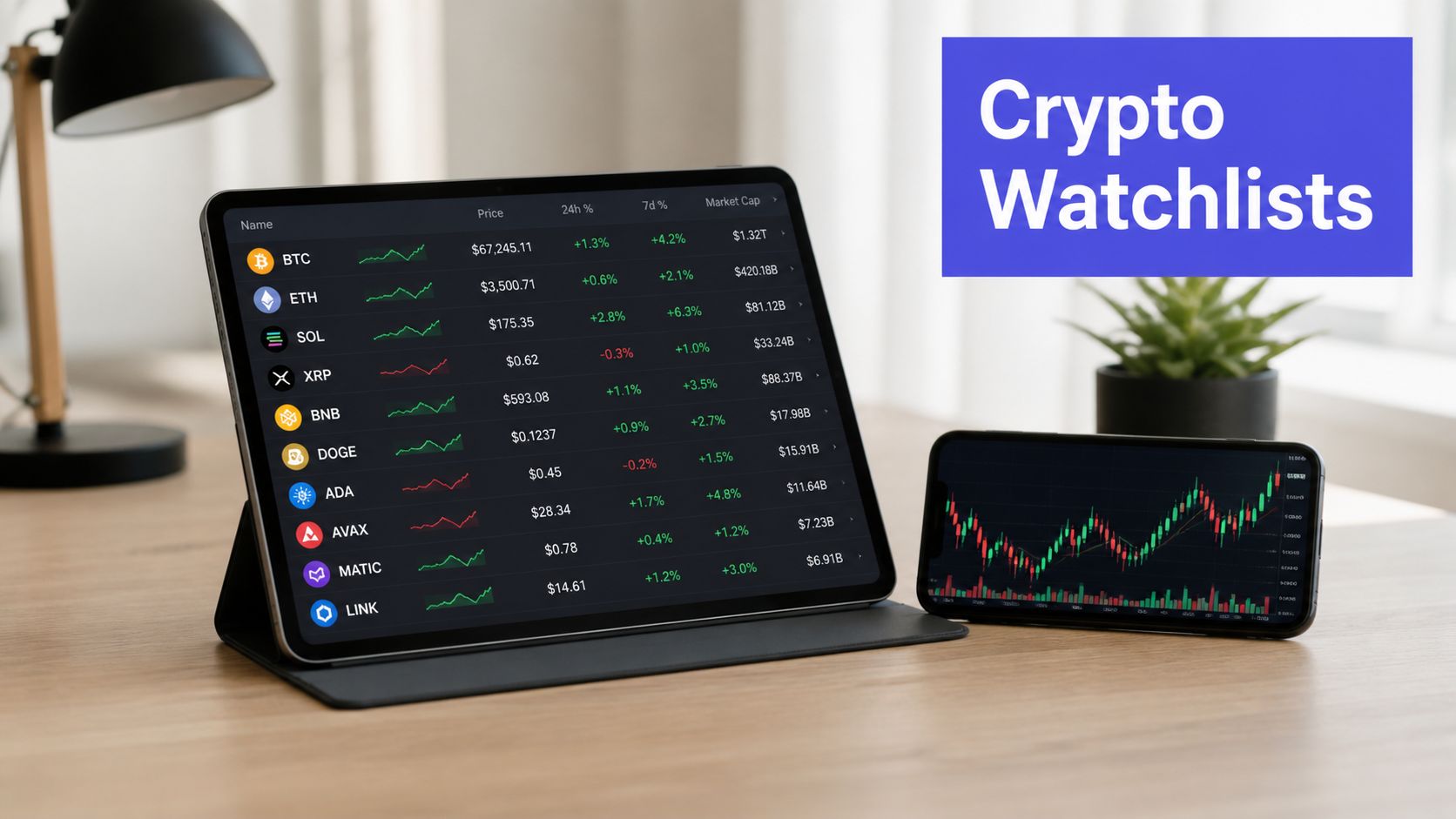
That workflow is useful for a crypto researcher comparing venues or building a focused charting universe. A researcher could create a market-cap watchlist, narrow a supported category, compare ecosystem assets, or combine several relevant lists into one exportable configuration. The result remains a list of cryptocurrency symbols for market review. It is not an equity-options chain and does not represent option contracts.
Supported surfaces have distinct jobs
TradingList's product surfaces are best understood as filters and list operations:
- Standard watchlists provide maintained universes by centralized exchange, market cap, category, or ecosystem.
- Custom crypto watchlists narrow a universe using supported market-cap, category, or ecosystem filters.
- ScreenerList builds a symbol list from market filters.
- DeltaList compares a reference exchange and pair with other exchanges that support the same pair.
- FusionList combines several watchlists into one exportable configuration.
The workflow can support charting, scanning, alerts, and list-based review in TradingView, but it does not provide predictions, signals, portfolio advice, or trade execution. A generic ticker such as BTC also is not automatically a venue-specific TradingView symbol. A formatted symbol such as EXCHANGE:PAIR identifies a venue and trading pair, so normalization remains essential when a crypto list moves into a charting workflow.
Scope matters: TradingList supports crypto symbol organization and export. It does not support equity-options trading, options pricing, exercise, assignment, or derivatives execution.
4. Combining the topics can create false product expectations
A LEAP strategy depends on variables that a crypto watchlist organizer doesn't manage. The trader needs to evaluate the underlying equity, ETF, or index, select a strike and expiration, inspect the premium, understand the option's Greeks, estimate breakeven, review bid-ask liquidity, and define how the position will be closed or adjusted. A crypto watchlist can organize symbols for charting, but it can't supply those contract-level decisions.
The problem becomes sharper when an article uses similar language for unlike instruments. Calling an AAPL call and a crypto ticker “positions” doesn't make them operationally interchangeable. The AAPL contract has a strike, premium, expiration, exercise style, and share multiplier. A crypto watchlist entry is a symbol reference that helps a user open a chart or build a scan.
Keep the editorial claims testable
A precise article should avoid implying that TradingList can:
- Find LEAP contracts: It doesn't provide an equity-options chain or contract scanner.
- Calculate option payoffs: It doesn't price calls, puts, spreads, or synthetic positions.
- Execute derivatives: It isn't a broker, exchange, or trading platform.
- Advise on portfolios: It doesn't provide financial or portfolio advice.
- Improve performance: It organizes symbols, but makes no promise about returns, alpha, or risk reduction.
TradingList can still be relevant in a separate crypto workflow. For example, a user may organize a supported centralized-exchange universe, compare market variants, and export normalized TradingView-compatible symbols for chart review. That process can help structure research, but the reader must not confuse a cleaner watchlist with a better LEAP trade.
The correct conclusion isn't that the subjects can never appear in the same publication. It's that they need a clear boundary, accurate descriptions, and no suggestion of unsupported options functionality.
5. TradingList is not an options tool
LEAP structures must be evaluated within an equity-derivatives workflow. A long call, long put, covered call, cash-secured put, debit spread, synthetic stock position, or protective put involves contract selection and risk mechanics that fall outside a cryptocurrency watchlist product's scope.
If TradingList were presented as a way to import or manage those contracts, a reader could reasonably misunderstand what the product does. That would change the apparent workflow from symbol organization to derivatives research and execution.
Keep the product boundary explicit
Common LEAP structures include:
- Directional structures: Long calls and puts respond to movement, time, and implied volatility.
- Income structures: Option selling creates premium but introduces assignment obligations.
- Spreads: Buying and selling contracts at different strikes or expirations defines a payoff range.
- Synthetic positions: Combinations of calls and puts can approximate stock exposure.
- Hedges: Puts or collars can change downside and upside tradeoffs.
Evaluating or placing those positions requires an appropriate options data and execution environment. TradingList becomes relevant only when the subject returns to crypto watchlist organization, where its role is limited to supported symbol filtering, comparison, combination, and TradingView-compatible export.
The product's FAQ and scope information reinforces this distinction. Product references should remain tied to capabilities that TradingList can substantiate.
6. Crypto derivatives research can use watchlists within clear limits
A crypto derivatives workflow applies only when the research universe is crypto rather than equity, ETF, or index options. It remains separate from LEAP options research. TradingList's role is limited to organizing supported cryptocurrency symbols by centralized exchange, market-cap grouping, category, or ecosystem, then exporting a TradingView-compatible symbol universe for chart review. It does not execute perpetual-futures positions or evaluate crypto-options contracts.
This creates a clear workflow boundary. A derivatives researcher can compare spot symbols with venue-specific derivative tickers where the charting setup supports them, review funding-rate context from a suitable data source, and test whether a directional thesis remains valid. The watchlist organizes symbols. A separate venue, data service, or broker supplies contract terms, risk data, and execution.
Four crypto research structures to evaluate
- Funding-rate monitoring: Track the relationship between perpetual-futures funding and the underlying market. Funding data and contract availability must come from the relevant venue.
- Directional futures review: Pair a market thesis with position sizing, invalidation levels, and stop-management rules. A watchlist does not create or validate those rules.
- Spot and derivative comparison: Compare price behavior across relevant symbols after checking exchange prefixes, pair formatting, and ticker normalization.
- Crypto options research: Where suitable contracts exist, study long-dated calls or puts through a qualified options venue. Do not treat a watchlist as an options chain.
A focused symbol universe makes chart review more repeatable, but it does not reduce position risk by itself. Funding, liquidation, basis, volatility, counterparty exposure, and contract-specific terms require separate analysis.
For a crypto-native screening workflow, TradingList's crypto screener workflow is a more accurate continuation than an equity-LEAP execution claim. ScreenerList, DeltaList, or FusionList may help organize the research universe, depending on whether the task involves filtering, comparison, or combination.
7. Choose the appropriate workflow
Start with the asset class and the decision that needs to be made. LEAP research and crypto watchlist research can share a disciplined process, but they require different data, tools, and implementation steps.
For equity, ETF, or index options, use an options-focused environment for payoff logic, contract mechanics, assignment, liquidity, volatility, and position management. TradingList does not provide options-chain analysis, pricing, execution, or contract management.
For crypto market review, TradingList can organize underlying symbols for TradingView-compatible charts. Venue availability, derivatives data, pricing, execution, and contract terms must come from the relevant platforms.
Match the tool to the asset class
Use these decision rules:
- Equity, ETF, or index options: Use an independent LEAP workflow centered on long-dated calls, puts, payoff scenarios, assignment, liquidity, volatility, and position management.
- Crypto spot research: Organize exchange, market-cap, category, and ecosystem symbols for chart review.
- Crypto derivatives monitoring: Identify the venues and supported symbols first. Use TradingList only for list organization and export.
- TradingView workflow education: Use
EXCHANGE:PAIRformatting, normalization, filtering, comparison, and import preparation.
The search intent differs by asset class. LEAP options research points to contract mechanics and payoff analysis. Crypto watchlist import, exchange prefixes, and market-cap searches point to symbol organization and charting workflow. Keeping the boundary explicit avoids implying that TradingList supplies equity-options functionality.
Workflow Comparison: LEAP Options Research vs TradingList
| Area | LEAP options workflow | TradingList workflow | Boundary |
|---|---|---|---|
| Market | Listed equity, ETF, or index options | Crypto symbols supported in TradingView-compatible watchlists | Different asset classes and data models |
| Primary data | Options chains, strikes, premiums, expirations, Greeks, and liquidity | Exchange, pair, market cap, category, and ecosystem data | TradingList does not supply options-chain data |
| Output | Contract analysis and payoff or risk scenarios | Organized crypto symbol lists and export | A watchlist is not a contract or position |
| Execution | Appropriate broker or derivatives venue | No execution; list preparation only | TradingList is not a broker or exchange |
| Risk controls | Position-specific loss, assignment, exercise, liquidity, and exit analysis | No signal, advice, or risk reduction | Risk decisions remain outside the watchlist workflow |
| Appropriate use | Long-dated options education and research | Structured crypto market review | Use each workflow only within its supported scope |
Keep LEAP Research and Crypto Watchlists Separate
LEAPS are long-term equity, ETF, or index options with standard calls and puts, defined strikes, premiums, expiration dates, exercise terms, and contract multipliers. Their long tenor can support directional exposure, stock-replacement planning, income structures, spreads, synthetic positions, and hedging, but each structure remains sensitive to underlying price, time decay, implied volatility, liquidity, assignment, and capital at risk.
TradingList belongs to a different layer of the research stack. It organizes supported cryptocurrency symbols into maintained watchlists by centralized exchange, market capitalization, category, or ecosystem. Its custom lists, ScreenerList, DeltaList, and FusionList help users filter, compare, combine, and export TradingView-compatible crypto symbol configurations. Those functions can support chart review and market-universe construction, but they do not price options, display equity-options chains, calculate LEAP payoffs, manage exercise, handle assignment, execute trades, or provide portfolio advice.
The practical rule is simple: use an options-focused environment for LEAP contracts, and use TradingList for supported crypto watchlist workflows. A cleaner list can make research easier to reproduce, but it does not establish a trading thesis, validate a derivative contract, reduce market risk, or promise a financial outcome.
TradingList provides maintained cryptocurrency watchlists organized by centralized exchange, market capitalization, supported category, and ecosystem, with TradingView-compatible export for structured chart review. Researchers can use its custom watchlists, ScreenerList, DeltaList, and FusionList to filter, compare, and combine supported crypto symbol universes. Visit TradingList to build a more organized crypto watchlist workflow without treating it as an options-trading tool.